Article: The First Drape Belongs to You
The First Drape Belongs to You
Why We Photograph Our Saris the Way We Do
A Question of Trust
At Parvai, we have always believed that the relationship between a patron and a handcrafted textile begins long before the sari is actually worn. It begins when someone first encounters the textile, looks closely at its colour and workmanship, reads about the people and processes behind it, asks questions, and eventually decides whether this is a sari she would like to make her own. Product photography is therefore not merely a marketing exercise for us. It is part of the information we provide to a patron, and consequently it carries a responsibility to be as truthful as possible.
Over the years, and particularly with the extraordinary growth of Instagram and influencer-led fashion marketing, we have also watched conversations emerge among consumers about what happens to the actual garments used to create promotional content. Saris and clothes may be sent for shoots, worn by models, celebrities or influencers, styled and pinned for photographs and reels, and subsequently returned. Consumers have publicly raised questions about whether some of these very pieces eventually return to regular inventory and are sold without their previous use being apparent. There are also individual online complaints from consumers alleging that garments received as new have appeared used, marked, stained or damaged. Such accounts are anecdotal and should certainly not be used to characterise an entire industry, but the questions they raise are legitimate: when we purchase something as new, what exactly does “new” mean?
This is one of the reasons we felt it was important to explain, in some detail, how a Parvai sari is photographed, handled and stored before it reaches its patron.
When a Sari Is Worn for a Photograph
There is nothing inherently wrong with a sari being worn by a model, celebrity or influencer. Beautifully styled imagery has contributed enormously to the renewed visibility of Indian textiles, and there are photographers, stylists, models and content creators doing exceptional work in this space. Our concern has never been with the people wearing the sari. It is with the subsequent journey of the physical textile itself.
A professional shoot requires considerably more handling than a photograph might suggest. A sari can be completely opened, pleated repeatedly, tucked around the waist, pinned, adjusted at the shoulder and handled by several people. It may remain on the wearer for hours, under lights or outdoors, and naturally come into contact with skin, perspiration, makeup, perfume, body products or the surfaces around the shoot. None of this necessarily damages the sari, but it does mean that the sari has been worn.
For many customers that may make no difference whatsoever. For others, it matters enormously. We believe neither position needs to be judged. What matters is that the patron should be able to make that decision for herself. If a sari has been used as a sample, worn for a campaign or professionally cleaned afterwards, transparency allows a customer to decide whether she is comfortable purchasing it and, importantly, whether its price and description appropriately reflect its history.
This idea of transparency is not peculiar to Parvai. India's advertising standards recognise that consumers need to understand the commercial circumstances surrounding influencer recommendations. The Advertising Standards Council of India requires material connections between brands and influencers to be disclosed, and specifically includes monetary compensation, free products, discounted products, gifts and barter arrangements within the idea of a material connection. The broader principle is one we strongly identify with: information capable of materially influencing a customer's understanding of a product should not remain invisible.
Why Cleaning Is Not the Answer for Us
It may seem that there is an easy solution to a sari having been worn for promotional purposes: have it professionally cleaned and return it to inventory. For the textiles we work with, however, we do not believe it is quite so simple.
A handcrafted sari is not an inert object. Fine silks, cottons, zari, natural dyes, hand-block printing, hand-painted surfaces and delicate weave structures can all respond to water, solvents, heat, steam and pressing in different ways. Washing can change the original finish or hand of a fabric. Excessive pressing can alter its surface. Natural colours can behave differently from synthetic dyes. Metallic yarns require their own care. Even when cleaning is undertaken professionally and successfully, the textile has undergone a process that it would not otherwise have required before reaching its first patron.
For this reason, our question has always been less about whether a sari can be cleaned after a shoot and more about why a sari intended to be sold as fresh and unworn should need to be worn and cleaned before reaching its patron in the first place.
The Cultural Meaning of an Unworn Textile
There is another dimension to this which is extremely important to us. India does not have a single relationship with textiles. The meaning attached to a sari varies enormously between communities, regions, religions, families and individuals. For one person it may simply be a beautiful garment. For another, the first wearing of a sari can carry cultural, emotional or religious significance.
Textiles accompany weddings, festivals, worship, gifting traditions and important passages in family life. A sari may be purchased specifically for a ceremony, offered as part of a religious observance, received from parents or grandparents, or kept for an occasion carrying enormous personal meaning. Different families also have their own beliefs surrounding new clothing, first wear, auspiciousness and whether a garment previously worn by another person is appropriate for a particular occasion.
Parvai does not attempt to define these beliefs, and we certainly do not suggest that every patron shares them. Respect, for us, means precisely the opposite. We do not need to know why a patron wants her sari to be unworn in order to respect the fact that she may. By keeping our saleable saris unworn, we leave the cultural, religious and personal meaning of that first wearing entirely with the person to whom we believe it belongs, the patron.
Inside the Parvai Photography Studio
This philosophy has shaped a remarkably simple photography practice. Parvai maintains its own in-house photography studio, kept in pristine and clean conditions specifically because finished textiles are regularly opened and handled there. Our photography is undertaken using soft professional lighting and a professional Nikon digital camera, allowing us to create high-resolution images without depending on dramatic styling or excessive manipulation.
Lighting is particularly important when photographing handcrafted textiles. Silk can change enormously according to the direction and intensity of light. Shot colours can reveal entirely different undertones at different angles. Zari reflects its surroundings, natural dyes can photograph differently from how they appear to the eye, and the texture of a handloom fabric can become either exaggerated or completely flattened by inappropriate lighting. Our objective is therefore not to make a sari appear brighter, richer, shinier or more dramatic than it actually is. We try to create controlled, neutral conditions in which the textile can speak for itself.
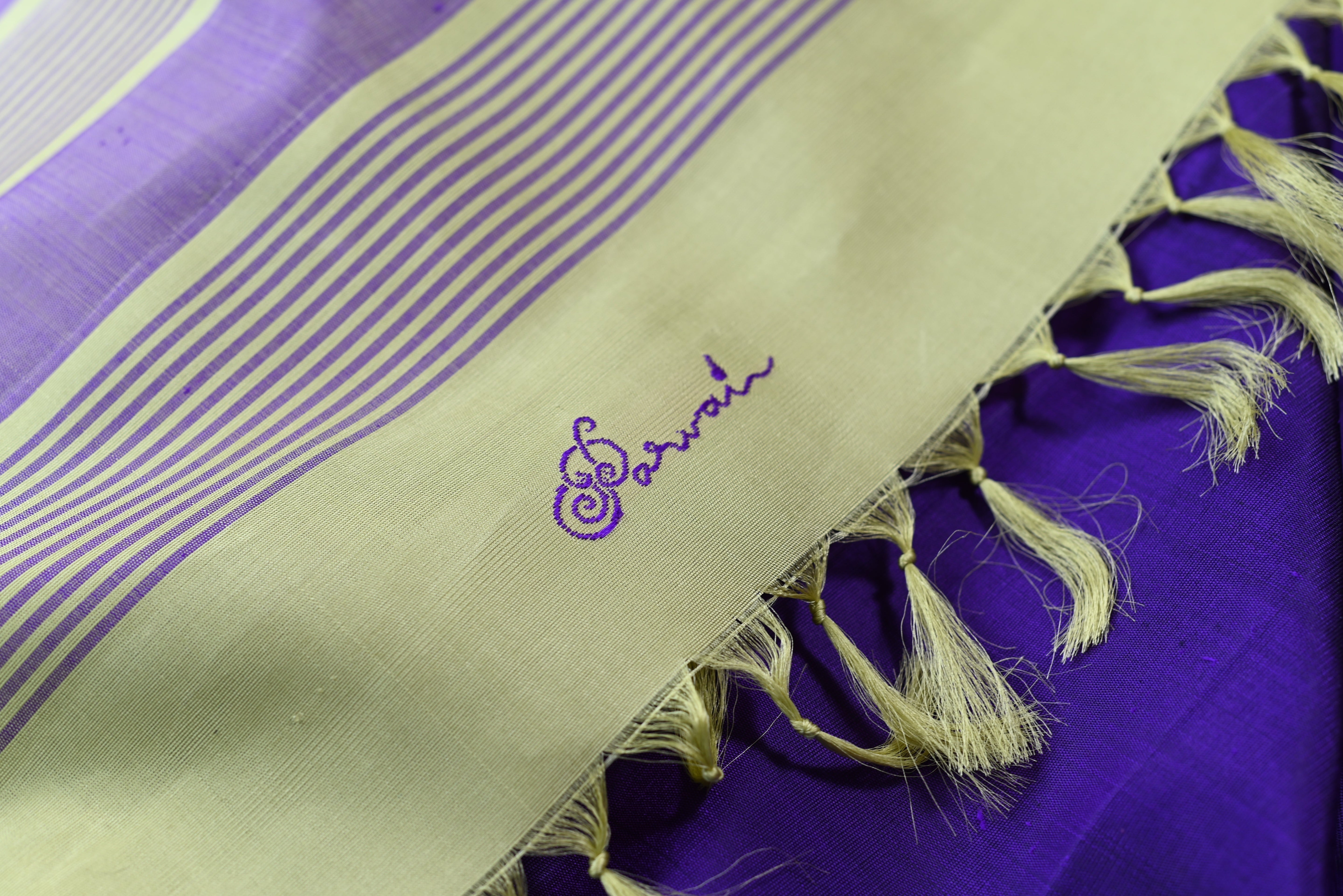
We photograph the complete sari as well as detailed close-ups because much of the significance of a handmade textile exists at a scale that a full-length photograph simply cannot communicate. A close photograph can reveal the weave, the slight irregularity of the human hand, the construction of a border, the character of zari, an individually woven motif or the registration of a hand-block print. These images are important to us because our patrons should be able to examine the textile rather than simply admire an overall styled image.
Our Mannequin Has Been Our Model for Years
For the longest time, the familiar Parvai mannequin has been our model. There is a very deliberate reason for this.
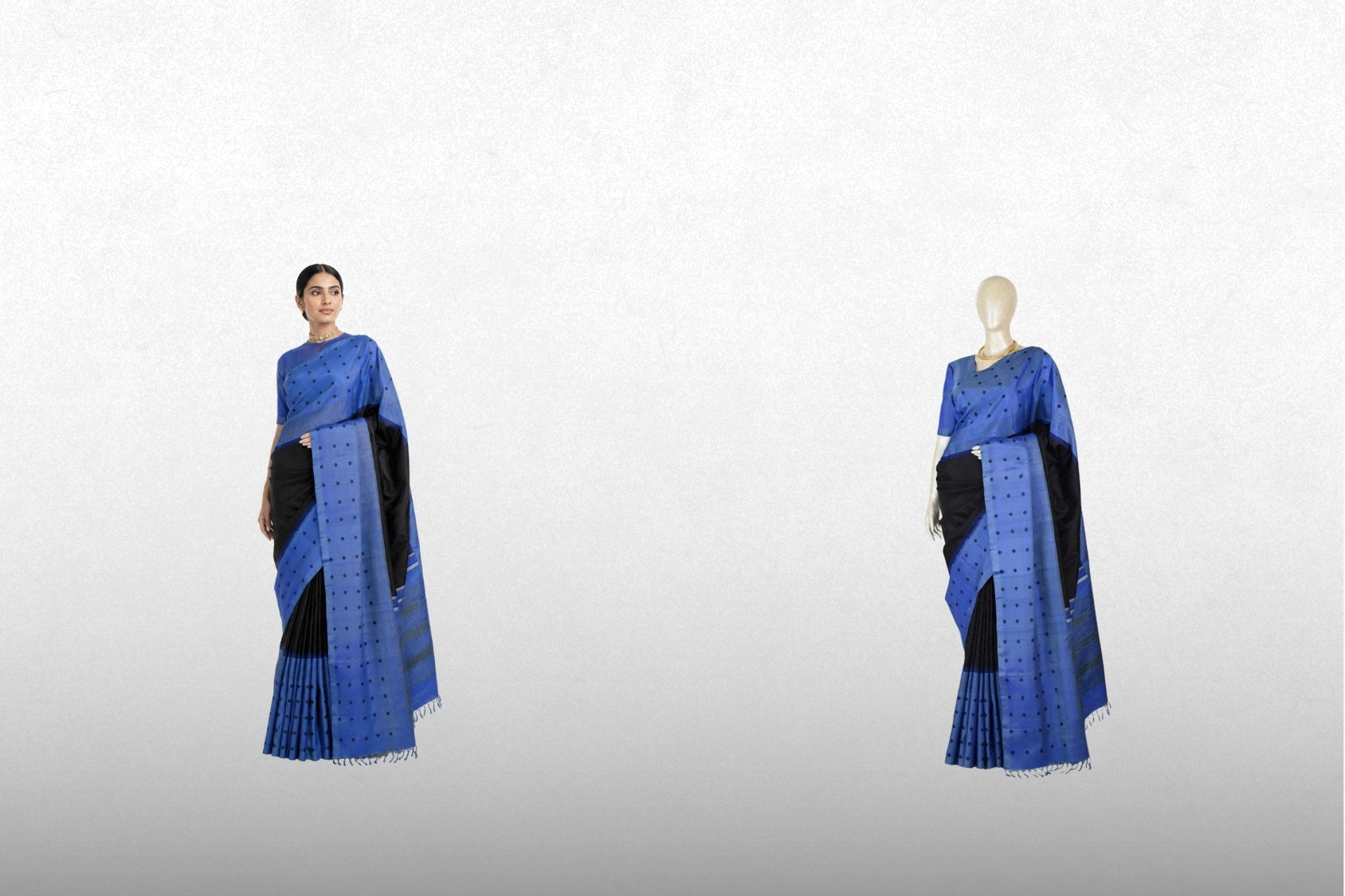
When a sari is ready to be photographed, it is carefully opened and gently steamed where necessary. Our team then drapes it on the mannequin in the classic Parvai style that many longstanding patrons will recognise. We take the necessary photographs to show the body, border, pallu, fall and overall proportion of the sari. Once the photography is complete, the sari is carefully removed, neatly folded and returned to storage.
The process is intentionally uncomplicated. We do not send the sari outside for styling. We do not circulate it between agencies, photographers, models or influencers. We do not repeatedly drape and redrape it to create multiple pieces of content. The purpose of the mannequin is simply to provide enough three-dimensional form for a patron to understand how the textile behaves while keeping the actual sari unworn.
When Photographs Are Not Enough
There are, of course, occasions when a patron needs more information. A photograph can never communicate everything about a textile, particularly when dealing with unusual colours, shot silks, natural dyes, transparency or the scale of a border against a human body.
If someone considering a Parvai sari asks to see it more closely, we simply open it again. We can make a private video, show its movement, bring the camera closer to the weave or hold the textile against ourselves so that the patron can understand its scale and colour in relation to a person. This is not a styled shoot and the sari is not draped and worn as clothing. It is simply part of the conversation we have always had with patrons before they make an important purchase.
We would much rather open a sari and answer another ten questions than allow a highly produced photograph to persuade someone to buy a textile she has not properly understood.
Why We Do Not Use Celebrity or Influencer Endorsements
Our decision not to use celebrities or influencers to wear Parvai saris is connected to this same philosophy, but there is also an economic consideration.
Influencer marketing exists within a commercial ecosystem. Collaborations can involve professional fees, gifting, free merchandise, barter, styling, logistics, photography and other promotional costs. Indeed, ASCI's guidelines explicitly recognise that a commercial relationship need not involve money: free or discounted products, gifts and barter arrangements are also considered material connections requiring appropriate disclosure. ASCI explains that these rules exist because the boundary between independent content and advertising can otherwise become blurred, compromising a consumer's ability to make an informed decision.
Parvai has consciously chosen not to create this economy around its saris. We do not give away saris in exchange for visibility. We do not offer free merchandise to influencers in the hope of receiving a post. We do not pay celebrities to make a textile appear more desirable. Consequently, these costs do not need to be recovered from the patron through the price of the sari.
A Parvai sari does not become more valuable because someone famous has worn it. Its value was already there, in the yarn, the loom preparation, the dyeing, the weaving, the printing, the design, the finishing and, above everything else, in the knowledge and labour of the people who made it.
The Arrival of AI and Why It Has Been Useful to Us
Over the last few months, however, we have begun cautiously exploring artificial intelligence as a new way of addressing one limitation of mannequin photography: sometimes a patron simply wants to understand what a sari might look like on a human figure.
For us, AI offers an interesting middle path. We can continue to keep the physical sari unworn while providing an additional visual reference showing approximately how it may look when draped on a person.
Importantly, the starting point remains our own high-resolution photography of the actual sari. We first document the textile carefully, including its colour, motifs, borders, pallu, weave, scale, spacing and texture. Those images then become the textile reference for generating a human visualisation. We give very specific instructions that the sari itself must not be redesigned: motifs must not be substituted, colours should not be changed, borders should not be enlarged or reduced and the character of the original weave must be retained as closely as the technology permits.
Nevertheless, we think transparency must work both ways. An AI-generated image is still an AI-generated visualisation. It is not the physical sari and it should never replace the original photographs when a patron wants to judge exact colour, weave, texture or craftsmanship. Our high-resolution photographs and close-ups of the real textile remain the primary product reference. AI simply helps answer the question, “Approximately how might this look when worn?” without requiring somebody to actually wear the sari that will eventually be sold.
What You See Should Be as Close as Possible to What You Receive
We are equally conscious that even conventional photography cannot reproduce a handcrafted textile with absolute accuracy. Screens differ. Phones automatically enhance photographs. Silk reflects light. Natural dyes can appear brighter on a screen than they do in person, while some subtle colours become almost impossible to photograph accurately. A purple shot with red, for example, can change dramatically depending upon the angle from which it is viewed.
This is why we encourage patrons to ask. If there is uncertainty about a colour, we can photograph it again. If someone wants to understand the texture, we can take a closer video. If a border appears brighter in one image than another, we can explain why. Photography should begin a conversation about the textile, not end it.
The principle also aligns with a wider standard of truthful advertising. ASCI's code states that advertising should not mislead consumers through distortion, omission, ambiguity or exaggeration, nor should it abuse consumer trust. That is very close to how we think about textile photography: the purpose of an image should be to communicate the product, not to manufacture an impression that the physical product cannot fulfil.
Our Pricing Follows the Same Philosophy
There is a direct connection between how we photograph our textiles and how we price them. We do not believe in creating an inflated ecosystem around a handcrafted sari and asking the patron to ultimately finance it.
Our prices are determined by the textile and the work surrounding its creation: materials, weaving, dyeing, printing where applicable, artisan compensation, design and development, pre-loom processes, finishing, documentation and the operational work necessary to responsibly bring that sari from its makers to its eventual patron. Celebrity endorsements, influencer gifting and elaborate fashion shoots are not hidden components of that price.
We also do not build our prices around a cycle of constant promotions. Parvai does not routinely offer sales or discounts. We would rather arrive at what we believe is a responsible price for a textile at the beginning than artificially create a higher number simply so that it can repeatedly be marked down.
There are occasions when we extend a consideration to patrons who have been with us for a very long time and have supported and invested substantially in our work. These are personal gestures within longstanding relationships and remain entirely at Parvai's discretion. They are not promotional discounts available because a particular season, festival or sale period has arrived.
Fresh Means Fresh
Ultimately, this entire discussion comes down to a very simple promise.
A Parvai sari will necessarily have passed through many human hands before it reaches you. That is the very nature and beauty of handcrafted textiles. Yarn has been prepared, dyed and handled. A weaver has sat with it at a loom. A printer or embroiderer may have worked across its surface. Our team has inspected it, opened it, photographed it, folded it and cared for it.
We make no attempt to remove those human hands from its story. They are the reason the textile exists.
But there is a difference between making and handling a sari and wearing it as a garment.
The sari offered to a Parvai patron has not been worn by a professional model for our product photography. It has not been worn by an influencer for a reel. It has not been sent to a celebrity and subsequently returned to us. It has not needed to be washed or dry-cleaned after promotional use. It has not been circulated as free merchandise in exchange for publicity.
It remains fresh and unworn.
And we believe that distinction becomes particularly meaningful when we remember that, although the sari may temporarily be sitting on a shelf in our studio, it is not really ours.
We Are Only Its Custodians
Someone has spent days, weeks or perhaps months creating this textile. Eventually, someone else will choose it and give it a completely different life. It might be worn to a wedding, taken to a temple, given by a mother to a daughter, carried across continents, brought out every year for a particular celebration, or simply become the sari someone reaches for because wearing it makes her happy. We cannot know what meaning it will eventually acquire.
And because we cannot know, we should not presume that the first wearing is ours to use for marketing.
Until the sari finds its patron, we see our role as that of a custodian. We document it carefully. We handle it respectfully. We show as much of it as we reasonably can. We answer questions about it honestly. Technology may help us present it better, but it should never require us to compromise the physical textile to create an image.
Perhaps that is the simplest explanation for the way Parvai photographs its saris.
We are not trying to make a sari look more extraordinary in a photograph than it really is. We are trying to photograph it truthfully enough for a patron to see how extraordinary it already is, and to ensure that when it finally reaches her, its first life as a worn sari begins with her.

Written by Effie Thomas