Rajeshwari
Chapter I
The Philosophy Behind Rajeshwari

Every Meaningful Textile Begins with a Question
Some questions seek to preserve traditions that have endured across generations. Others ask how inherited knowledge can continue to evolve while remaining true to its origins. Rajeshwari emerged from the latter. It began with a simple yet profound enquiry that stayed with us for several years: Can the experience of wearing something truly regal become part of everyday life rather than an occasional privilege? Across India, the sari occupies a remarkable place within cultural life. It is simultaneously a garment, a repository of memory, an artistic medium and a reflection of generations of accumulated craftsmanship. Yet many of our finest handwoven textiles remain closely associated with ceremonies and celebrations. They are admired, preserved and carefully stored, often waiting for the next important occasion before they are worn again. At Parvai, we began to question this relationship between luxury and rarity. Could a handcrafted sari possess the refinement and dignity of an heirloom while remaining light enough, comfortable enough and practical enough to become part of everyday life? Could technical sophistication exist without visual excess? More importantly, could a textile become more meaningful through repeated use rather than careful preservation? Rajeshwari was conceived as our response. Its name reflects the idea of quiet royalty, not the spectacle of grandeur, but the confidence, grace and composure that accompany a life lived with intention. The project was never about recreating historical royal textiles. Instead, it sought to reinterpret royalty as an everyday experience, where exceptional craftsmanship quietly accompanies ordinary life.This philosophy shaped every decision that followed.
Designing Through Dialogue
At Parvai, every project begins not with a sketch, but with listening. For nearly a decade, our greatest source of inspiration has been the people who live with our textiles. Through conversations that have unfolded over years, our patrons have shared stories of inherited saris that continue to hold emotional significance, fabrics that have grown softer with time, colours that evoke memories, and borders whose proportions remain elegant despite changing fashions. Equally valuable have been their observations about contemporary life, textiles that feel too heavy after several hours, saris that require more maintenance than modern lifestyles allow, or beautiful pieces that are admired but rarely worn. These conversations gradually become something more valuable than customer feedback. They become collective knowledge. Rather than approaching design as an act of individual creativity, Parvai views it as an ongoing dialogue between designer, artisan and wearer. Rajeshwari emerged directly from this exchange. Again and again, we heard a desire for light textiles without appearing delicate, refined without excessive ornamentation, and versatile enough to accompany everyday life while retaining the dignity of an heirloom. The project therefore became a collaborative endeavour shaped not only by design decisions but by years of shared experiences. We hope that when someone wears Rajeshwari, they recognise something familiar within it, not simply because they appreciate its craftsmanship, but because many of the ideas that shaped it originated in conversations with people who value handcrafted textiles as deeply as we do.
Designing With Responsibility
Designing for handloom carries a responsibility that extends far beyond aesthetics. Every line drawn on paper eventually becomes another person’s labour. Every motif influences the complexity of weaving. Every colour decision affects dyeing, preparation and the behaviour of the yarn. Unlike industrial production, where changes can be made repeatedly with minimal consequence, handloom weaving requires an extraordinary investment of time and skill long before the first centimetre of fabric is woven. This understanding has shaped Parvai’s design philosophy from the beginning.
Before asking an artisan to dedicate weeks of work to a textile, we believe it is our responsibility to ensure that every design decision justifies the effort it demands. Borders are refined repeatedly until their proportions feel balanced. Colours are studied under changing natural light. Motifs are simplified or reworked until they contribute meaningfully to the textile rather than existing as decoration alone. This process is intentionally slow because thoughtful design is ultimately an act of respect. At the same time, we recognise that handcrafted textiles possess a life of their own. Silk and cotton respond differently to humidity and tension. Colours change subtly with light. Every artisan brings an individual rhythm to the loom. Rather than viewing these variations as imperfections, we understand them as evidence of human participation. They remind us that every Rajeshwari sari remains unique, carrying within its structure the presence of the hands that created it. The search for a textile that embodied these ideas eventually led us towards an exploration of weaving traditions whose understanding of lightness, structure and material offered the perfect foundation for Rajeshwari. Rather than reproducing an existing tradition, we intended to learn from the strengths of multiple disciplines and allow those ideas to evolve into something entirely new.
Chapter II
Research, Development and Engineering Rajeshwari

Learning Before Creating
Every Parvai project begins with research. Before attempting to create something new, we first seek to understand the knowledge that already exists. India’s weaving traditions represent centuries of accumulated observation, experimentation and refinement. Each has developed its own understanding of material, structure, proportion and drape, shaped by geography, climate and the communities that have sustained them over generations. Rather than asking which tradition should be reproduced, we ask a different question: what can we learn from each, and how can those principles contribute to a textile that belongs to the present? Rajeshwari was developed through this philosophy of learning.
The project drew upon the strengths of two of Central India’s finest weaving traditions, each contributing a distinct body of knowledge. One offered an extraordinary understanding of creating lightweight, fluid fabrics with exceptional drape, while the other demonstrated remarkable sophistication in balancing silk and cotton to produce textiles that combined comfort with structural integrity. Instead of treating these traditions as separate identities, we viewed them as complementary sources of technical wisdom. To realise this vision, Parvai collaborated with artisans whose experience extended across both traditions. Rather than working within an established production setting, a traditional loom was installed in the artisan’s own home, allowing the project to evolve through continuous discussion, observation and experimentation. The loom became a place of enquiry rather than production alone, where ideas could be tested, refined and reconsidered without the pressures of commercial timelines. Over the following months, yarn combinations were repeatedly altered, warp arrangements recalculated and border proportions refined until every element achieved the desired balance. Rajeshwari therefore emerged not from a single moment of inspiration but from a sustained process of research and collaboration between designers and artisans.
Engineering the Fabric
The defining character of Rajeshwari lies not in elaborate ornamentation but in the structure of the cloth itself. Rather than relying on heavy motifs or decorative techniques, we sought to create beauty through the intelligent organisation of fibres. During the development process, considerable attention was devoted to understanding how silk and cotton behave within a woven structure. Although both fibres can be dyed to the same colour, they interact with light in remarkably different ways. Silk reflects light with brilliance because of its smooth filament structure, while cotton diffuses it softly through its staple fibres. This difference became the foundation of the textile. After extensive sampling, we developed a carefully engineered warp in which silk and cotton threads are arranged in deliberate sequences. The objective was not to create visible stripes or patterns but to produce a subtle ribbed texture that responds continuously to changing light. As the wearer moves, the surface alternates between luminous highlights and softer matte passages, creating a quiet sense of depth without relying upon additional ornamentation.
The beauty of Rajeshwari therefore, emerges from its construction. Its character is revealed gradually through movement, allowing the fabric to reward close observation rather than immediate attention. For Parvai, this represents one of the most satisfying expressions of handloom design, where material itself becomes the ornament.
Reinterpreting the Border
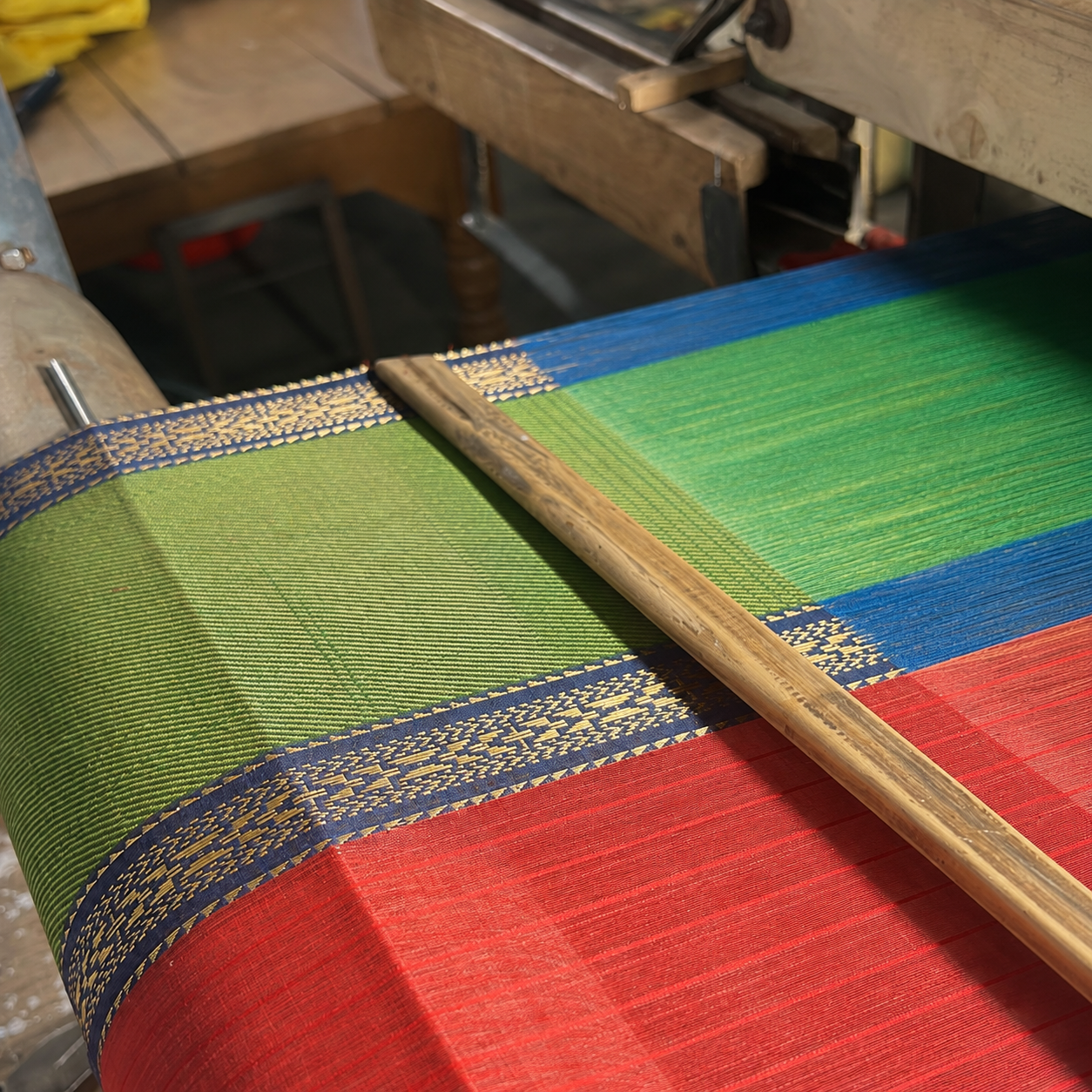
While the body of Rajeshwari remains understated, the borders provide the textile with its architectural identity. Years of conversations with our patrons revealed a consistent appreciation for the broad, parallel borders found in many South Indian saris. Beyond their decorative role, these borders frame the drape, establish visual rhythm and lend quiet authority to the garment. Rajeshwari embraces this sensibility through generous ten-inch borders that balance the delicacy of the body while preserving the overall lightness of the textile.
The proportions of these borders were refined through repeated trials. What appeared balanced on paper often behaved differently once woven, requiring continual adjustments until the relationship between body and border felt harmonious both on the loom and when draped. The decorative language of the borders emerged from an entirely different source. During the research phase, we studied the geometric compositions found in Bhujodi weaves and Suf Emboidery, particularly their disciplined use of repeated triangular forms. Rather than reproducing these embroideries directly, we interpreted the underlying principles of rhythm, proportion and repetition through weaving. The triangular motif bands that define Rajeshwari are therefore original woven compositions inspired by the geometry of these embroidery traditions rather than copies of existing patterns.
Running through the centre of each border is a contrasting extra-weft twill band that introduces visual stability while reinforcing the architectural quality of the design. The pallu continues this geometric vocabulary through multiple bands of triangular motifs, creating a measured rhythm that complements the subtle engineering of the body.
Colour as Structure
Colour development formed one of the most time-consuming stages of the Rajeshwari project because colour could never be considered independently of the woven structure. Every shade behaves differently on silk and cotton, and these differences become more pronounced when both fibres coexist within the same engineered warp. Several weeks were therefore devoted to studying how colour interacted with texture, light and movement. Numerous combinations were woven, observed under different lighting conditions and refined before arriving at the final palette.
The inaugural Rajeshwari combines a vibrant vermilion body with deep olive-green borders accented by restrained gold highlights. These colours were selected not simply for their visual richness but because they enhance the subtle optical qualities of the woven structure. As light moves across the surface, colour and texture work together to create a textile whose appearance continues to evolve throughout the day.
By the end of this development process, Rajeshwari had become far more than a new sari. It represented an exploration into how research, material, geometry, colour and craftsmanship could come together to create a textile that honours inherited knowledge while expressing a distinctly contemporary design philosophy. The next stage of the journey, however, would move beyond design and into making, where months of research would finally be entrusted to the loom and to the extraordinary skill of the artisans who brought Rajeshwari to life.
Chapter III
The Human Hand Behind Rajeshwari

From Design to Cloth
Every handwoven textile reaches a moment when research, drawings and discussions must give way to the loom. For Rajeshwari, this transition marked the beginning of the most demanding stage of the project. Months of research had established the philosophy of the textile, its structure had been refined through repeated sampling, and the colour palette had finally been resolved. Yet none of these decisions could be considered complete until they were translated into woven cloth. Unlike industrial production, where a design can be reproduced repeatedly with minimal intervention, handloom weaving demands complete commitment long before the first centimetre of fabric appears. Every decision made during the design process eventually becomes another person’s physical labour. This awareness shaped the way Rajeshwari moved from concept to creation, reminding us that the success of a handcrafted textile depends as much upon preparation as it does upon weaving itself.
Four Months Before the First Thread
Although each Rajeshwari sari requires approximately twelve days to weave, its journey begins much earlier. Nearly four months were devoted to research, technical planning, colour studies, sampling and pre-loom preparation before weaving could commence. During this period, every aspect of the textile was carefully resolved. Warp calculations were revised repeatedly, yarn combinations were tested, colours were woven and evaluated under natural light, and the relationship between the body, borders and pallu was refined through successive samples. The objective was not simply to achieve visual balance but to ensure that every design decision justified the effort required to weave it. Once these questions had been answered, the preparation of the loom began. Every warp thread was measured, dyed, wound and arranged according to the engineered sequence developed during the research phase. The order of the silk and cotton threads had to remain absolutely consistent throughout the warp, as even minor variations would alter the optical qualities of the finished textile. By the time weaving began, the loom already embodied months of careful thought and technical planning.
The Loom as a Living Instrument
One of the least visible yet most remarkable aspects of traditional weaving is the preparation of the loom itself. A traditional pit loom is often perceived as a simple mechanical device. In reality, it is a sophisticated system whose precision depends almost entirely upon the judgement of the artisan. Every heddle, reed, beam, cord and supporting member must work together in perfect harmony before weaving can begin. Every thread passes individually through the loom, and every adjustment influences the behaviour of the entire warp. Watching a loom being assembled reveals that weaving is as much an intellectual process as it is a physical one. Although calculations provide the foundation, many decisions rely upon experience acquired over decades of practice. Tension is judged by touch, alignment by observation and balance through instinct. These forms of knowledge are rarely written down; they are passed from one generation of artisans to the next through years of shared work. For Rajeshwari, the loom became more than a tool. It became the place where months of research were transformed into a living textile.
A Conversation Between Generations
Rajeshwari was made possible through the collaboration of two generations of weavers whose knowledge complemented one another in remarkable ways. The senior artisan brought decades of experience in understanding yarn behaviour, loom preparation and structural balance. Many of the most important technical decisions emerged not from written calculations but from practical wisdom developed through years of weaving. Alongside this experience worked a younger artisan whose curiosity and willingness to experiment allowed the project to move beyond familiar solutions. Together, they approached Rajeshwari not simply as another commission but as a shared exploration. This collaboration reflects one of the enduring strengths of India’s craft traditions. Knowledge survives not because it remains unchanged, but because each generation understands it deeply enough to adapt it thoughtfully. Rajeshwari became an opportunity for that exchange to take place, where inherited wisdom and new ideas could coexist at the loom.
Twelve Days of Weaving
Once the loom was prepared, each Rajeshwari sari required approximately twelve days of uninterrupted weaving. Those twelve days demanded complete concentration. Every movement of the shuttle, every beat of the reed and every advance of the cloth required careful attention. Because the body relied upon a precisely engineered arrangement of silk and cotton threads, consistency of tension remained essential throughout the weaving process. The artisan continually observed the behaviour of the fibres, making subtle adjustments that ensured the textile retained its intended character. The weaving of Rajeshwari was therefore never a repetitive task. Every day involved continual interpretation as the artisan responded to the changing behaviour of the material. The finished sari carries within it not only technical precision but also the rhythm, judgement and patience of the individual who wove it.
Rajeshwari: A Continuing Conversation
Rajeshwari represents far more than the creation of a new sari. It reflects Parvai’s belief that meaningful design emerges through dialogue between designer and patron, between artisan and material, and between tradition and contemporary life. The project demonstrates that innovation need not arise from abandoning tradition. Instead, it can emerge through careful observation, respectful collaboration and a willingness to learn from existing knowledge while asking new questions. Rajeshwari does not belong exclusively to one weaving tradition, one artisan or one designer. It is the result of many conversations brought together through a shared commitment to thoughtful craftsmanship. For Parvai, this remains the true meaning of everyday royalty. It is not expressed through excess or spectacle, but through the privilege of living with objects made patiently, intelligently and with respect for the human hand. We hope that Rajeshwari becomes such a companion, one that grows softer with time, richer with memory and more meaningful with every wear.
Ultimately, the success of Rajeshwari will not be measured solely by the saris that leave the loom. It will be measured by the conversations it continues to inspire: about craftsmanship, about collaboration, and about the enduring relevance of India’s handloom traditions in contemporary life. In that sense, Rajeshwari is not the conclusion of a project but the beginning of an ongoing journey, one that Parvai hopes will continue to explore, question and celebrate the extraordinary possibilities of handmade textiles.
Chapter IV
Beyond the Textile
Every meaningful act of creation eventually begins to speak about something larger than the object itself. While Rajeshwari may have started as an exploration in textile design, the journey gradually became one of observation, collaboration and learning. Somewhere along the way, the project ceased to be about creating a sari alone and instead became an opportunity to better understand the relationships that exist between people, materials, time and the quiet act of making. Over the years, one lesson has remained constant. Knowledge rarely belongs to a single individual. It grows through conversation, through shared experience and through the willingness to learn from others. Every artisan, every patron and every collaborator contributed something that could never have been developed in isolation. The finished textile therefore represents not the vision of one person, but the meeting of many perspectives brought together by a common purpose. This way of working has gradually shaped Parvai itself. Rather than approaching design as an act of authorship, we have come to see it as an act of stewardship. Our responsibility is not simply to create beautiful objects, but to observe, ask meaningful questions and provide the conditions in which knowledge can continue to evolve. Every project becomes part of a larger conversation that began long before us and will hopefully continue long after us.
Perhaps this has been the greatest lesson of Rajeshwari. It reminded us that the value of craftsmanship cannot be measured only through technical excellence or visual beauty. Its deeper significance lies in its ability to connect people. A thoughtfully made object carries within it the patience of those who prepared it, the experience of those who shaped it, the generosity of those who shared their knowledge and, ultimately, the life of the person who chooses to live with it. In many ways, this understanding extends far beyond textiles. The finest things that human beings create, whether they are works of art, architecture, music or craft, are rarely the result of individual brilliance alone. They emerge through collaboration, accumulated knowledge and an enduring respect for those who came before us. Every generation receives something, learns from it, adds its own understanding and quietly passes it forward. Rajeshwari is one such contribution.
It does not seek to define a tradition, nor does it claim to represent its conclusion. It is simply one attempt to participate thoughtfully in a much larger continuum of learning and making. If, through this project, we have created an object that encourages someone to slow down, observe more carefully and appreciate the quiet intelligence that exists within things made by human hands, then it has achieved its purpose. Ultimately, we believe that meaningful design is not about leaving behind a legacy of objects. It is about leaving behind a way of thinking, one that values curiosity over certainty, collaboration over authorship, patience over speed and understanding over imitation. Everything else is simply the result of that way of thinking.
Rajeshwari is our contribution to that continuing conversation.

Written by Effie Thomas