The Vineyard of Prosperity
Reimagining an Ancient Ornamental Tradition through the Weaving Heritage of Molakalmuru

An Ornament That Travelled Across Civilisations
Among the many ornamental vocabularies that have flourished across the Indian subcontinent, the vine occupies a particularly fascinating yet often overlooked position. While the lotus, mango, palmette, creepers and sacred foliage remain among the most recognisable motifs in Indian decorative traditions, the grapevine represents a quieter but equally significant chapter in the history of Indian visual culture. Its presence reflects centuries of artistic exchange across Persia, Central Asia, the Mediterranean world and the Indian subcontinent, before being thoroughly absorbed into India's own architectural, sculptural and textile traditions.
The grape (*draksha* in Sanskrit) entered the Indian imagination through long-established networks of trade and cultural exchange. References to grapes appear in early Ayurvedic treatises such as the *Charaka Samhita* and the *Sushruta Samhita*, where they are valued not merely as a cultivated fruit but as symbols of nourishment, vitality, longevity and prosperity. By the Gupta period (4th–6th century CE), luxuriant vine scrolls bearing clusters of fruit had emerged as an established ornamental language across northern India, appearing on temple architecture, sculptural friezes, manuscripts and decorative objects.
Indian craftsmen never treated these vines as botanical illustrations. Instead, they transformed them into idealised expressions of nature itself. Curling tendrils, intertwining foliage, flowering stems, birds and fruit flowed endlessly across stone and wood, symbolising abundance, renewal, fertility and the cyclical continuity of life. Rather than depicting cultivated vineyards, these compositions celebrated nature in perpetual movement, where every leaf and branch formed part of an interconnected living universe.
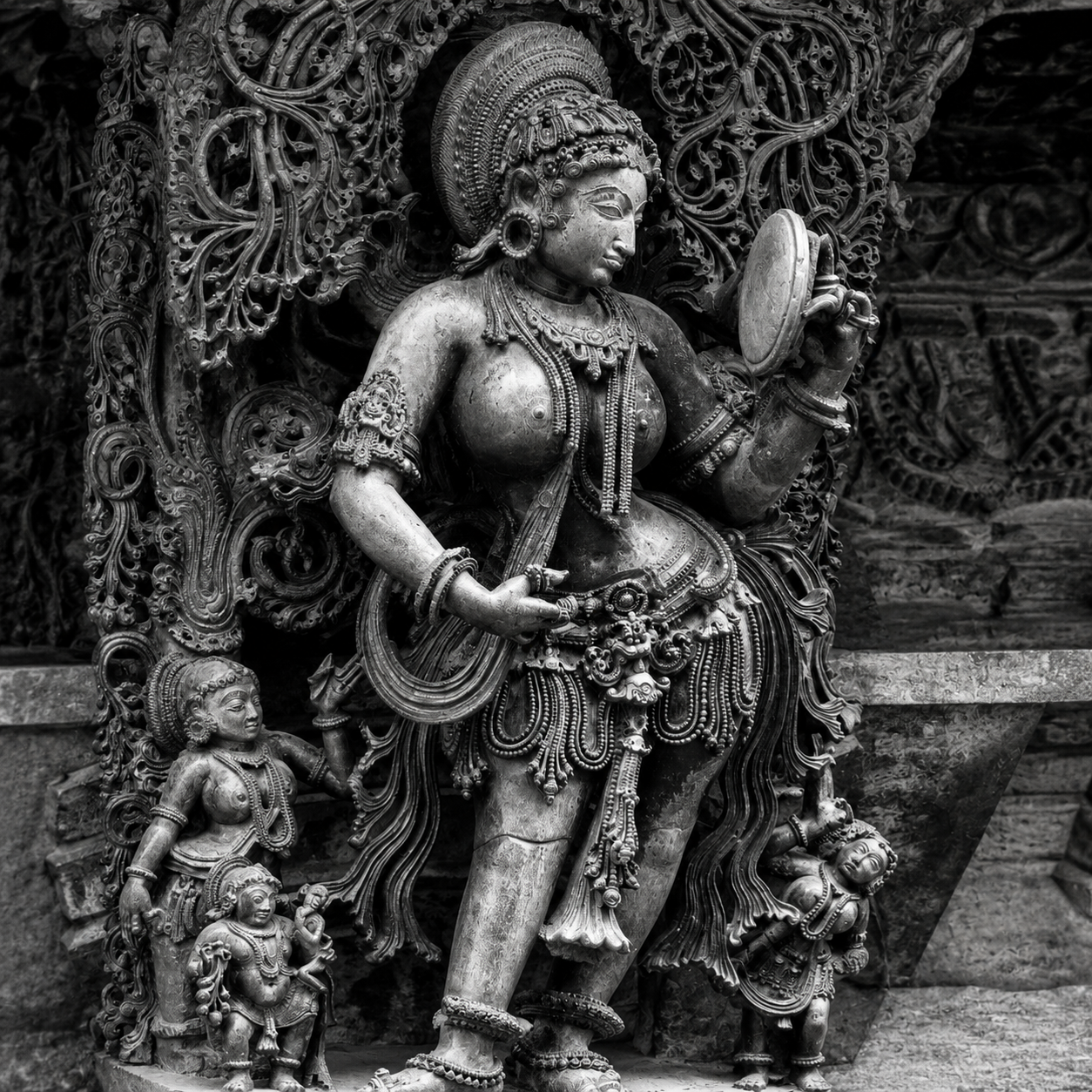
One of the most celebrated representations of grapes in Indian temple sculpture appears in the magnificent Chennakeshava Temple at Belur, Karnataka. Among its renowned Madanikas is the graceful figure of a young woman delicately holding a cluster of grapes while playfully teasing a monkey seated beside her. Executed during the twelfth century by Hoysala sculptors, the composition extends far beyond decorative elegance. The grapes evoke cultivated abundance, refinement and prosperity, while the monkey introduces the timeless dialogue between desire, restraint and the transient nature of worldly pleasures. The sculpture exemplifies the extraordinary ability of Hoysala artists to combine symbolism, narrative and ornament into a single harmonious composition.
Across the Hoysala temples of Belur, Halebidu and Somanathapura, sculptors continued this visual vocabulary through elaborate vine scrolls inhabited by birds, foliage and fruit. Although many of these carvings are broadly interpreted as sacred creepers or celestial vegetation, several exhibit unmistakable characteristics associated with grapevines. Their uninterrupted movement across pillars, capitals and architectural friezes symbolises continuity, interconnectedness and the eternal rhythm of creation, where every element participates in a larger cosmic order.
Even earlier, the Buddhist artistic traditions of ancient Gandhara introduced one of the earliest vine-scroll compositions into the Indian subcontinent. Emerging through the meeting of Greco-Roman, Persian and Indian artistic traditions, these celebrated "peopled vine scrolls" intertwined human figures, birds and animals among luxuriant grape-bearing vines. Over subsequent centuries, these imported visual ideas were gradually transformed by Indian craftsmen until they became entirely indigenous in character, seamlessly integrated into the decorative grammar of Indian architecture and ornament.
It is this remarkable visual heritage that became the point of departure for the present textile.
Where History Becomes Imagination
It did not begin on the loom. It did not even begin on paper. Like many of the textiles we develop at Parvai, it began as an idea, born from countless conversations with our patrons and the remarkable entrepreneurs who run independent boutiques and stores across the world. Every partnership reminds us that true originality is rarely created in isolation. It emerges from a shared desire to discover a visual language that is both deeply rooted in history and unmistakably one's own. That pursuit constantly challenges our imagination. Rather than inventing something entirely new, we return to India's immense design vocabulary, one that has evolved over centuries through temples, manuscripts, architecture and textiles. Our role is not to replace that heritage but to understand its visual language, draw inspiration from it and contribute our own small chapter to its continuing evolution.

The Courage to Imagine, the Discipline to Create
For an idea like this to find its way onto a loom, many people and many disciplines must come together. It begins with an imagination that is willing to ask questions and explore possibilities. It then passes through the hands of artists who translate those ideas into drawings, graph makers and jacquard technicians who interpret them into a language the loom can understand, and finally weavers whose experience allows those technical decisions to become woven cloth. The process itself is collaborative. As the design moves from paper to graph and from graph to loom, conversations continue. Proportions are adjusted, colours are reconsidered, the balance between silk and zari is refined, and the weight, texture and visual rhythm of the fabric gradually evolve. Every stage offers an opportunity to learn something new, and each person involved contributes their own knowledge to the outcome. For us, this has always been one of the most rewarding aspects of working with handloom. Every new textile becomes an opportunity to participate in a tradition that has been shaped by generations of designers, technicians and artisans, while adding, in our own small way, another chapter to its continuing story.
A Vineyard Takes Shape
This particular journey, like many others at Parvai, grew from years of travelling, observing and learning. Annie Thomas, my sister and Parvai's Design Head, and I have spent much of the past decade visiting weaving clusters, temple towns, museums, historical sites and artisan communities across India. Some journeys were planned around textiles, while others unexpectedly revealed remarkable details hidden in architecture, sculpture, manuscripts or everyday craft traditions. Together, they have shaped the way we look at design. Rather than searching for motifs to reproduce, we have always tried to understand the visual language that connects India's artistic traditions across regions and centuries. Conversations with artisans, time spent in craft clusters, hours walking through temple corridors, and the countless details encountered during our travels continually influence the way we think about textiles. They remind us that every motif has a history, every ornament carries a story, and every region contributes something unique to the larger vocabulary of Indian design. The vineyard emerged from that continuing journey of observation. Drawing inspiration from vine scrolls found in temple architecture, historical manuscripts and traditional ornament, Annie began exploring how this centuries-old visual language could find a new expression on the jacquard loom. She referred to numerous historical examples, not to recreate any single source, but to understand the rhythm that united them. Gradually, birds found their place among curling vines laden with clusters of grapes, and a composition began to take shape that felt rooted in history while belonging to its own time. The intention was never to recreate the past. It was simply to participate in a living design tradition, to learn from it, contribute to it with humility, and allow the loom to carry that conversation forward in its own language.
Speaking the Language of the Loom
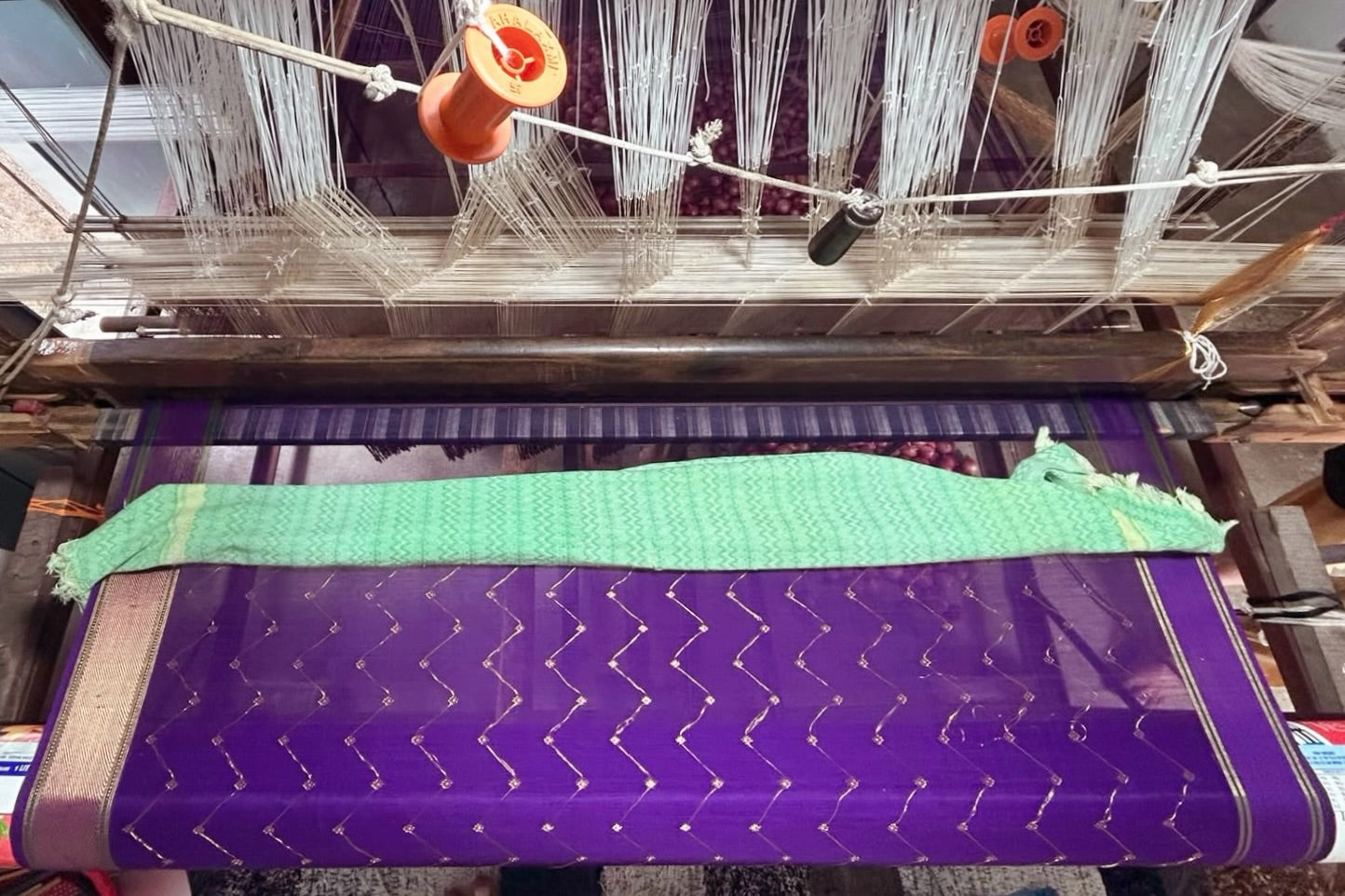
Transforming that artwork into a woven textile presented an entirely different challenge. Unlike illustration, jacquard weaving demands that every curve, every tendril, every bird and every cluster of grapes be translated into thousands of individual warp lifts. Fine leaves required simplification without losing their character. Delicate bird forms needed sufficient structural integrity to withstand weaving in silk and zari while preserving their grace. Every transition between silk and metallic thread demanded careful engineering before the artwork could finally be translated into a workable jacquard graph. Only then did the design begin its second life.

Thread by Thread: Molakalmuru Brings It to Life
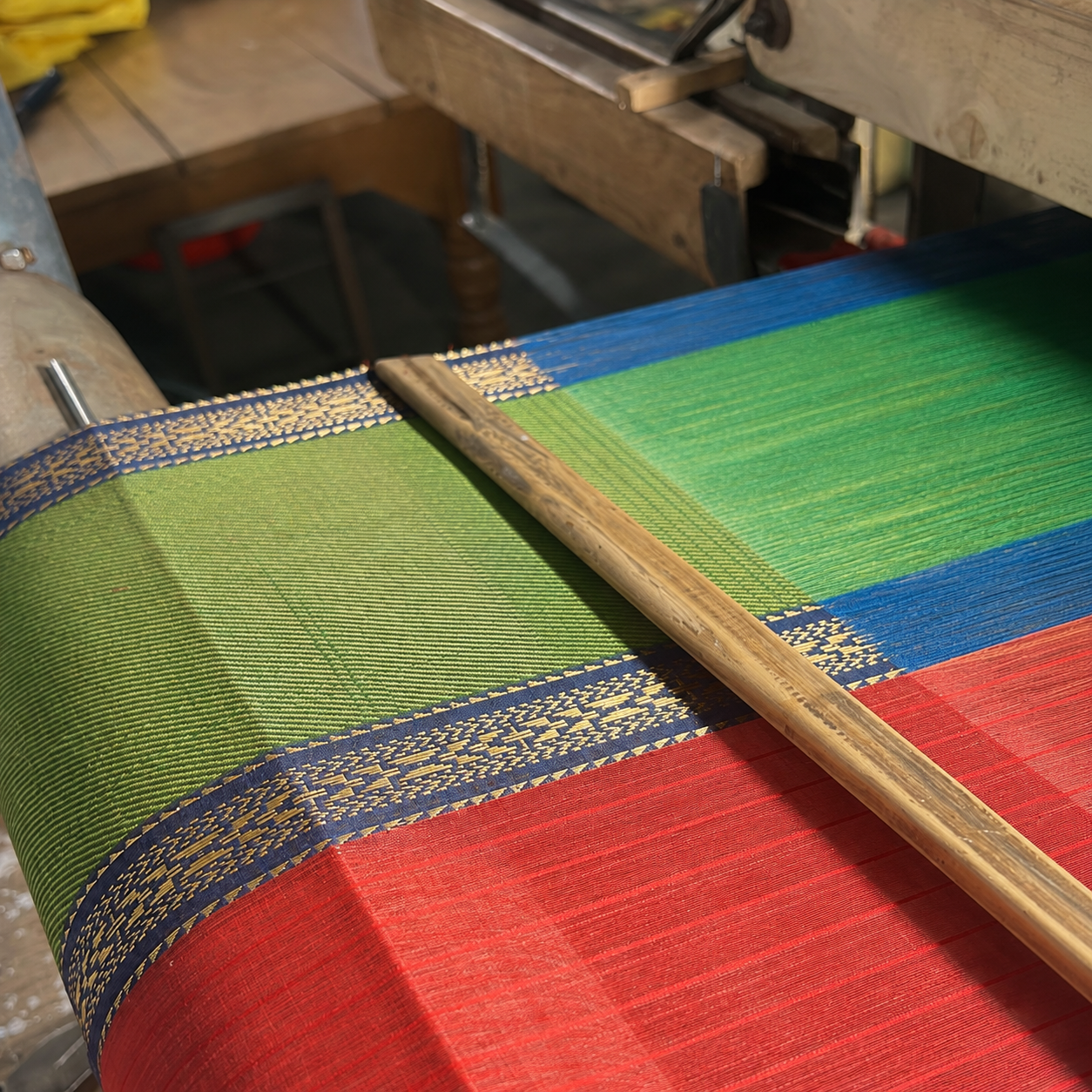
That second life unfolded in Molakalmuru, Karnataka. Within our weaving cluster, the design was received with extraordinary enthusiasm. Every original composition introduces its own challenges, but equally its own excitement. For the weavers, technicians and loom preparers, this was not simply another production order. It represented an opportunity to weave a visual language they had never before encountered on their looms. Preparing the jacquard demanded precision and patience. As the cards were assembled and the loom gradually came alive, the vineyard slowly revealed itself. Birds settled naturally among scrolling tendrils. The grape clusters acquired depth through the interplay of silk and zari. What had existed only in imagination, and later as pencil lines on paper, gradually transformed into a woven landscape of remarkable richness.
Where Many Hands Become One Textile
What makes this textile especially meaningful is that it represents the convergence of multiple disciplines across both time and geography. It is simultaneously an exercise in historical understanding, artistic drawing, textile engineering and traditional craftsmanship. The visual vocabulary inherited from anonymous sculptors, manuscript painters and ornamental designers of earlier centuries finds new expression through the knowledge of contemporary graph makers, jacquard technicians and master weavers. Although separated by centuries, each contributes to the final textile.
A Shared Journey
This particular textile has found its home with one of the newest entrepreneurs in our growing community of collaborators. As we begin this new journey, we are also grateful to celebrate years of working alongside Areegee by Aarti, whose belief in handcrafted textiles has helped sustain not just individual designs, but the many families and traditions that make them possible. For us, collaborations such as these extend far beyond creating a collection. When Areegee by Aarti chooses to commission a design, she is not simply introducing another sari to her store. She is committing to the months of preparation that precede every woven textile. She invests in the designer's imagination, the technical expertise of graph makers and jacquard specialists, the patience of the loom preparers, and the skill and time of the weavers of Molakalmuru. In many ways, she assumes responsibility for an entire creative ecosystem, allowing traditional knowledge to continue through meaningful work. Every patron who discovers this textile through her becomes part of that same journey. Their choice supports far more than the purchase of a sari. It sustains livelihoods, encourages original design, and gives artisan communities the confidence to continue exploring new ideas while remaining rooted in generations of inherited knowledge. This vineyard is therefore more than an ornamental motif woven in silk and zari. It represents a shared belief that India's textile traditions continue to flourish when designers, artisans, entrepreneurs and patrons work together with mutual trust and respect. Every curling tendril, every bird and every cluster of grapes carries that collective effort within it, a quiet reminder that heritage is not preserved by any one individual, but by communities who choose to nurture it together.
If you happen to visit Azhagi by Aarti, we hope you will take a moment to experience this collection and the stories it carries. Behind every textile lies not only the work of the hands that wove it, but also the belief of those who chose to make its journey possible.


Written by Effie Thomas