Those Who See
"When I saw this saree, it reminded me of the farming season in India. The buttas look so much like paddy or corn tops gently standing in the fields, and the warm golden body feels like sunlight over the land. With Ugadi approaching in just a week, it made the feeling even stronger. This time of year always feels like the earth is beginning a new cycle again, and the colours and motifs of this saree somehow capture that quiet sense of renewal. It almost feels like wearing a small piece of that moment when the land is ready to grow again. I just wanted to share how beautiful and evocative this design felt to me. Thank you and the team for making such meaningful art! "
At Parvai, we often speak about craft through the language of making: the loom, the disciplined rhythm of the shuttle, the intelligence of silk, and the patience of the artisan who brings form out of thread. Yet over time, it has become increasingly clear to me that a textile is never merely the outcome of a technical process. Its life extends beyond the loom. It is shaped by the land in which it is produced, the people whose lives surround the craft, and the patrons whose perception allows its deeper meanings to emerge.
A recent reflection from one of our patrons reminded us of this truth in a particularly moving way.
After receiving a saree with a warm golden-brown body and delicate motifs woven across its surface, she wrote to us from the United States with an observation that was both poetic and deeply perceptive. The buttas scattered across the fabric, she said, reminded her of paddy heads or corn tassels gently rising above cultivated fields. The luminous golden body of the saree felt to her like sunlight resting upon farmland. With Ugadi approaching, the festival that marks the beginning of a new agricultural cycle in parts of southern India, she felt that the saree carried the quiet energy of renewal.
“It almost feels,” she wrote, “like wearing a small piece of that moment when the land is ready to grow again.” Her words resonated profoundly with us. They did not simply praise the textile. They revealed something about the conditions from which it emerged. She saw the land within the loom.

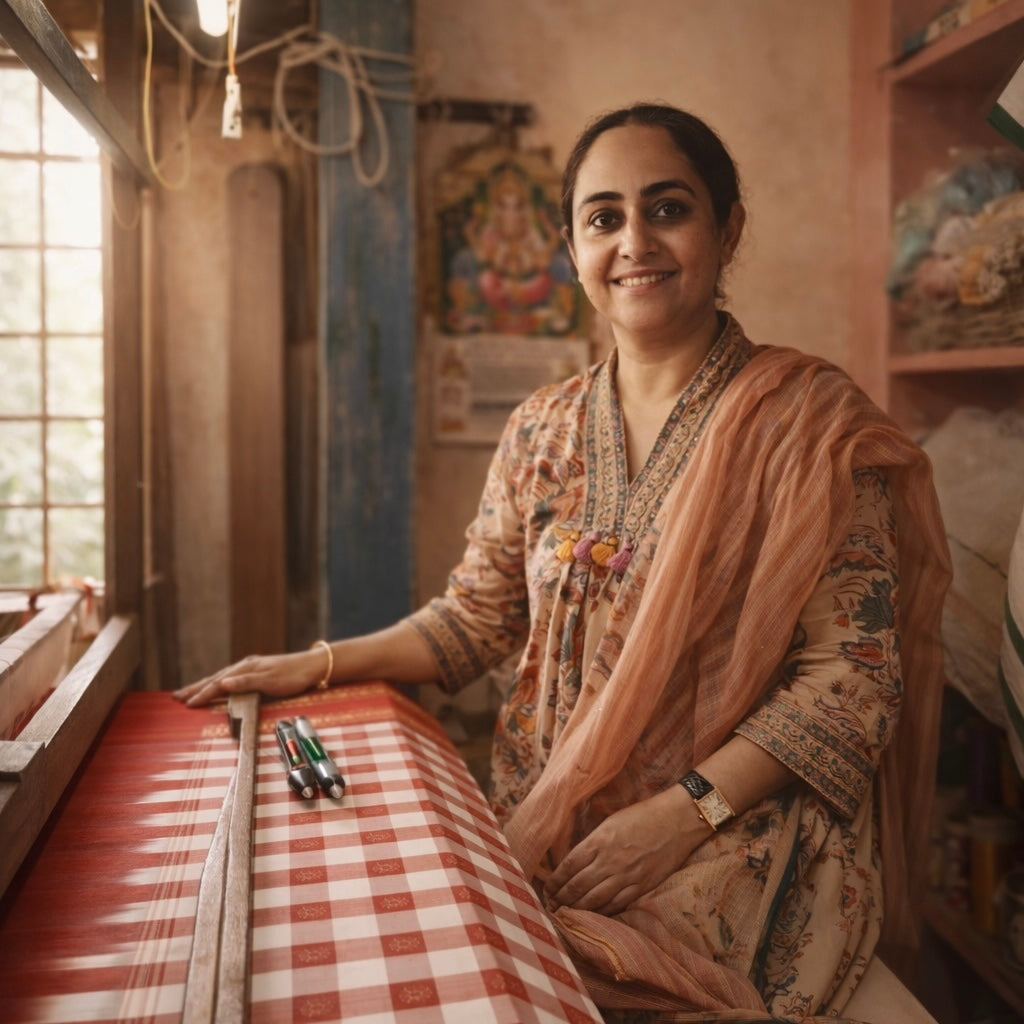
To understand why this moment was meaningful for us at Parvai, it is necessary to consider the environments in which many of these textiles are actually created. One of the great privileges of our work has been the opportunity to collaborate with artisans not in industrial settings but within their own homes and villages, places where weaving exists as part of a larger rural ecology. Among the many weavers with whom we work, several of Parvai’s most respected artisans, whose looms have produced some of our most cherished works, live in villages situated directly within acres of paddy fields. These looms have brought to life projects that many of our patrons recognise today: collections such as Shringa, Amudha, Padma, and several others that carry the aesthetic language of Parvai.
The physical location of these looms is not incidental. It is foundational.
They stand within landscapes shaped by agriculture, water systems, and seasonal rhythms. When the weavers pause in their work and lift their gaze from the loom, the world before them is not a workshop wall but a living landscape. They see paddy fields stretching toward the horizon. They see the expansive bed of the Palar River, whose presence, sometimes flowing, sometimes resting dry, has long shaped the ecology and agricultural life of the region around Kanchipuram.
They see palms rising above fields, goats grazing quietly along pathways, cattle moving slowly through village roads, and the continuous interaction between human life and land. These surroundings are not simply picturesque. They form the environmental context within which the craft exists. The artisans with whom we work are not solely weavers. They are also farmers. Their lives move fluidly between loom and land, between thread and soil. This dual engagement reflects an older pattern of rural livelihoods in which artistic production and agricultural work coexist as complementary forms of labour.

The rhythm of the day reflects this balance. Weavers begin their work before dawn. At around four in the morning, when the village is still enveloped in the quiet of early light, they sit at their looms and begin weaving. The hours between dawn and mid-morning, often until about nine o’clock, are devoted to the work of creating the textile: preparing the warp, guiding the shuttle, shaping motifs, and advancing the cloth line by line.
After these early hours of weaving, attention shifts toward the land.The fields require care. Crops must be observed, irrigation managed, and cattle tended. The same hands that move silk threads through a loom walk through rows of paddy plants, assessing the health of the crop and the condition of the soil. Later in the day, after rest and after the responsibilities of farming have been addressed, the weaver returns to the loom to continue the work of weaving. Often, before retiring for the night, there is one final visit to the fields to ensure that the land rests in good order.
Thus the day unfolds through a continuous movement between two crafts: the cultivation of land and the cultivation of cloth. For us at Parvai, this relationship between weaving and farming carries deep significance. It means that the textiles we produce emerge not from environments of mechanical repetition but from places of attentiveness, where human work remains closely aligned with the rhythms of nature.
The serenity of these environments inevitably shapes the spirit of the craft.
Our weavers work in spaces where wind moves through fields of grain, where sunlight shifts across land throughout the day, and where the seasonal cycles of agriculture structure daily life. These surroundings create conditions of calm concentration, conditions that allow craft to unfold with care, patience, and dignity. Yet the influence of these landscapes does not end with the artisans alone.
They also shape the vision with which Parvai approaches design.
The lands surrounding Kanchipuram, long considered sacred within the cultural history of South Indian weaving, have become a profound source of creative inspiration for us. Over the years, the villages in which we work, the riverbeds, the fields, and above all, the people who inhabit these places have become part of our extended family. The warmth of these communities has shaped not only our working relationships but also our aesthetic sensibilities.

The landscapes themselves inform the colours we choose, the golden tones reminiscent of ripening grain, the deep reds that echo evening skies, the earthy browns that recall soil after rain. The materials we assemble and the textures we pursue are guided by the visual and tactile experiences of these environments. Even the care with which each piece is produced reflects the ethos of these places, places where time is measured not by industrial schedules but by the movement of seasons.
In this sense, designing a Parvai saree is not an isolated act of artistic invention. It is an act of listening. It involves listening to the land, to the people who inhabit it, to the histories embedded in craft traditions, and to the quiet observations that emerge from living closely with these environments. The landscapes of Kanchipuram and the lives of the artisans who reside there continue to guide the sensibility with which we approach every textile we create.
Many of our patrons who have visited these villages have spoken of the sense of calm they experience in these environments. Walking through paddy fields, sitting beside the looms, and observing the quiet deliberation of the weaving process often creates a profound sense of connection to the craft, to the place, and to the people whose lives sustain it. This shared experience between artisan, land, and patron forms an important dimension of Parvai’s philosophy. It is why the message from our patron resonated so deeply with us. When she looked at the saree and recognised paddy heads in the motifs and sunlight in the golden silk, she was not merely offering a poetic interpretation. She was perceiving a relationship that genuinely exists within the conditions of the craft’s making. The motifs may resemble grain because the artisans themselves live among fields of grain.
The colours may evoke sunlight because the landscapes that inspire them are shaped by that light.
In this way, the saree becomes more than a garment. It becomes a translation of landscape into textile. The patron’s perception completes this translation. Through her recognition, the meanings embedded within the craft become visible again. This act of seeing is not incidental; it is essential. Craft achieves its fullest expression when someone encounters it with attentiveness and imagination.
For us at Parvai, this moment of recognition carried profound satisfaction. It affirmed that the work of our artisans had been understood in the spirit in which it was created, and by the very people for whom these pieces are intended. In that recognition lies a quiet sense of fulfilment. It tells us that the textile has succeeded in carrying something beyond itself: the rhythms of rural life, the harmony between human labour and nature, and the enduring capacity of craft to connect distant worlds. And so today, with humility and a small measure of pride, we celebrate this moment.
Because when a patron sees the land within the loom, the craft has truly spoken.

Written by Effie Thomas