The Privilege of Pause
A Reflection on Creation, Consumption, and the Meaning of Handiwork
“In a world where news of inhumanity bombards our sensibilities, where grasping for things goes so far beyond our needs, where time is squandered in busyness, it is a pleasure and a privilege to pause for a look at handiwork, to see beauty amidst utility, and to know that craft traditions begun so long ago serve us today.”
This quotation has stayed with me for many years because it articulates with remarkable clarity the tensions of the world we inhabit today. We live in an age defined by acceleration, an environment in which information circulates continuously, objects are produced and consumed at extraordinary scale, and daily life is structured by relentless activity. Within such conditions, the act of pausing, truly pausing, to observe something carefully made becomes both rare and meaningful.
For me, this pause has been made possible through my engagement with craft. Over the past decade, my work has increasingly revolved around understanding the processes, people, and knowledge systems that sustain handcrafted traditions. What began as an interest in textiles and objects gradually became a deeper exploration of how craft operates as a form of human intelligence, an intelligence that resides in the hands, in materials, and in the imagination of those who create. Through this journey I have come to understand that craft is not merely about making objects. It is about rethinking our relationship with time, consumption, creativity, and ultimately with one another.
Grasping Beyond Need
The line in the quotation that speaks of “grasping for things going so far beyond our needs” resonates with me in a deeply personal way.
Like many people living within modern consumer economies, I once experienced the ability to purchase beautiful objects as a form of freedom. Access to textiles, garments, artefacts, and crafted objects from different regions felt like a privilege. The act of acquiring them often appeared to be a form of appreciation, an acknowledgment of beauty and culture. Yet over time I began to notice a subtle but significant contradiction.
Many of the things I owned had very little story attached to them. They did not necessarily support the livelihood of a particular artisan. They did not contribute to the preservation of a design language or the documentation of a technique. They did not represent recognition of the maker whose knowledge and skill had brought them into existence. They existed simply as objects. This realization did not emerge suddenly. It developed gradually, through years of observation and engagement with craft communities. I began to understand that much of what we accumulate in modern life carries very little relationship to the processes of making. Objects become detached from their origins, and in that detachment they lose a great deal of meaning.
Anthropologists and sociologists studying consumer culture have often described this phenomenon as a separation between production and consumption. When the maker disappears from view, the object becomes a commodity rather than a carrier of human relationships. Craft, however, refuses this separation.
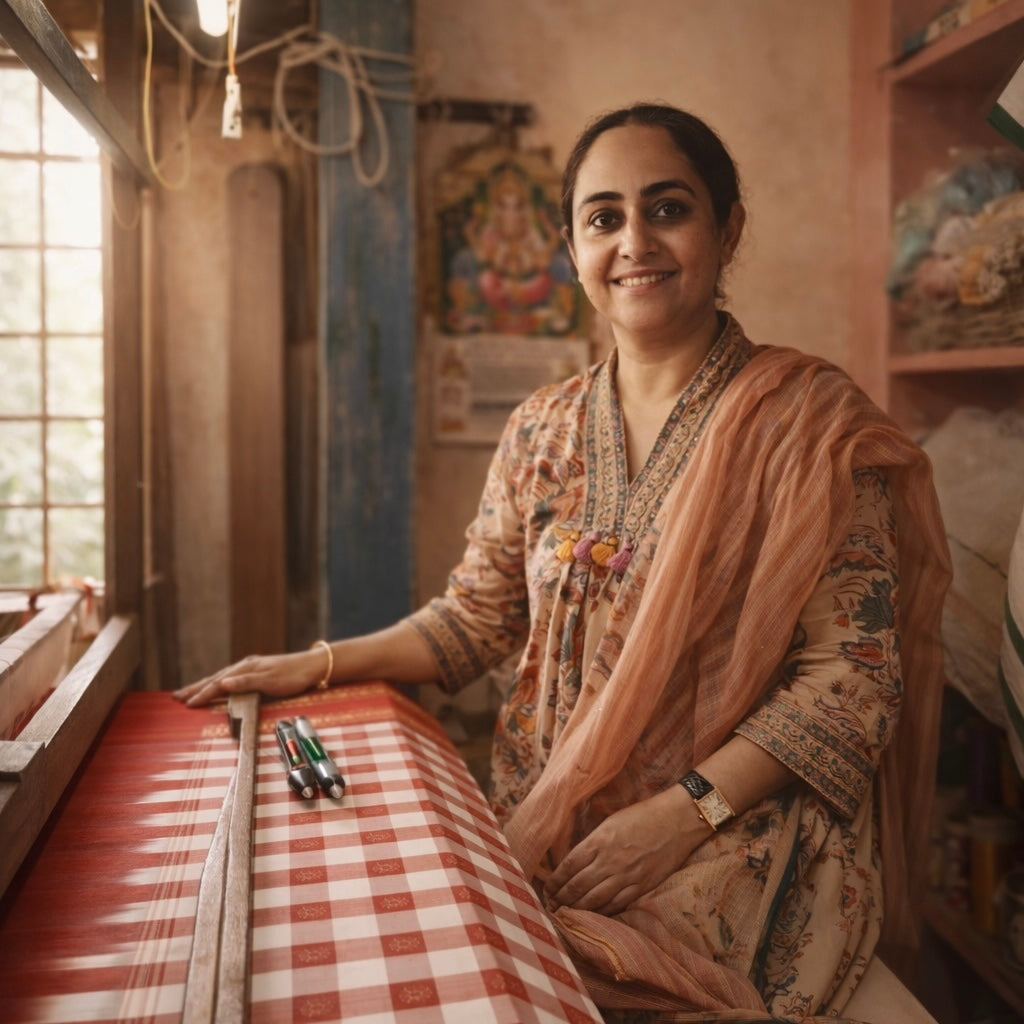
When I began spending time with designer, artisans, sitting beside weavers, observing printers at work, watching the gradual transformation of raw material into finished form, I realized that objects could not be understood without understanding the processes that created them.
Craft began to ask questions that were difficult to ignore. Do I really need so much? Or have I simply become accustomed to abundance because modern systems make it possible?
Craft and the Revaluation of Time
One of the most transformative lessons craft has taught me concerns the nature of time.
Modern production systems operate through the compression of time. Efficiency and speed are treated as indicators of progress. The faster an object can be produced, transported, and sold, the more successful the system appears. Craft traditions operate within an entirely different temporal logic.
The rhythm of the loom unfolds through repetition and concentration. The preparation of dyes involves stages of soaking, drying, and fixing that cannot be rushed. Metal responds gradually to the pressure of the hand shaping it. These processes require patience.
The sociologist Richard Sennett has described craftsmanship as the human desire to do work well for its own sake. Craft, in this sense, is not simply a method of production but a form of learning. It involves a sustained engagement with material, an attentiveness that develops over time through practice and observation. When I began to observe these processes closely, I realized that time in craft is not a limitation. It is a fundamental component of value.
Objects acquire depth precisely because they cannot be produced instantly. This understanding has profoundly reshaped my relationship with material culture. It has taught me that the speed with which an object can be acquired often bears little relationship to the care with which it has been created.
Beauty Amidst Utility
Another idea contained within the quotation“beauty amidst utility”captures something essential about traditional craft cultures. In many historical societies, the distinction between beauty and usefulness was far less rigid than it is today. Objects created through craft traditions were designed to serve everyday purposes while simultaneously embodying aesthetic refinement.
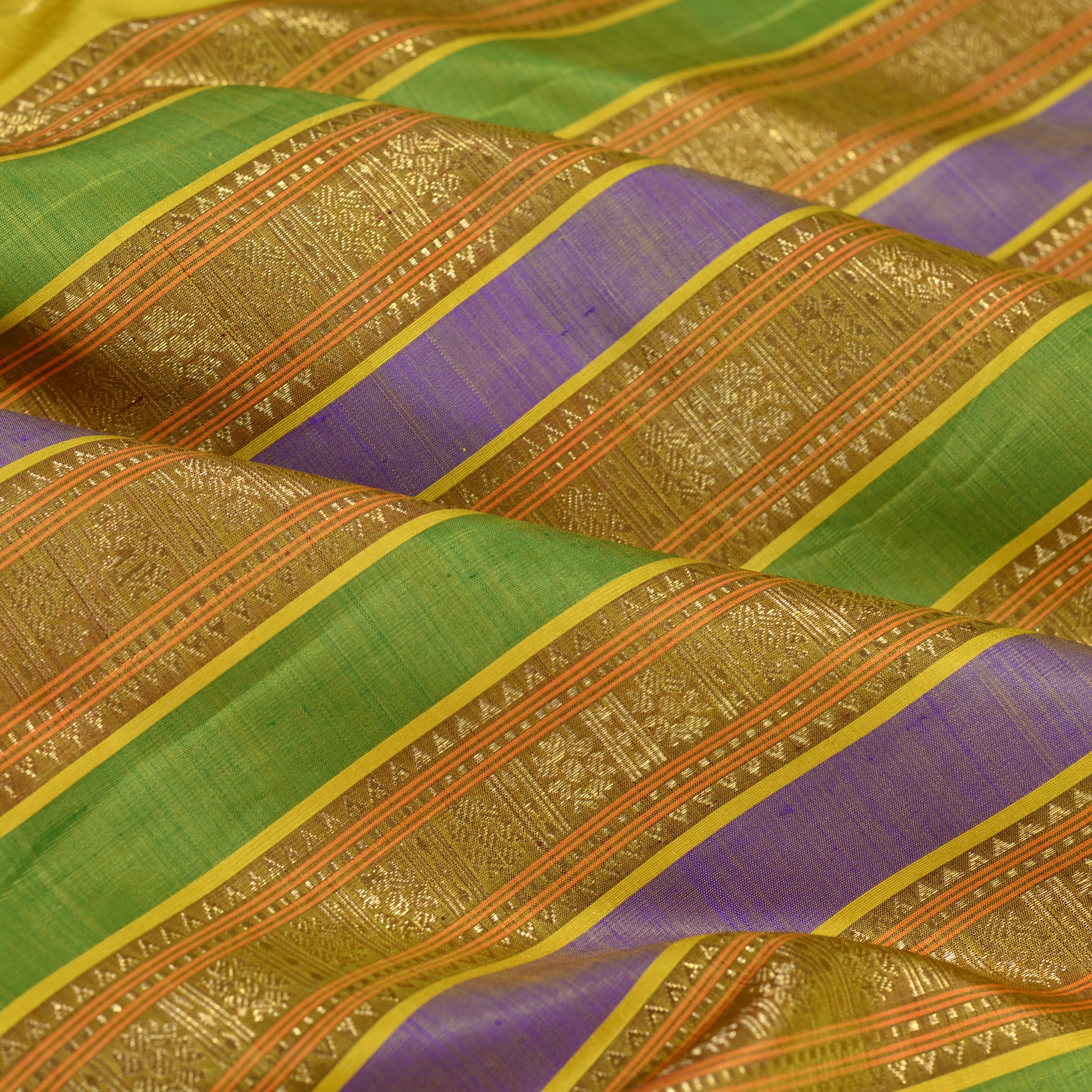
A sari, for example, functions as clothing, yet it is also an extraordinary architectural structure in cloth. Its drape, proportion, and movement represent centuries of experimentation and knowledge. Jewellery serves as adornment while also operating as miniature sculpture, balancing form, material, and movement with remarkable precision.
In these traditions, beauty is not separate from life. It exists within the objects that people use daily. This philosophy has deeply influenced the work I do through Parvai. Rather than treating handcrafted objects as rare artefacts, I have become increasingly interested in how craft can remain integrated within everyday living. Textiles, garments, and jewellery can carry aesthetic intelligence while still being part of daily experience. Beauty, in this sense, is not an indulgence. It is a way of inhabiting the world more attentively.
Imagination as the Beginning of Creation
While much of the discourse around craft focuses on technique and skill, I have come to believe that the most profound stage of creation occurs even earlier, in imagination.
Every crafted object begins first as an idea.
Someone imagines a motif before it is carved into wood. Someone imagines the structure of a textile before the first thread is woven. Someone imagines the movement of an earring before metal is shaped into form.
The time spent imagining, observing, reflecting, sketching, contemplating possibilities, is perhaps the most important part of the creative process. Process and technique transform materials, but imagination provides the initial impulse.
In my own work, many ideas begin in moments of quiet observation, studying the geometry of a traditional motif, considering how a historical technique might take on new form, or imagining how an object might bring beauty into everyday life. Imagination becomes the bridge between tradition and innovation.
Craft as Living Knowledge
The final line of the quotation “to know that craft traditions begun so long ago serve us today” captures the enduring relevance of craft. Traditions are often misunderstood as static inheritances preserved only for historical interest. In reality, craft traditions are dynamic systems of knowledge that continue to evolve across generations.
Techniques such as designing, weaving, dyeing, printing, and metalwork represent centuries of accumulated experimentation. They embody forms of knowledge that are rarely written down in manuals or formal systems of instruction. Instead, they are transmitted through practice, observation, and repetition. Anthropologists often refer to this as tacit knowledge, knowledge embedded in the body and learned through doing.
Working closely with craft communities has made me increasingly aware of how layered this knowledge really is.
Before any object is made, someone must first imagine it. A designer or thinker conceives the form of the object, measures proportions, considers geometry and structure, and translates an artistic idea into something that can eventually exist in material form. The conceptual act of imagining, of translating beauty, mathematics, proportion, and utility into a coherent design is itself a form of knowledge within the creative chain. Only after this imaginative stage does the artisan begin to translate that idea into material reality.A weaver understands thread tension through touch. A printer knows how dye behaves under sunlight, water, and humidity. A metal artisan recognizes the subtle moment when a material is ready to bend, shape, or cool.
These forms of knowledge cannot easily be replaced by machines because they are inseparable from human perception, intuition, and experience. When craft traditions are sustained, they preserve not only objects but entire systems of understanding, systems in which imagination, design, skill, and material intelligence come together to produce something meaningful.
Craft and the Ethics of Making
Engaging with craft also raises important ethical questions.
Because craft production remains closely tied to human labour and skill, it encourages more thoughtful relationships between makers, materials, and users. Objects become reminders of the people who created them and the knowledge they embody. This awareness invites a different form of consumption, one that values fewer objects but invests them with greater meaning.
Craft traditions also sustain livelihoods and preserve cultural memory. They represent networks of knowledge that extend across generations. Supporting these traditions therefore becomes not only an aesthetic choice but also an ethical one. For me, craft has gradually shifted the question from “What can I acquire?” to “What relationships does this object represent?”
Living Beautifully
Ultimately, my engagement with craft has reshaped how I understand beauty itself. Modern consumer culture often equates beauty with abundance or luxury. Craft suggests a different understanding. Beauty emerges through attention, through the careful design of objects that respond to human need rather than excess.
Living beautifully does not require surrounding oneself with many things. It requires living with objects that carry meaning. The texture of woven cloth. The fall of a sari. The quiet radiance of jewellery. These small encounters with material can transform everyday life into a space of reflection and appreciation.
The Privilege of Pause
Returning to the reflection that frames this essay, I am reminded that the act of pausing to look at handiwork is not merely an aesthetic experience, it is a way of understanding the world differently.
Over time, this quotation has become far more than a line of thought that I admire. It has gradually become a grounding principle for the philosophy behind Parvai, and in many ways it has also shaped my own thinking about craft, creativity, and the role of objects in our lives.
“In a world where news of inhumanity bombards our sensibilities, where grasping for things goes so far beyond our needs, where time is squandered in busyness…” these words describe with striking accuracy the condition of contemporary life. They speak of the overwhelming pace of our world and the culture of accumulation that often replaces reflection. But the quote does not end there. Instead, it offers a quiet alternative: the privilege of pausing to observe handiwork, to notice beauty within the objects that serve everyday life, and to recognize that traditions begun long ago continue to shape the present.
For me, this idea has gradually become central to how I understand craft.
Over the past decade, working with artisans and engaging with craft traditions has revealed that objects are never simply objects. They carry imagination, labour, and knowledge. A woven textile contains the rhythm of the loom and the discipline of the weaver. A printed motif holds the memory of generations who refined its geometry and form. A designed object reflects the imagination of someone who first envisioned its proportions, its structure, and its presence long before it came into material existence.
To pause before such objects is to recognize the continuity of human creativity. This recognition lies at the heart of Parvai. The philosophy of Parvai has always been shaped by the belief that craft traditions are not relics of the past but living forms of knowledge. They continue to serve us, not only by producing beautiful objects but by reminding us how imagination, patience, and human skill can come together to create meaning.
Craft invites us to reconsider the relationship between what we need and what we accumulate. It reminds us that meaningful objects emerge not from abundance but from attention. It encourages us to value fewer things, but to value them more deeply, because each object represents a network of relationships between imagination, material, and human effort.
In this sense, craft is not simply about making. It is about sustaining ways of thinking and creating that preserve the dignity of human work. It is about recognising that the process of imagining, designing, and making carries cultural and ethical significance. For me, this quote continues to serve as a quiet compass. It reminds me that the work of Parvai is not simply about producing textiles or objects. It is about creating spaces where craft can still be seen, understood, and valued.
And perhaps most importantly, it reminds me that the act of creating something beautiful, with care, with imagination, and with respect for the traditions that came before us, remains one of the most meaningful ways in which we affirm our shared humanity. Through that simple act of pausing to look at handiwork, we begin to understand that traditions begun long ago do not merely survive in the present. They continue to shape how we live, how we create, and how we imagine the future.

Written by Effie Thomas