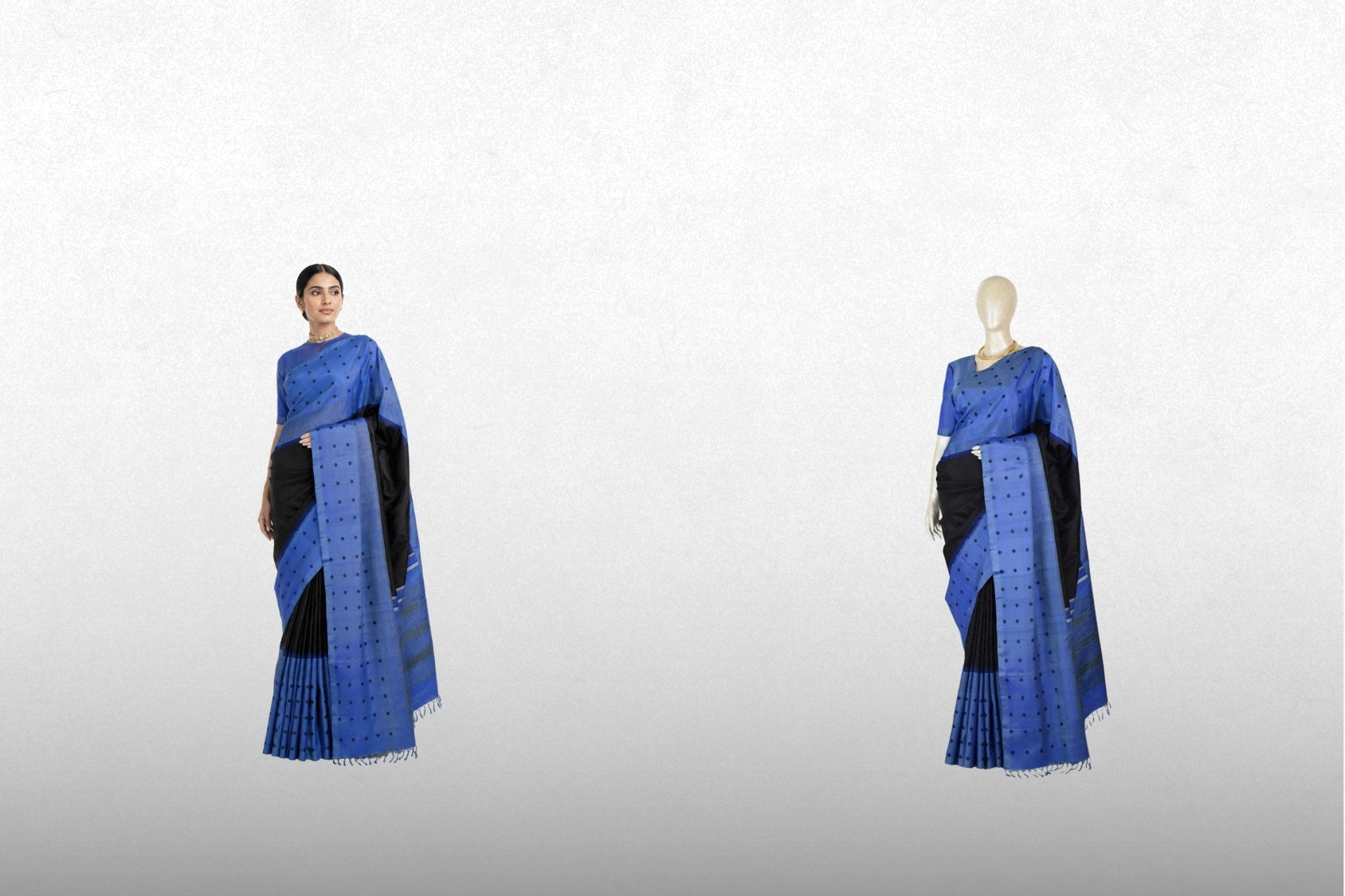
Article: Zari, Value and the Meaning of Quality
Zari, Value and the Meaning of Quality
A Parvai Perspective on Material, Craft, Cost and Contemporary Relevance
Reconsidering the Place of Zari
At Parvai, our understanding of zari has evolved through practice. We work with textiles in which zari can be historically significant, technically important, visually transformative and, in certain contexts, materially valuable. At the same time, we work within the realities of contemporary production, where gold and silver prices have risen dramatically, silk and labour costs have changed, traditional specifications have evolved, and patrons bring very different expectations to the same textile. This has led us repeatedly to a larger question: how much weight should the metallic composition of zari carry in determining the perceived quality and value of an entire handwoven textile?
Our position is not that zari is unimportant. Quite the opposite. Material should be understood, accurately represented and honestly disclosed. What concerns us is the tendency to allow the composition of one yarn to become a shorthand for the quality of the whole textile. A handwoven sari is a composite work. Its character emerges from yarn, dyeing, loom preparation, technical construction, motif development, border architecture, supplementary-weft work, design intelligence, finishing, drape, proportion, labour and accumulated knowledge. Zari participates in this structure, but it does not constitute the structure by itself.
Historically, the emphasis on real or pure zari had an economic logic that is important to acknowledge. Earlier metallic yarns could contain significantly higher proportions of precious metal than many contemporary constructions. In those contexts, gold and silver contributed not only luminosity and ceremonial value but also meaningful intrinsic value. A fine sari could therefore function as dress, ceremonial object, family inheritance and, in some circumstances, portable wealth. This history helps explain why zari continues to be discussed in terms resembling jewellery and why resale value remains deeply embedded in consumer thinking.
The problem arises when that historical understanding is transferred unchanged to contemporary zari. The terminology may sound continuous, but the material has evolved. Modern real zari is a composite metallic-textile yarn, generally involving a textile core together with copper, silver and a relatively small amount of gold. Its composition has changed over time in response to technology, economics and material availability. This does not diminish its legitimacy. It simply means that contemporary zari must be understood within its own material context rather than assumed to be identical to much older forms of precious-metal yarn.
Government Regulation, Inflation and the Changing Composition of Zari
One of the strongest pieces of evidence for this evolution comes from the Government's own regulation of zari composition. The Government Order shared with Parvai, G.O. (Ms.) No. 198 dated 10 December 2025, records that the recognised composition had already undergone substantial reduction over time. An earlier standard had reduced the gold component from 0.6% to 0.5%, with a permitted tolerance of ±0.02%, while silver had been reduced from 57% to 40%, with a tolerance of ±2%. The 2025 Order then sanctioned a further reduction, bringing gold to 0.4% with a tolerance of ±0.02% and silver to 30% with a tolerance of ±2%.
What makes this directive particularly important is not only the percentages themselves, but the reasoning behind the change. The Order explicitly refers to the substantial rise in gold and silver prices, the resulting increase in the price of silk sarees, and the effect this was having on sales. The reduction in precious-metal content was therefore not presented as a rejection of quality, but as a response to economic reality and the need to keep the handloom ecosystem viable.
This distinction is fundamental. When the gold content was reduced, the skill of the weaver did not reduce with it. When silver moved from 57% to 40%, and then to 30%, a difficult korvai did not become easier. A supplementary-weft motif did not require less precision. A complex pallu did not take fewer days. The knowledge required to control the loom, maintain tension, execute joins, prepare an adai, calculate motifs or resolve proportion remained exactly where it had always been: with the maker. The material specification changed because the economics changed. The craftsmanship did not.
The 2025 directive is equally significant because it did not abandon quality control. It calls for the revised zari composition to be verified through testing, including through appropriately accredited laboratories such as those recognised under the NABL framework. This is an important contemporary principle. The answer is not to be vague about zari because specifications have changed. The answer is to be more precise. A lower precious-metal specification is not inherently a problem; misrepresentation is.
The Problem with 2G, 3G and the Reduction of a Textile to One Yarn
It is within this wider historical and regulatory context that the contemporary fixation on terms such as 2G, 3G, 5G and similar classifications becomes problematic. These descriptions may be useful when they refer to a clear supplier specification or to a tested composition. They may tell us something about the zari. What they cannot do is tell us whether the textile itself is exceptional.
A zari grade cannot tell us the quality of the silk. It cannot tell us whether the loom preparation was simple or extremely complex. It cannot tell us whether the sari took ten days or eighty days to weave. It cannot assess the intelligence of the design, the density of the motifs, the precision of the joins, the quality of the reverse, the difficulty of the pallu or the experience of the weaving team. Yet in the marketplace, this one classification can sometimes carry disproportionate weight.
This is a tension we encounter repeatedly at Parvai. We may spend months developing a textile. There may be research, design correction, sampling, dyeing, yarn preparation, motif scaling, border calculation, pallu development and repeated technical negotiation at the loom. The makers may be bringing decades of knowledge to the work. Yet, when the sari reaches the patron, all of this can suddenly be overshadowed by a single question: “Is it 2G or 3G?”
We understand where that question comes from. Consumers have been trained to associate higher precious-metal content with authenticity, longevity and value. But when the question dominates, the rest of the textile begins to disappear. The quality of the silk disappears. The weaving disappears. The design disappears. Time disappears. The maker disappears. And eventually, good work gets overshadowed by the composition and price of the metal passing through it.
That is the point Parvai wishes to question.
Material Value and Textile Value
A useful way of approaching this is to distinguish between material value and textile value. Material value is relatively easy to calculate. Gold has a market price. Silver has a market price. Silk has a cost. Zari has a cost by weight. These things can be quantified with relative precision.
Textile value is more difficult to calculate. How does one price a weaving technique learned over forty years? What is the financial value of knowing exactly how a complicated border must be tensioned? What is the value of being able to study an old textile and reconstruct a motif correctly rather than approximately? How should we price an additional twenty days on the loom, a more difficult supplementary-weft structure, or the accumulated knowledge of a weaving family?
Markets are extremely efficient at pricing commodities. They are much less efficient at pricing knowledge. This imbalance can distort how we understand quality. A sari may become more expensive because silver has risen in price, even though nothing about the weaving has changed. If that higher price is then interpreted automatically as evidence of a superior textile, commodity inflation becomes confused with craft improvement.
This is precisely why the Government's 2025 directive is so instructive. When rising precious-metal costs pushed sari prices upward and affected sales, the response was to reconsider the material specification rather than allow the entire textile ecosystem to become hostage to commodity inflation. The broader lesson is clear: the preservation of craft cannot be separated from economic viability.
Pricing, Preference and the Question of Where Value Should Go
For Parvai, this is where the discussion becomes practical. Every sari involves decisions about where money should be spent. If a textile can absorb an additional amount in its production cost, should that amount go entirely into a higher zari specification? Or could it create greater textile value if it allowed the weaving team additional time, supported a more complicated border, enabled denser motifs, made possible a more elaborate pallu or simply allowed the makers to be compensated more appropriately?
There is no universal answer. For certain textiles, the finest real zari available may be completely appropriate. A historically informed recreation, an important ceremonial textile or a particular brocade may genuinely require its weight, warmth, luminosity and material presence. A patron may also have a strong personal preference for a particular zari specification, and that preference is entirely legitimate.
But there will also be textiles where increasing the precious-metal content adds significantly to cost without producing an equivalent increase in textile quality. In those situations, the question should not be whether the more expensive zari is technically “better” in isolation, but whether it is the best decision for the work as a whole.
This is why affordability cannot simply be dismissed as compromise. Affordability is not the same as cheapness. A fine handwoven textile should not be made cheap at the expense of yarn quality, technical integrity or fair wages. Good silk costs money. Dyeing costs money. Pre-loom preparation costs money. Skilled weaving must cost money. Specialist techniques must cost money. Most importantly, the maker's time must be valued properly.
At the same time, a weaving tradition also requires patrons. If the accepted definition of the “best” sari always requires the maximum possible precious-metal specification, then rising gold and silver prices inevitably narrow the market for exceptional handmade work. A craft that becomes accessible only to a very small number of buyers is not necessarily being preserved more successfully. In some cases, it may simply be becoming less viable.
The Government directive recognises this relationship directly by linking high metal prices, rising sari prices, weaker sales and the need to sustain the handloom sector. For Parvai, that is an important reminder that affordability can itself be part of craft preservation.
Kanchipuram as One Example of a Larger Question
Kanchipuram is an especially useful example, but it is not the main subject of this discussion. Its identity has never depended solely on zari. Kanchipuram is recognised through a much larger vocabulary of silk structure, contrast borders, korvai joins, petni pallus, traditional motifs, specialised loom practices and the accumulated knowledge of its weaving community. Changes in zari composition did not erase those characteristics.
This illustrates a broader principle that applies equally to other zari-bearing traditions. A textile tradition survives through continuity of knowledge, technique, structure and cultural vocabulary. The exact composition of one material may change over time without the entire tradition becoming inauthentic.
Zari should therefore also be understood as a design material rather than simply as a status marker. Different zari constructions affect tone, luminosity, weight, flexibility, hand and drape. One sari may require a strong, substantial metallic presence. Another may work better with a softer and lighter effect. A sari intended for frequent use may have different requirements from one designed for a ceremonial context. The most expensive zari is not automatically the most appropriate zari.
The more intelligent question from the maker's perspective is not always, “Which zari has the highest precious-metal content?” It may be, “Which zari best serves this textile?”
Resale Value, Jewellery and the Contemporary Heirloom
The subject of resale value also needs to be reconsidered in light of contemporary material realities. Historically, textiles containing substantial quantities of precious metal could indeed possess meaningful recoverable value. Contemporary real zari still contains gold and silver, but successive reductions in those proportions make clear that its relationship to intrinsic metal value has changed. The 2025 Government Order's movement from an earlier 0.5% gold and 40% silver specification to 0.4% gold and 30% silver is especially revealing in this regard.
This does not make contemporary real zari valueless. It simply means that a sari should not automatically be purchased or evaluated as though its purchase price were secured by the future value of the metal that could be recovered from it. If the primary objective is investment in gold or silver, those materials can be purchased directly.
A textile is different. Its value is distributed across material, labour, technique, design, rarity, provenance, time and cultural meaning. This is why the jewellery model can be misleading when applied to handwoven sarees. Jewellery can reasonably be judged heavily through purity and weight because the precious metal represents a major part of the object's intrinsic financial value. In a textile, the elements that are hardest to weigh may be the ones that matter most.
The same is true of heirloom value. An heirloom is not simply the sari from which the next generation can recover the greatest amount of silver. An heirloom is something another generation considers worthy of preserving. That may be because of its materials, but it may equally be because of the rarity of its technique, the quality of its weaving, its provenance, its design, the identity of its maker or its emotional significance.
A magnificently made textile with a moderate zari specification can therefore possess profound heirloom value. Conversely, a poorly designed textile does not become important simply because it contains more precious metal.
Gold and silver can be bought again. Lost weaving knowledge may be far more difficult to recover.
Parvai's Position: Transparency Without Hierarchy
At Parvai, this leads us to a position that we describe as **transparency without hierarchy**.
We believe patrons should know what zari has been used. We should never misrepresent material composition. Where testing is useful, we should test. Where a particular specification has been promised, it should be delivered. We would rather communicate an actual material specification or a test result than rely on a vague label that encourages assumptions.
But once that disclosure has been made, the textile should be judged as a complete work.
The yarn should be examined. The construction should be understood. The joins, reverse, motifs, proportion, drape and finish should matter. The time on the loom should matter. The complexity of the technique should matter. The maker should matter. Fair compensation should matter. Zari should remain part of that evaluation, but it should not be allowed to eclipse everything around it.
For Parvai, the more meaningful conversation therefore moves beyond simply asking, “Is it 2G or 3G?” We would rather ask: What is the actual composition? Has it been tested? What silk has been used? What weaving technique has been employed? How complicated is the construction? How much time did it require? What did the zari contribute aesthetically and technically? And, ultimately, how good is the work?
That is the question we believe deserves to return to the centre of the discussion.
The December 2025 Government directive gives contemporary weight to this position. It demonstrates that zari composition itself is not immutable. When commodity prices changed, the specification changed. When sari prices rose and sales were affected, affordability entered the policy discussion. When precious-metal content was reduced, testing and verification remained important.
Materials matter. Standards matter. Honesty matters. Personal preference matters.
But materials must ultimately serve the textile and the people who make it, rather than overwhelm them.
Gold can be weighed. Silver can be assayed. Their value can be calculated at any given moment.
The value of exceptional workmanship is much harder to quantify.
And it is precisely because it is harder to measure that Parvai believes we must take greater care not to allow it to disappear behind the easier language of metal content.

Written by Effie Thomas