Beyond the Transaction
“What Are You Seeking From Craft And What Are You Willing to Give?”
A reflection from the Ambassadors of Heritage & Crafts Foundation
At the Ambassadors of Heritage & Crafts Foundation (AHC Foundation), our engagement with craft does not begin with objects, collections, or markets. It begins with questions. Questions we return to repeatedly in conversations with patrons, artists, collectors, and fellow travellers in this journey, and questions we are constantly asking ourselves. What are we truly seeking from craft, and equally, what are we willing to give in return? These are not abstract or philosophical indulgences. They are ethical questions, and the answers we arrive at, consciously or unconsciously, shape the future of the craft ecosystem far more decisively than trends or commercial success ever could.
In a world where accumulation is easy and often celebrated, owning art, sculpture, textiles, and heirloom objects can feel deeply fulfilling. There is, by nature, no end to collecting. One can always acquire more, across mediums, regions, and traditions. Historically, collections have played an important role in preserving culture and knowledge. Yet when accumulation is divorced from memory, meaning begins to erode. Without the human story, without remembering who made an object, under what circumstances, and with what lineage of skill and sacrifice, objects slowly lose their soul. They may retain aesthetic or monetary value, but they cease to carry emotional or moral weight. What truly endures is not the object itself, but the human presence embedded within it: the feeling it holds, the labour it carries, and the dignity or indignity with which it was made.
This becomes particularly evident when we confront the question of value. In contemporary systems, value is often reduced to measurable components. Raw material costs can be calculated, labour broken down into hours, and operational expenses neatly tabulated. Comparative data is abundant and easily accessible. But craft resists this kind of simplification. What cannot be measured is intent. What cannot be priced is devotion. What cannot be benchmarked is a lifetime of learning that begins in childhood and continues through repetition, failure, discipline, and patience. Craft skill is not acquired in isolation; it is lived within families, communities, and generations. When we reduce craft to efficiency and cost-cutting, we do not merely underpay an artisan, we diminish the meaning of their work.
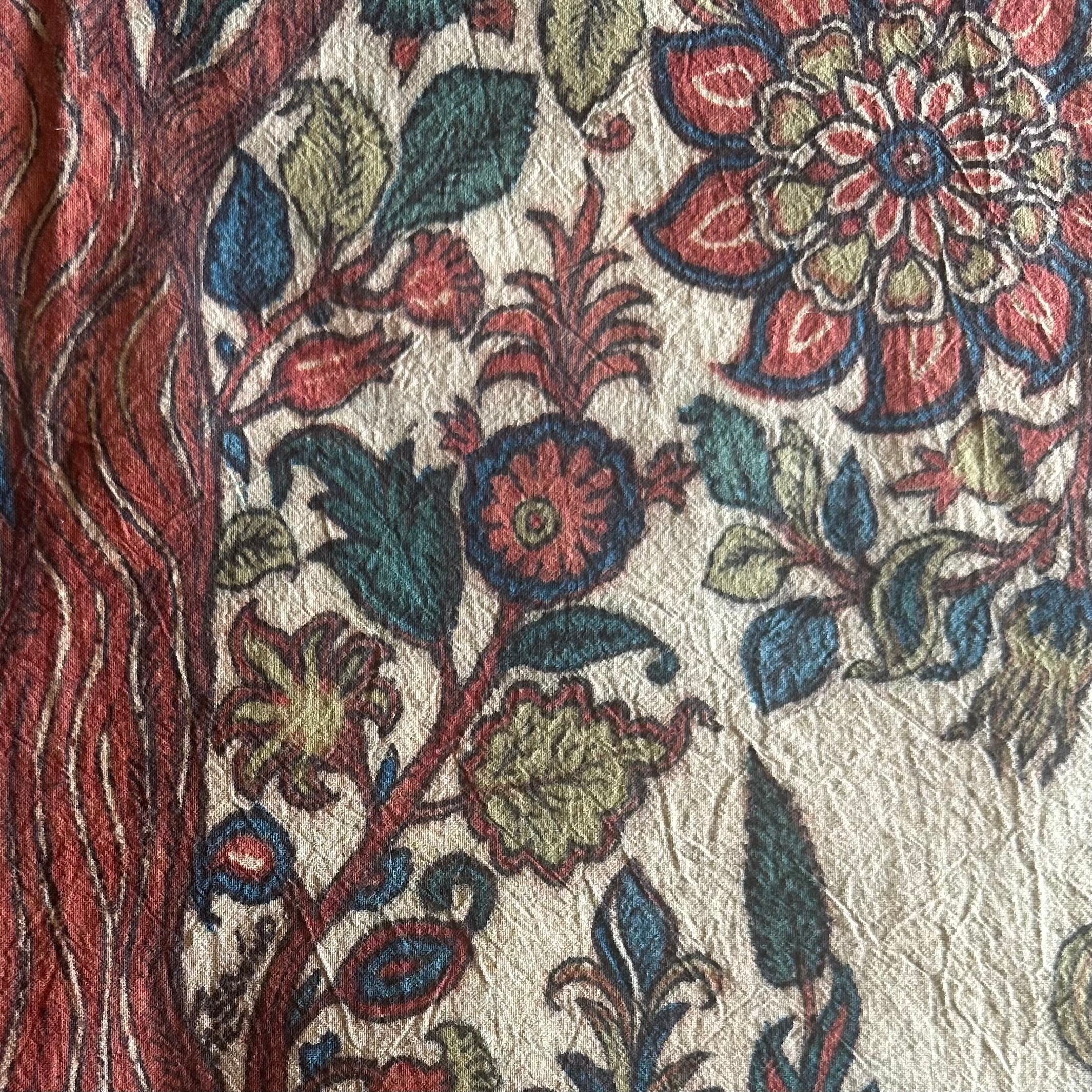
In my own journey with craft, I have had the privilege of working closely with one of the finest Kalamkari artists of our time. Over the years, I observed not just my own interactions with him, but also how he engaged with many others who came to purchase his work. When asked about price, his response was almost always the same, delivered gently and without hesitation: “Amma, you give what your heart desires. Whatever you feel is right.” I have seen someone hand him ₹5,000 for a piece, and I have seen someone else hand him ₹40,000 for a similar work. In both moments, he accepted the payment with grace and gratitude. There was no outward judgement, no visible comparison.
It was only later, through deeper conversations and moments of reflection, that I understood what those exchanges truly meant to him. He remembered every instance, not as a number, but as a feeling. He spoke emotionally about how it felt when someone valued his work generously, and just as poignantly about how it felt when they did not. These moments stayed with him because they were never merely about money. They were about recognition, dignity, and being seen. That was when it became clear to me that buying a handcrafted object is never a neutral transaction. It is always a relationship, one that can affirm or diminish, uplift or wound. And whether we acknowledge it or not, it becomes part of what we have done as human beings in our lifetime.
This realisation did not come from a single experience alone. Over time, through conversations with artists across regions, disciplines, and traditions, I heard the same truth echoed repeatedly in different ways. The stories varied, the circumstances were different, the amounts and people involved were never the same. And yet, the emotional response was uncannily consistent. Every artist remembered the moments when they were truly seen, and every artist remembered the moments when they were not. Craft remembers. People remember. These memories, often carried quietly, shape the health and continuity of the craft ecosystem.
At the Ambassadors of Heritage & Crafts Foundation, this understanding lies at the heart of our philosophy. People remain foremost, and relationships remain foremost. We do not view patronage as a transaction, but as a long-term responsibility. The price stated by an artist is not a bargaining point; it is an assertion of self-worth, lived experience, and reality. To honour that price is not an act of charity, it is an act of respect. And when this respect is extended, the one who pays is rewarded with far more than what is exchanged. They receive trust, continuity, and the privilege of becoming part of a living human story.
As ambassadors and patrons of heritage and craft, we are constantly assessing ourselves and the paths we choose. Do we seek the cheapest possible way to produce craft, or do we choose a path where craft is made with dignity, where artisans are remunerated consciously, often beyond survival—and where the benefits of creation are shared and celebrated across the ecosystem? Craft is not a bargain, and there is no victory in acquiring it cheaper. True participation lies in choosing responsibility over convenience, relationship over transaction, and legacy over accumulation.
At AHC Foundation, we believe that the choices we make today determine whether craft remains a living, breathing force tomorrow or becomes a hollow relic detached from its makers. When we centre people over objects, craft becomes ethical. When we honour the human spirit behind making, craft becomes sustainable. And when we choose consciously, craft becomes a source of hope, for artisans, for communities, and for generations yet to come.

Written by Effie Thomas