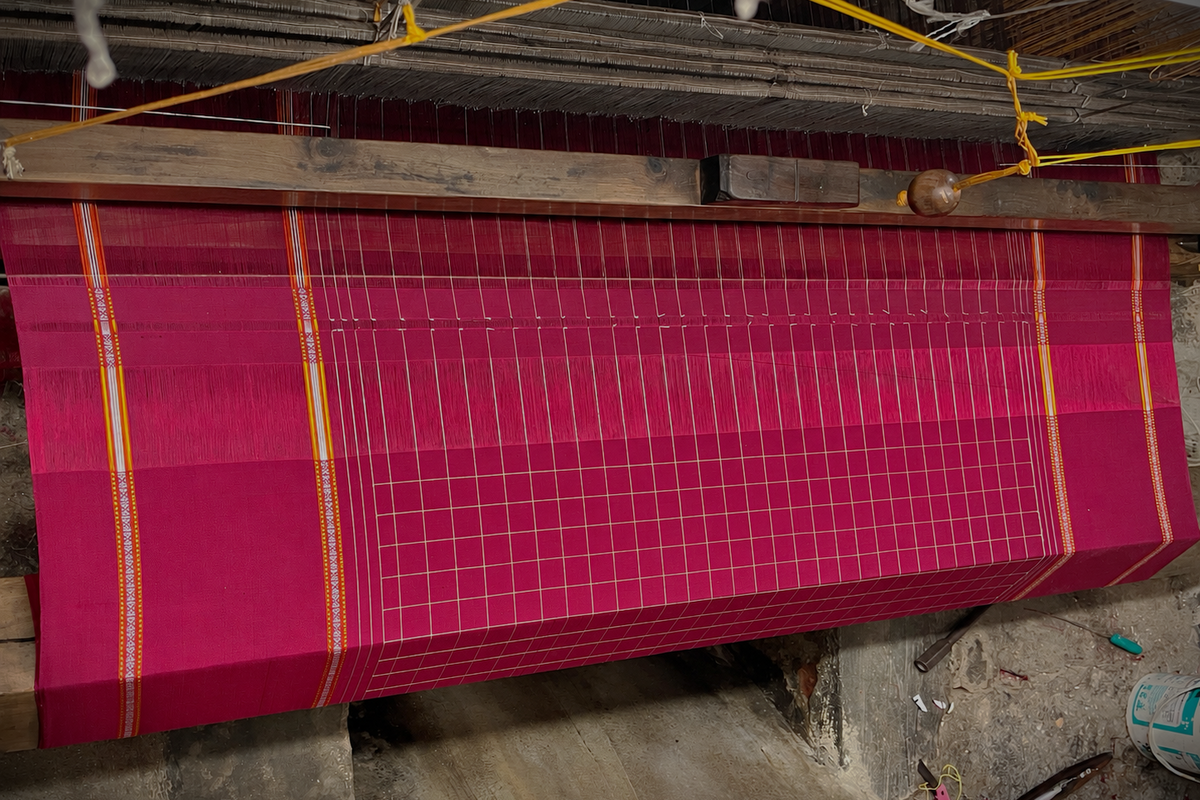
An exploration of people, knowledge, design and the possibilities of making.
The Thought Behind Independent Works
At Parvai, our understanding of craft has been shaped by years of working with artisans, travelling through weaving communities, studying textiles and participating in their development. These experiences have revealed extraordinary differences in materials, tools, techniques and cultural expression, but also a remarkable commonality in the lives of the people who make things. The discipline of mastering a skill, the patience of repetition, the pride of good work and the uncertainty of sustaining a livelihood are experiences we have encountered across India.
We have also come to recognise that a craftsperson’s knowledge is often much larger than the particular textile for which their community or region is known. A weaver who has spent decades in a cooperative society or weaving cluster carries an understanding of yarn, tension, construction, loom adjustments and production challenges that can be applied in other contexts. That knowledge remains valuable when the practitioner retires from regular commercial work or moves away from the system in which it was acquired.
Parvai | Independent Works has emerged from these observations. It is our dedicated practice in textile research, design development and independently arranged production. It sits alongside our work within established weaving clusters, but serves a different purpose: to bring together experienced practitioners, people interested in learning and knowledge drawn from different practices to explore new possibilities in making. The identity of a finished textile emerges from its design, construction, workmanship and quality—not merely from the address of its loom.
Why We Established Independent Works
Commercial weaving programmes understandably depend on agreed designs, production schedules, quantities and predictable outcomes. Research does not always proceed in this way. An enquiry into an unfamiliar construction may demand repeated trials, revised specifications, different materials or the abandonment of an initial idea. We wanted an environment in which that uncertainty could be accommodated, and where learning could be valued alongside a finished sari.
A project may begin with a question about how a border is constructed, how yarn behaves in a different density, how a motif might be executed through another technique, or how a loom could be adapted to achieve a particular effect. Such questions cannot always be answered from drawings or documentation. They require hands-on experimentation, observation and discussion with the people who understand the equipment and materials.
Independent Works also opens a space for those interested in studying a particular weave, design or construction through practical research. We value historical and academic documentation, but recognise the distinct knowledge that comes from preparing a loom, testing a structure and understanding why it succeeds or fails. Not every enquiry must produce an immediately saleable textile. The findings themselves may improve later work.
People, Experience and the Opportunity to Learn
We seek opportunities to collaborate with artisans who have spent years within traditional clusters, cooperative societies, family workshops and other established production arrangements, including practitioners who have retired or stepped away from regular commercial weaving. Their technical judgement has been shaped by years of repetition, adaptation and problem-solving. An experienced weaver may understand a loom’s limitations instinctively or recognise a more effective way to achieve a design before the first trial is complete.
We are equally interested in people who have not inherited weaving as a family occupation but wish to acquire skills or explore textile making as a possible livelihood. Craft competence requires aptitude, discipline, practice and access to good instruction; it need not be assumed to belong exclusively to a hereditary community. A learner may begin with materials and pre-loom preparation, gradually participating in more demanding stages of production as ability develops.
The roles of experienced artisans and new learners are not interchangeable. Each brings a different contribution, and each needs a working arrangement appropriate to their abilities. We do not assume every participant will become a professional weaver, but we believe that providing opportunities to learn and to continue practising is worthwhile in itself.
A Studio Defined by Its Work, Not Its Address
For Independent Works, the studio is a production environment rather than necessarily one fixed building. A project may take place within our existing facilities or in a dedicated space established where an artisan is able to work. This flexibility is especially valuable when collaborating with senior practitioners who are no longer attached to a cluster-based commercial arrangement.
Parvai undertakes the setup and financial commitments required for these projects: looms and loom accessories, pre-loom arrangements, raw materials, technical development, design direction and production coordination. Participating artisans are not expected to finance the equipment or materials required for our experiments. The risk of a trial that needs repeating or a design that requires revision belongs to the initiative commissioning the research.
This is not an absence of standards. It is a way of making room for technical rigour without requiring the individual craftsperson to bear the cost of uncertainty. The artisan’s time and knowledge remain valuable whether a trial meets its original objective or reveals the need for a different approach.
Design as Enquiry and Collaboration
We approach design as a conversation between an idea and the practical intelligence of making. A drawing may suggest a particular motif, border or fabric character, but the loom and the materials will determine how it can be realised. A weaver’s observations may change our original specification; a material trial may reveal a better solution; an unfamiliar construction may lead to a new design direction.
Independent Works can draw upon methods developed in different weaving traditions without claiming that every component is newly invented. Textile knowledge has always been refined through collective practice, adaptation and exchange. We acknowledge the sources of techniques and the contributions of makers, while taking responsibility for the specific design enquiry, combination of methods, infrastructure and production decisions that constitute a Parvai original.
Innovation is not a value in itself. A more elaborate technique is worthwhile only when it serves the fabric, advances understanding or creates a meaningful result. We are interested in sound construction, appropriate materials, thoughtful design and the ability to explain why each decision has been made.
An Independent Loom in Practice
One recent project illustrates this approach. We are working with a senior silk weaver operating independently from a home-based loom. The sari uses a two-ply mulberry silk warp and a five-ply mulberry silk weft, with zari specified with a two-gram gold coating. Floral medallions sit within square frames, with motifs individually woven through jacquard-assisted patterning on a pit loom. The weaving work is estimated at approximately twenty-three days.
The interest of this project is not simply the intricacy of its motifs or the number of days at the loom. It lies in bringing a senior practitioner’s accumulated skill into an independently arranged design and production exercise. Rather than allowing the loom’s location to determine a traditional label, we describe the sari through its actual materials, structure, motif development and execution.
This example is one part of a wider direction. Other Independent Works enquiries may focus on learning, loom adaptations or material trials and may not yet have a finished product to show. We intend to distinguish clearly between completed work, projects under development and future ambitions when documenting the collection.
Quality: Product, Craftsperson and Process
We consider quality across the entire course of making. In the product, it means appropriate yarns, a considered warp-and-weft construction, sound motif execution, reliable finishing, good drape and comfort in use. A sari must work as a sari. Technical difficulty alone does not justify a higher valuation, nor does a familiar regional name guarantee the quality of an individual piece.
In the craftsperson, quality includes technical judgement, consistency, problem-solving and the capacity to apply experience thoughtfully. These strengths may differ from one practitioner to another. We seek to recognise the person and the skill rather than treating an inherited occupational identity as a complete measure of ability.
In the process, quality means adequate equipment, appropriate materials, realistic development time, transparent documentation and respectful working arrangements. Parvai carries the financial responsibility for the infrastructure and research it initiates. These principles are inseparable from the integrity of the finished textile.
The Patron’s Place in Independent Works
Independent Works also invites our patrons into a more technically informed understanding of textiles. We want the conversation to go beyond a familiar weave name or a claim of rarity. Why was this yarn selected? How was the loom prepared? What does the construction contribute to the weight or drape? Which parts required trials, and what did those trials teach us? These are questions that help explain the value of a sari through the work itself.
Our documentation aims to record materials, construction, technical decisions, the people involved and the stages of development. We hope this enables patrons to make informed choices and to appreciate the individual qualities of a textile without relying entirely on inherited associations or marketing language.
Patron participation can also be meaningful after the sari leaves the loom. Thoughtful observations about wear, comfort, maintenance and design can inform subsequent work. This does not shift responsibility for design or quality to the buyer. It makes the relationship between maker, textile and wearer more informed and personal.
A Distinct Practice Within Parvai
Our cluster-based projects continue to engage with the histories, technical vocabularies and established practices of particular weaving traditions. Independent Works is not a substitute for that work, nor a claim that regional identities are unimportant. Those identities provide vital cultural and historical context and deserve careful acknowledgement.
This initiative has a separate remit. It enables us to establish production arrangements independently, draw on skills from different backgrounds and pursue research without requiring the outcome to conform to a prescribed regional format. The two approaches complement one another and are guided by the same commitments to fair working conditions, transparent communication, technical integrity and useful, well-made textiles.
What Makes an Independent Work
We understand an Independent Work through five connected considerations: the quality and functionality of the finished textile; the skills and dignity of the people involved; the integrity of the process; the research and design perspective behind it; and the patron’s informed engagement with the result. None can be reduced to a geographical label or an elaborate description.
The term “Parvai original” does not suggest ownership of generations of inherited techniques. It refers to the particular design direction, development work, production infrastructure and collaborative decisions through which a textile is brought into existence. Its place of making and the contributions of individual practitioners remain part of its record.
Looking Ahead
Independent Works will grow through the questions we ask, the people who join our enquiries and the knowledge we gain. Some projects will bring experienced artisans into unfamiliar areas of design; others may offer new practitioners opportunities to learn. Some will produce finished saris, while others will remain valuable technical studies. We intend to document both the outcomes and the decisions that lead to them.
Our responsibility is to provide the conditions for purposeful exploration: the infrastructure, resources, time and working arrangements needed to test ideas without passing the financial burden of our experiments to the artisans involved. We hope that the resulting records will be useful to our future practice and will give patrons a fuller account of the work behind each textile.
Ultimately, Independent Works is not defined by the number of saris produced, but by the quality of our enquiries, the integrity of our processes, the opportunities we create and the value of the textiles that emerge. It is our continuing commitment to making with curiosity and responsibility, respecting inherited knowledge while allowing it to find new applications.
Parvai | Independent Works is an exploration of what we can make, how we can make it better, and the people with whom we can make it possible.


