Project Shashikala
Craft, Continuity, and the celeration of a mother and daughter's love for craft
Some saris do more than clothe us; they anchor us. They become touchstones of who we are and where we come from. They remind us that craft, when lived through generations, becomes a form of shared language, a quiet, evolving dialogue between mothers and daughters. These are the saris that gather meaning with time, not because they age, but because the relationships around them deepen.
In early 2024, one such sari became the heart of a new journey for Vidhya Raghunathan and her mother, Shashikala. The sari, woven in the early 1980s, had long been a familiar presence in their home, a piece that Shashikala wore with characteristic ease, the kind of elegance that leaves an imprint on a child’s imagination. Its colours, its borders, and the way it carried itself on her became part of the visual vocabulary that shaped Vidhya’s own appreciation for craft.
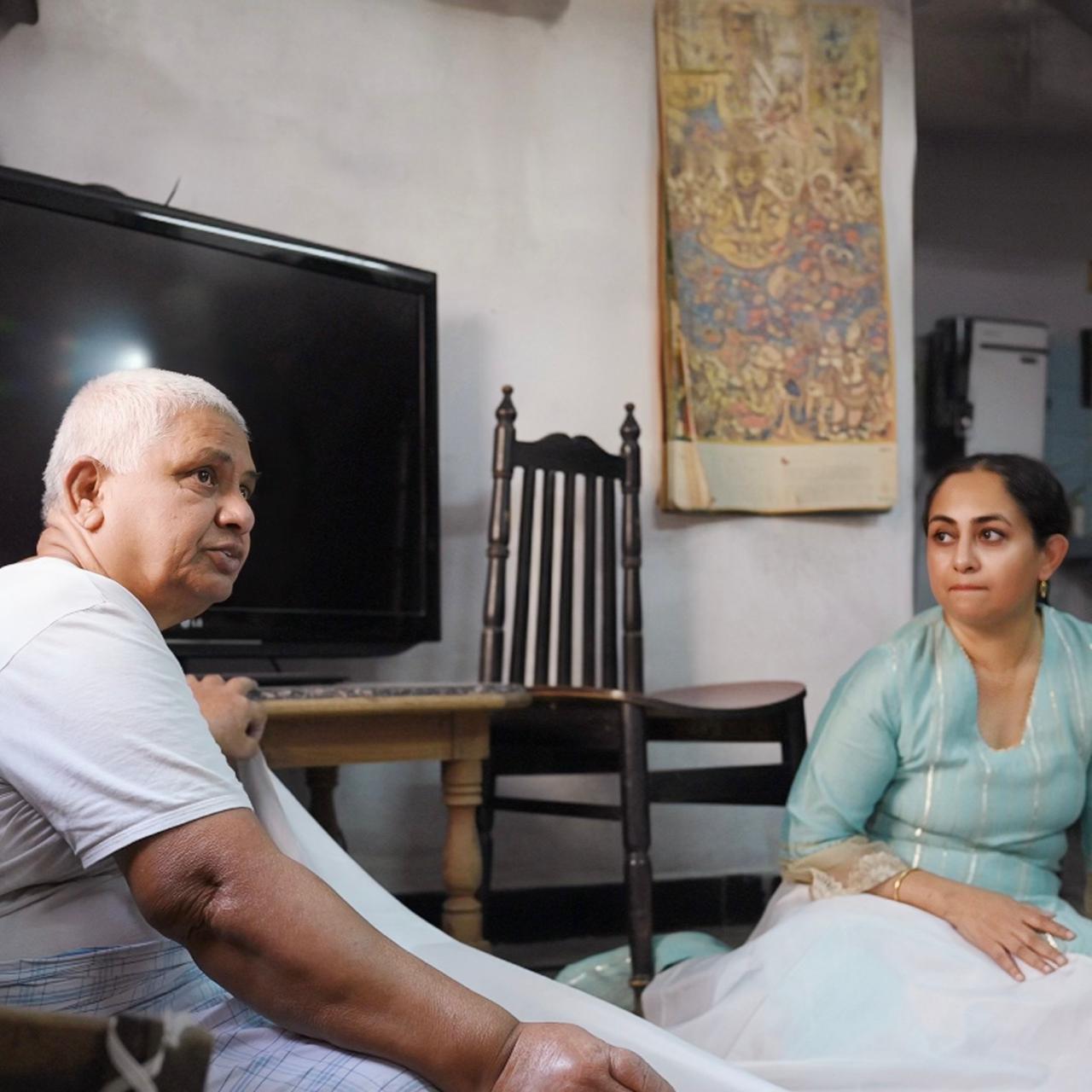
But what makes this story special is that Shashikala is not a distant figure from the past. She is present today, warm, spirited, and deeply engaged with the world, with a sense of style that continues to inspire her daughter. The conversations between them about saris, craftsmanship, and design are ongoing and alive. They discuss colours, compare weaves, and revisit memories tied to the textiles they’ve lived with. Craft, for them, is not nostalgia; it is a shared, living interest that travels across years.
The sari that now forms the foundation of Project Shashikala is woven from this relationship of presence and participation. When Vidhya brought the sari to the Ambassadors of Heritage & Crafts Foundation and Parvai, she was not trying to preserve something fading. She was exploring a way to carry a cherished piece forward , not as a replica, not as a tribute, but as a continuation. A way for mother and daughter to stand together in the present, celebrating the craftsmanship that they have both admired for decades.
The original sari was a classic Kanchipuram silk, woven in a period when artisans worked with a sense of grounded confidence that defined the city’s weaving aesthetic. Its wide korvai borders, its seepu reku pallu, and the disciplined scattering of adai-woven neelavattam motifs spoke of a time when proportions were bold and techniques were uncompromising. This was not a ceremonial sari kept for special occasions , it was a sari woven for presence, for everyday grace, and for the rhythm of a woman’s life.
Shashikala wore it exactly as it was meant to be worn, not cautiously, but naturally, allowing the sari to become a part of her personality. And as daughters often do, Vidhya absorbed the details: the way her mother chose her colours, the sensitivity with which she handled her fabrics, the intuitive knowledge she had of what suited her, and the comfort with which she carried tradition without announcing it.
Recreating this sari, therefore, was less an act of looking back and more an act of looking with, with her mother beside her, with her mother’s presence still defining her aesthetic sensibilities, and with a shared enthusiasm for the legacy of Kanchipuram weaving.
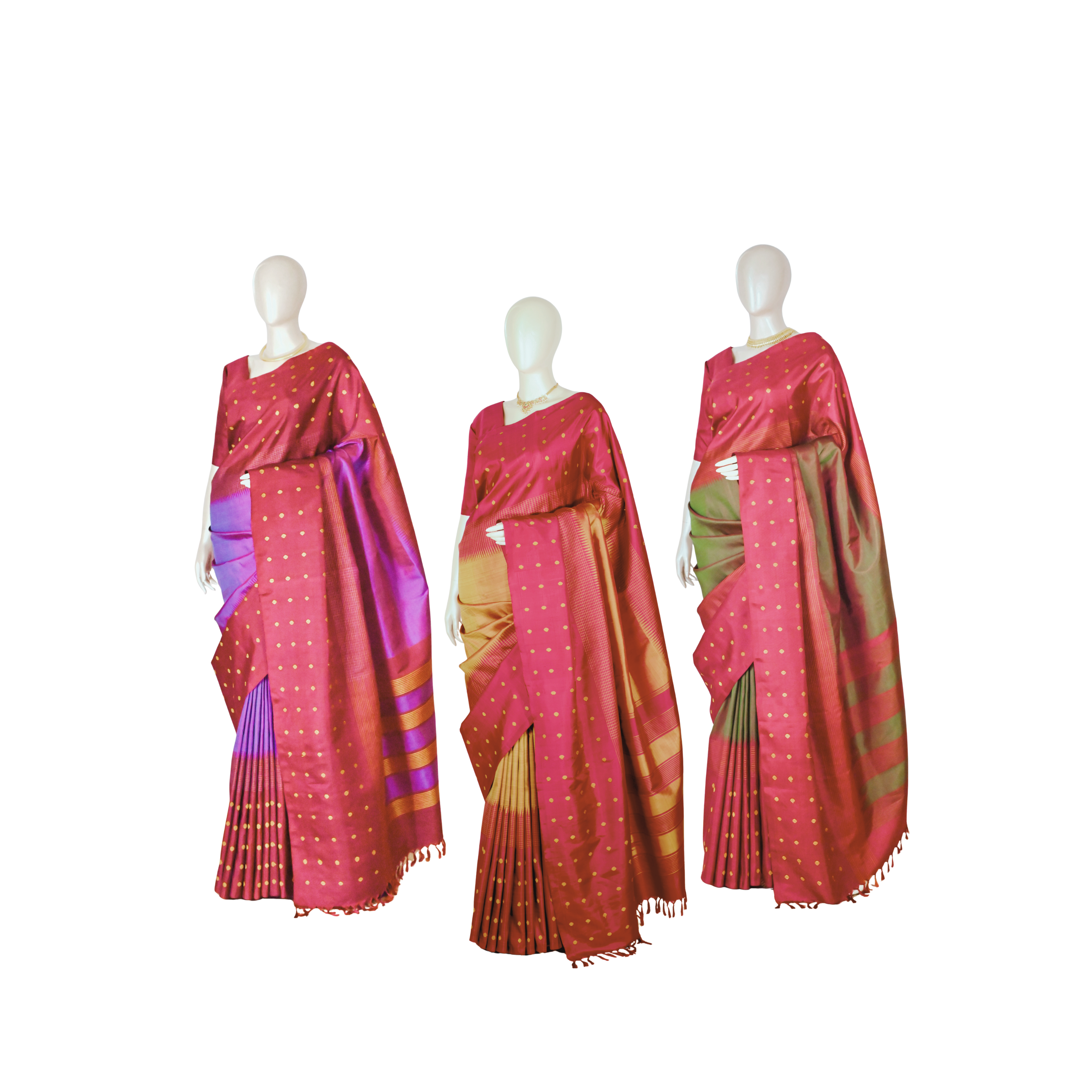
The recreation unfolded on a traditional three-shuttle korvai loom in Kanchipuram, mirroring every nuance of the original. The reddish-blue body, luminous and alive, was developed to echo the shade that had always complemented Shashikala so beautifully. The borders, fourteen inches wide were reconstructed with the same intelligent exactness: the expansive outer section populated with 870 adai-woven neelavattam motifs, each placed with mathematical rhythm, and the inner band composed of tightly-held checks that gave the border its balance.

The two-centimetre saw-tooth korvai line, sharp and unfaltering, was woven with the kind of mastery that comes from deep concentration and historical understanding. And the pallu, at twenty-four inches, revived the musical geometry of seepu reku, a design that mother and daughter both loved for its structure, dignity, and sense of continuity.
Over sixty days, more than fifteen artisans contributed to the process: dyers who matched tones with meticulous patience, card cutters who mapped the adai motifs, warpers who measured continuity into threads, petni workers who prepared the joints, young women learning adai weaving, and a senior master weaver who guided the loom with the assurance of decades. It was a collective effort, carried forward not by sentiment, but by shared respect , artisans honouring a craft, and a mother and daughter honouring a legacy.
When the sari came off the loom after forty-eight days of weaving, it felt like the completion of a circle. Not a circle of memory, but of continuity. A mother’s aesthetic, a daughter’s admiration, and a craft tradition they both love had converged into a new piece of silk. This new sari is not meant to replace the old one. It stands beside it, a companion piece, a continuation of the same thread, a reaffirmation of a craft lineage that Shashikala lives and that Vidhya now carries forward.
Project Shashikala is ultimately a celebration of this living connection. It is about the way mothers shape our sense of beauty without instructing us, the way daughters carry these impressions into their adult lives, and the way a craft like Kanchipuram weaving becomes a quiet but powerful part of a family’s identity. This project does not speak of tribute or remembrance. It speaks of continuity, of two women, both present, both engaged, both celebrating the artistry that has woven its way through their shared years.
To hold this sari is to touch a story that is still unfolding , a story of two generations standing side by side, celebrating a craft that continues to shape their lives, not as memory but as a living


Written by Effie Thomas