Never Fully Told: In the Quiet Company of Kailasam and Kamalamma
Never Fully Told: A Journey with Kailasam, Kamalamma and Me
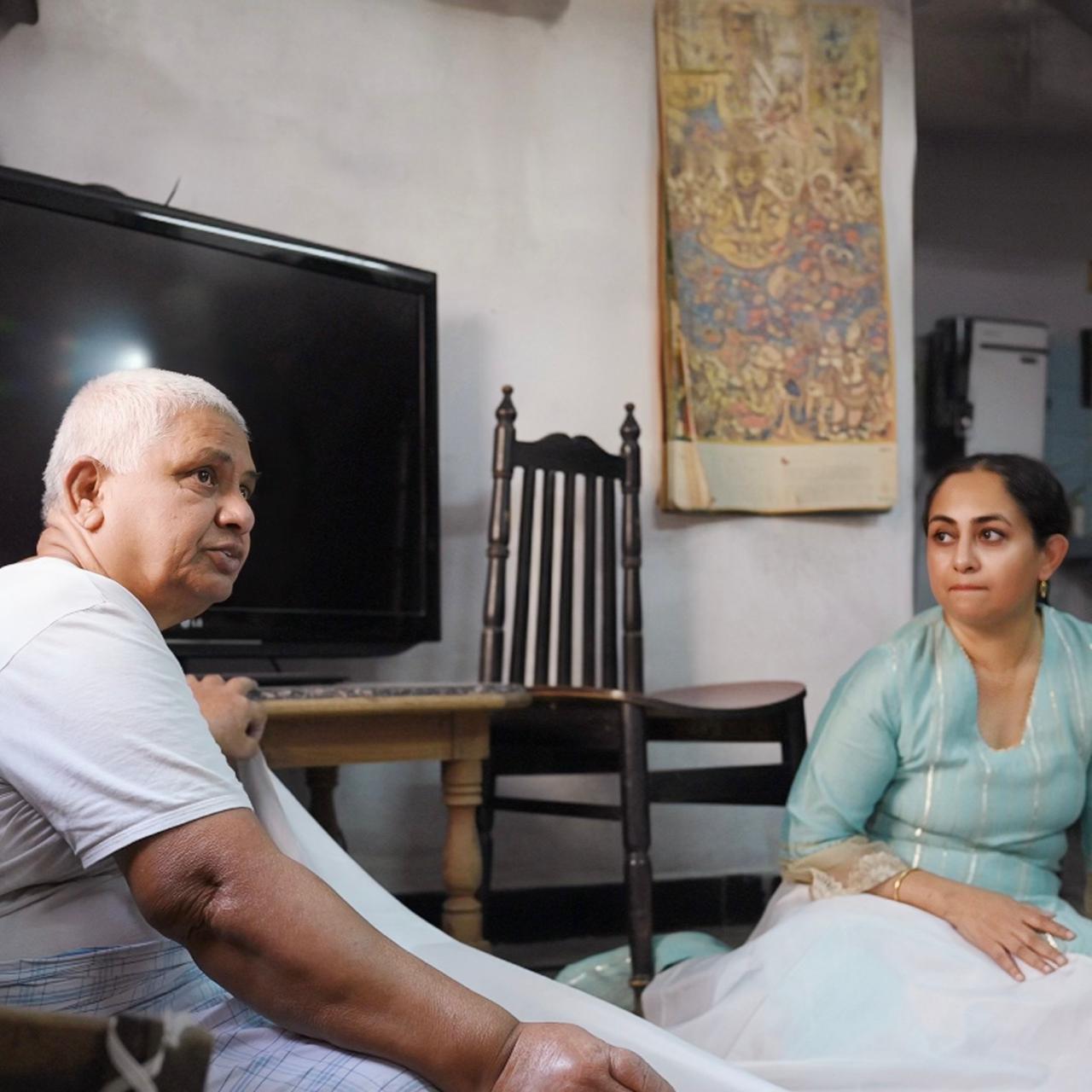
My journey with M. Kailasam began twelve years ago, on a day that now feels like the quiet opening of a chapter I did not yet know would shape the soul of my craft journey. I still remember walking into that busy, densely populated residential area in Srikalahasti, children running, scooters passing, families calling to one another from balconies, the hum of everyday life rising and falling like a soft tide. Down a narrow, winding lane that seemed to fold into itself stood his three-storey home, modest yet filled with the unmistakable signs of a life devoted to art. Framed photographs of him receiving awards lined the walls, trophies glimmered in small glass cupboards, calendars featuring his own artwork hung alongside shelves stacked with natural dye materials, and in one corner sat his low wooden desk, brushes arranged neatly, bowls of colour beside him, the air scented with harda drying on freshly washed cloth. The whole space felt suspended in a timeless rhythm. And there, in the middle of that stillness, sat Kailasam, the unassuming custodian of Padmasaliyar heritage, a lineage whose ancestors had wove hand-spun, handwoven cotton for generations. Born in 1947, the seventh among ten siblings in a family whose life revolved around looms, he had the choice to follow the family tradition of weaving or step into art. Quietly, courageously, he chose the brush. His destiny, it seems, found him early.
The Making of a Master
Kailasam received his initial training under Shei A. Munikrishnaiah, one of the most respected master craftsmen of the Srikalahasti Kalamkari tradition. Under his mentor’s watchful eyes, he learned not only technique but also discipline, the strength of a steady line, the patience required to build a composition, the humility demanded by natural dyes.

He then underwent two years of formal training at the Kalamkari Art Training and Production Centre in Srikalahasti. Later, he received advanced training in vegetable dyes at the Regional Technical Development Centre in Bangalore. Through years of experimentation, he mastered countless shades of natural colour and became known for creating new palettes within the constraints of traditional dyeing. Kailasam carries within him an extraordinary depth of knowledge of Hindu, Christian, Islamic, and Buddhist texts. This spiritual and philosophical range breathes life into his work, allowing him to paint stories that belong not to one culture alone but to the many layers of India’s civilizational memory. His mastery led to his involvement with the Weavers’ Service Centre in Hyderabad, where he created several large panels for the celebrated Vishwakarma Exhibitions, including the 1982 Festival of India in London. For this historic showcase, he produced more than a dozen exclusive compositions, portraying mythological and philosophical themes from across religions: Hindu epics, Biblical narratives, Quranic verses, and Buddhist stories. These works established him not only as a Kalamkari artist but as a custodian of India’s pluralistic visual traditions.
A Golden Era Under Martand Singh

To understand Kailasam’s journey is to understand the cultural tide he lived through. His golden years unfolded under the visionary leadership of Martand Singh, whose revival of Indian textiles through the iconic Vishwakarma exhibitions changed the course of craft history. These exhibitions did more than display textiles; they resurrected traditions that colonialism, industrialisation, and changing economies had pushed to the margins. They restored dignity to weaving, dyeing, and painting traditions across India. As Open Magazine wrote, Singh “revived an entire civilisation’s textile memory,” bringing together scholars, curators, master artisans and weavers into a unified cultural assertion. Kailasam often tells me that standing inside this movement felt like standing inside history itself. Those years shaped him, the intense workshops, the discipline expected by Mapu, the intellectual depth of Pupul Jayakar and Kamaladevi Chattopadhyay, the rigour of G.V. Trivedi. It was during this time that he realised he was not just making fabric, he was carrying heritage.
The Beginning of “Us”

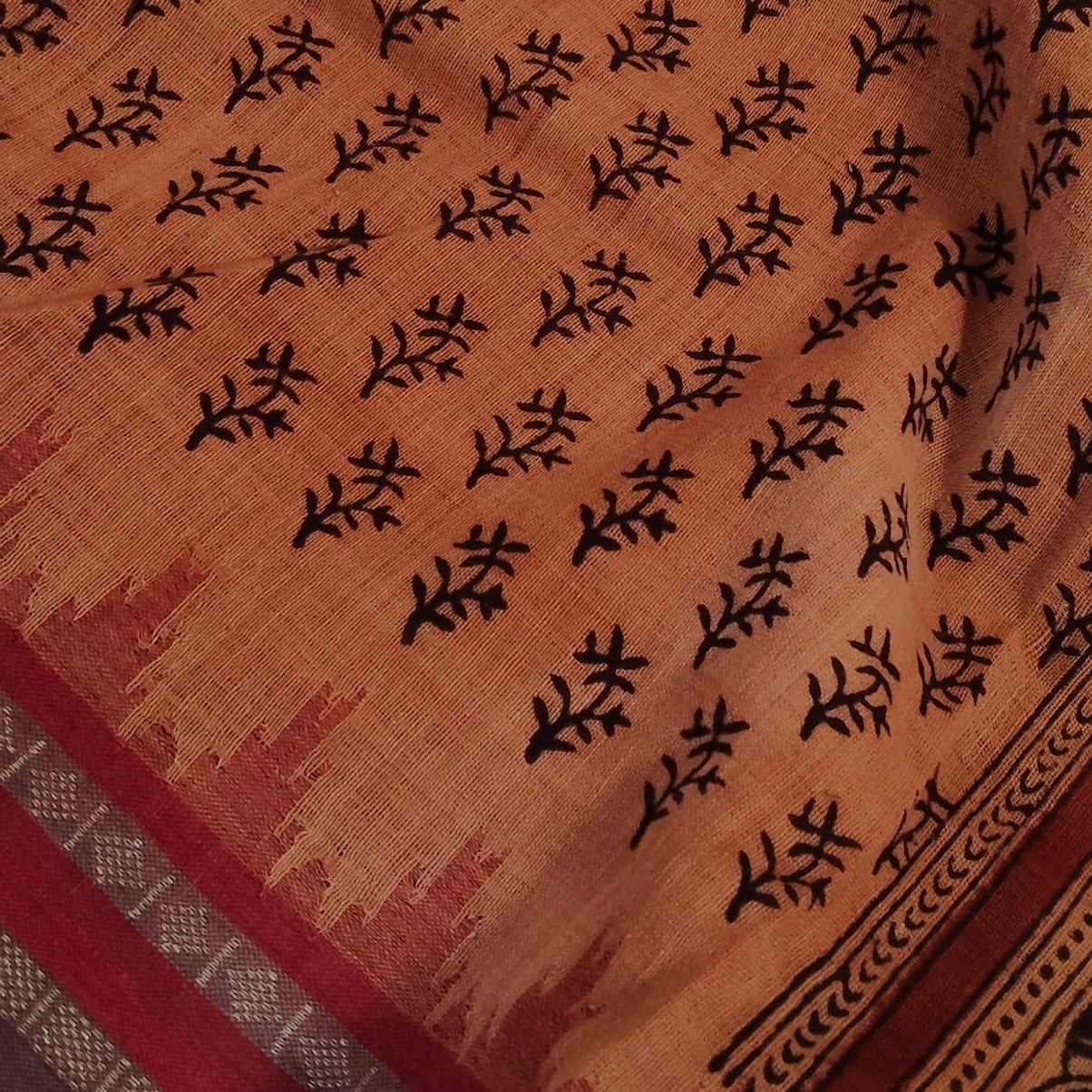
My first visit was meant merely to commission a piece for myself, to see the legend of Kalamkari with my own eyes. I had arrived overwhelmed, even choked, by the flood of so-called “rules” about what made Kalamkari authentic. People told me to smell the fabric, judge the sharpness of mordants, and seek the “real” scent of natural dyes. But it was Kailasam who dismantled every myth. Softly, patiently, he explained that the smell was only a small part of the preparatory process, not the essence of the art. He showed me that Kalamkari was about the finesse of the line, the unbroken stroke that carries generations of discipline. It was about the recipes of colours perfected through trial, error, and devotion. It was about the secrets of containing pigments on cloth, the intuition of knowing when to let colour breathe and when to restrain it. Above all, he taught me that Kalamkari was about imagination, the courage to see a story before it exists. I thought I had come to see art; instead, I met the artist. And through him, a universe I had not known my heart was waiting for.
Twelve Years of Work, Silence, Faith
What began as a single commission slowly matured into a rhythm of shared work, shared silence, shared reverence. Together we created pieces that travelled far beyond that winding lane: to Chennai and Singapore, Dubai and California, London and Sydney. Each piece carried not only his mastery but also the warmth of a partnership built slowly and honestly. Over time, Kailasam and his wife Kamalamma became family. We barely spoke each other’s language, yet we understood one another through gestures, smiles, hesitations, and silences that communicated more clearly than words ever could. We learned to hear each other without sound. In these twelve years, I have heard countless stories of his childhood, his family, his tryst with the Festivals of India in 1982, his work with national leaders, and his friendships with designers, curators, and fellow artists. I learned of Suriya Appa’s invaluable influence, of clients who taught him, supported him, challenged him, and shaped him. Through all this, he never once carried resentment. “The good and the difficult,” he often says, “both made me who I am.”
The Difficulties of an Artist

Understanding art through the difficulties an artist faces is, I now realise, a turning point in a patron's life. It certainly was for me. To admire a finished Kalamkari piece is one experience to marvel at its beauty, its finesse, and its storytelling. But to understand what it costs the artist to create it is something else entirely. It is a different kind of awakening, one that alters the very way you see a work of art. In my own journey with Shri M. Kailasam, it reshaped my eyes, my ethics, my gratitude, and the responsibility I carry as a patron.
Over twelve years of conversations, silences, shared work, and shared spaces, I have come to understand the invisible burdens that accompany his mastery. The first and perhaps the most painful struggle he speaks of is recognition. In today’s world, where the value of art is too often determined by markets rather than mastery, the artist himself becomes invisible. The wearer’s name takes precedence, the curator’s voice becomes louder, and the maker, the one who breathes life into the cloth, slowly disappears behind the finished work. Kailasam speaks of this without bitterness, almost philosophically, but beneath his words lies the quiet ache of someone who has spent a lifetime wondering whether the lineage of Kalamkari artists will be remembered or dissolve into anonymity.
Then there is the shifting availability and integrity of resources, which form a constant, unpredictable struggle in his practice. Cloth, something so foundational to Kalamkari, has changed profoundly over the years, its weave, texture, finishing, and chemical treatments altered by industrial processes. These seemingly small changes drastically affect how dyes behave, how lines hold, and how the narrative settles on fabric. Natural dye materials, too, have become inconsistent, unpredictable, and in many cases, challenging to obtain. Their quality varies by season, region, and source, turning each colour into an act of negotiation rather than a matter of certainty. These shifts threaten an entire process built on predictability, patience, and deep, embodied knowledge.
Commercialisation brings another kind of sorrow. When art is forced into mass production, the soul is the first casualty. The craft becomes a commodity, imagination gets replaced by templates, and discipline is overshadowed by speed. For someone like Kailasam who lives each line, each colour, each wash with devotion this dilution of craft is painful to witness. He speaks of it with the sadness of someone who has watched a sacred tradition being reshaped by pressures that have nothing to do with art.
Cheap copies form another wound, one that few artists speak of openly. He has seen his work traced, scanned, block-printed, screen-printed, and sold at a fraction of its value. There is nothing he can do to prevent it, and he tries not to dwell on it, but I see in his eyes how deeply it hurts. The pain is not rooted in pride or ownership but in the knowledge that imitation strips away the devotion, discipline, and surrender that form the essence of his original work.
Patrons, too, pose their own challenges. Not all patrons see or understand the artist. Many fixate on the smell of harda, the sharpness of natural dyes, or the visible steps of the process, believing these markers represent authenticity. He gently corrects them, explaining that these are only preparatory steps, not the soul of the art. “The art is not the smell,” he once told me. “The art is imagination.” For him, the true miracle of Kalamkari lies in the freehand line that is a steady, unbroken stroke born of memory, intuition, devotion, and grace. But most patrons focus on what is seen, not what is felt.
Monetary value presents another quiet struggle. Kailasam admits, with a shy laugh that always carries a hint of vulnerability, that he does not understand the world of money. He does not know how to price imagination or effort. He remembers a time in India when princely patrons understood value instinctively, when the relationship between artist and patron was governed by mutual respect. Today, he sometimes hopes, uncertainly, that those who receive his work will recognise its true worth and respond with fairness.
One of the most haunting realities he speaks of is the absence of documentation. Decades of his work, hundreds upon hundreds of exquisite pieces, now reside in museums, institutions, exhibitions, archives, private collections, and homes across the world. Yet he has no record of them. No photographs. No catalogues. No files. He says he could have documented everything had someone guided him earlier, but now those works are out of his hands forever. “It is not around me anymore,” he says softly. “I have no access to it.” This truth shifted something inside me. It deepened not just my respect for his craft but my responsibility toward it to honour not only the art but the artist, to preserve not only the piece but the hand that created it.
Beyond these, another layer of difficulty arises from time itself. The world in which he learned Kalamkari no longer exists as it once did. Environmental changes have altered everything. He speaks often of water, how the rivers and wells that once offered mineral-rich water ideal for natural dyes have transformed in composition. The hard water of today behaves unpredictably with alum, iron, indigo, and harda. Colours that once bloomed effortlessly now demand patience, adjustment, and faith.
Even the cloth has changed. Finding organic cotton or chemically untreated fabric has become increasingly complex. And even the slightest alteration in texture or finish affects the entire process, how the dye enters, how the line settles, how the composition breathes. Natural dyes, too, no longer remain consistent, requiring experimentation with each new piece.
Weather conditions have become one of the most unforgiving challenges. The sun, once his greatest collaborator, no longer behaves predictably. Monsoons stretch longer, summers grow harsher, and the windows of workable climate shrink each year. “I cannot work as many hours or days as before,” he says. “The weather does not allow it.” Yet even as time and climate test him, he refuses to accept stopping as an option.
When he speaks of his youth, his eyes brighten, as though lit by memories of a different world. He remembers how he devoted his youth to Kalamkari, creating hundreds, even thousands, of pieces for museums, labour centres, government institutions, national exhibitions, private designers, and international agencies. He poured his entire life into his brush, never imagining a world where his body might slow while his mind remained wide awake with ideas. Today, even at this age, he does not feel he can stop. He does not want to stop. He often says that as long as there is even one right patron, one person who sees the artist before the art, he will continue. He will work. He will paint. He will dream. “Art leaves me only when I leave it,” he says gently.
And then came 2019, the year life suddenly halted. In a life filled with struggles, this was the most devastating. A life-threatening accident fractured his right arm and right foot, leaving him unable to move the very limb through which his art lived. For a man whose identity was inseparable from the movement of his hand, the injury was shattering. It severed not just mobility but continuity, rhythm, and purpose. He spent nearly three long years in recovery, three years without touching his Kalamkari tools, three years separated from the practice that had defined him for decades. He describes this period as being “derailed,” as though the path he had always travelled had disappeared beneath him. Yet even in that excruciating uncertainty, he held on to hope. He believed that if he survived the accident, he would one day coax his arm back into movement. “Perhaps God wanted me to rest,” he tells me. “I worked very hard all my life. Maybe those three years were the rest I never took.” There is no bitterness in his words, only acceptance shaped by faith. And then, a miracle. His right arm never fully recovered; he still cannot lift it naturally. But his fingers, the very instruments of his art, regained complete functionality. His doctors remain baffled by this unexplained recovery. To this day, there is no medical explanation for how his fingers retained their precision and grace.

And so, he paints differently now, in a way only he can. He lifts his right arm with his left hand, moving it carefully from the ink pot to the cloth. He lowers it onto the canvas, and then his fingers, steady, deliberate, alive, begin to move. When he needs to change his position at work, he again uses his left hand to reposition his right arm. Watching him paint is to watch a kind of faith made visible, a devotion that transcends physical limitation. Despite every challenge, he has not surrendered to despair. He looks at life with the same steady hope, the same exuberance, the same childlike enthusiasm that has defined him from the beginning, an enthusiasm so pure, so unbroken, that it humbles everyone who meets him. Parvai resumed work with him in 2022, after his long recovery. Since then, he has created nearly forty pieces, each one breathtaking, imaginative, and filled with the clarity and grace of his unmistakable line. His brush may have slowed, but his spirit refuses to. His fingers still tell stories. His lines still hold worlds. His art shows no trace of the difficulty his body endures. Kailasam’s life is not just a lesson in craft. It is a lesson in courage, in devotion, in resilience, in refusing to give up what you were born to do. It is a reminder that true art does not simply survive struggle; it is forged in it.
A 78-Year-Old Man Steps Into a New World.
One of the most heartwarming chapters of our journey unfolded recently, when he travelled to Dubai for the first time. At seventy-eight, he was as excited as a child and as proud as a man who had waited a lifetime for a moment quietly deserved. He told me he was the first among his artistic and community circles to travel abroad, and that thought filled him with joy that lit up his entire being. He spoke to everyone he met, sharing stories of his art, his lineage, Martand Singh, and Kalamkari. A visit to a small artisanal gold shop moved him deeply; he spoke fondly of his jewellery-making friends back home and proudly pointed to the handcrafted ornaments Kamalamma wore. He shopped, too, slowly and carefully, using the earnings he had saved from years of working with Parvai. Watching him, brimming with dignity, he whispered, “I feel recognised. I feel acknowledged.” Before leaving, he promised to return home and create even more magic. Journeys do not measure themselves in distance, but in grace.
A Journey Always Unfolding
Even now, when I think of where all of this began, I return to that narrow lane, the scooters, the children, the maze of homes, the hum of life, and to that small, warm house where time softened its pace. I remember walking up those steps and seeing him rise from his low desk with the same gentle smile that has anchored me for over a decade. Some journeys do not merely enter our lives. They stay. They shape. They hold. They continue long after the first meeting.
My bond with Shri M. Kailasam and Kamalamma is one such journey,
never fully told, constantly unfolding.
Effie Thomas
Founder
Parvai

Written by Effie Thomas