Article: Bagru: A Living Tradition of Colour, Cloth and Community
Bagru: A Living Tradition of Colour, Cloth and Community
Parvai’s continuing pursuit of traditional block printing, natural dyes, inherited design languages and the people who keep an extraordinary textile tradition alive.
A town that has held on to its craft
Some textile traditions are distinguished by their materials, others by their techniques. Bagru, a historic craft town near Jaipur in Rajasthan, is distinguished by an entire community of people whose lives, occupations and inherited knowledge have developed around the making of printed cloth.
For generations, Bagru has been associated with the Chhipa community, whose expertise in hand block printing, natural dyeing and textile preparation has given the town a distinctive place in India’s textile history. What emerged here was not simply a method of decorating fabric but a highly developed system of production, involving specialised skills, locally understood materials, inherited colour recipes and a design language closely connected to the social and cultural lives of the people who wore these textiles.
Historically, printed fabrics from Bagru served different communities across Rajasthan. Their colours, motifs, arrangements and uses were influenced by local customs, occupations and dress traditions. A printed cloth could be part of an everyday wardrobe, a community identity or a ceremonial occasion. Flowers, foliage, geometric repeats and borders formed a vocabulary that was familiar and meaningful long before printed textiles became fashionable products for a wider market.
At Parvai, we find this history particularly compelling. We are interested not merely in how a textile looks but in why it looks the way it does, who developed its design language, how its production evolved and how much of that knowledge continues to survive in the hands of practising artisans.
Our work with Bagru grows from this curiosity. We are constantly pursuing traditional methods, tracing older prints and colour combinations, learning from family archives and seeking to understand the interconnected community of specialists responsible for producing a piece of printed cloth.
Before the print, there is a process
It is easy to admire a finished hand block printed textile without recognising the preparation that takes place before the first wooden block touches the fabric.
In traditional Bagru printing, the cloth must first be prepared to receive colour. Raw fabric may contain starch, oils, sizing and other residues from weaving. These interfere with the absorption and development of dyes, and the fabric must therefore undergo washing, soaking and scouring before printing begins. Traditional preparation methods, including processes known as saaj, have used combinations of water, oils, alkaline materials and, in some practices, animal dung to cleanse and condition the fibres. The precise treatment varies between workshops, fibres and printing methods.
The prepared cloth may then be treated with harda, or myrobalan, obtained from the fruit of the Terminalia chebula tree. Harda is especially important because of its tannin content. It gives the fabric a characteristic yellowish cast and helps create the chemical conditions necessary for certain traditional colours to develop, particularly iron-based blacks. This is one of the fascinating aspects of natural dye printing. Colour is not always simply transferred from a container onto the fabric. It may be produced through a reaction between the fibre, a plant extract, a metallic mordant and a subsequent dye bath.
A cloth that appears pale yellow during preparation may eventually carry deep black and red impressions. Understanding how this transformation takes place requires familiarity with materials, their proportions, the quality of water, time and temperature. The preparatory work is therefore not secondary to printing. It is fundamental to its success.
Natural dyes: the knowledge of making colour
The natural dye traditions of Bagru are particularly remarkable for their understanding of plant and mineral materials and the ways in which these substances interact with cloth.
Traditionally, black is developed using an iron-based solution known as syahi. Iron is fermented with ingredients such as jaggery, producing an iron-rich liquid that reacts with the tannins already present in harda-treated fabric. The resulting colour can range from greyish black to a deep, almost inky tone, depending on the process and concentration.
Red is commonly associated with begar printing, in which an alum-based mordant is applied to the cloth and the colour is subsequently developed through a dye bath. Historically, madder and other dye-producing materials supplied the red colourants. The interaction between mordant and dye produces the warm reds, brick tones and terracotta shades closely associated with Bagru.
Indigo provides another important dimension to the region’s printing traditions. Unlike ordinary surface colouring, indigo dyeing requires the preparation and management of a reducing vat. The dyed cloth develops its familiar blue as the colourant oxidises on exposure to air. Repeated dipping can deepen the shade.
Harda contributes yellowish tones and tannins, while other materials, including pomegranate rind and iron salts, can be used to develop additional colours and variations.
These are not merely ingredients in a recipe. They are part of an accumulated body of practical knowledge.
A dyer must understand when a solution is ready, how a fabric will react, whether a particular colour needs further treatment and how one stage will influence the next. The final outcome depends upon the skill of the people managing the process.
Natural dyes are frequently described through the language of sustainability, but at Parvai, we find their technical and cultural significance equally important. They represent generations of observation, experimentation and refinement. Their continued use preserves knowledge of materials and methods that could otherwise disappear.
It is also important to recognise that natural dyeing is not automatically environmentally harmless. Water consumption, mordant selection, effluent management and responsible processing remain essential. Preserving traditional methods must go hand in hand with responsible production practices.
The wooden block and the language it carries
One of the most significant elements of Bagru’s heritage lies in its wooden printing blocks.
The blocks are themselves products of a specialised craft. A block maker must translate a drawn pattern into a carved surface capable of transferring colour repeatedly and accurately onto cloth. The depth of carving, the spacing between motifs, the handling of fine lines and the relationship between positive and negative spaces all determine the quality of the eventual print.
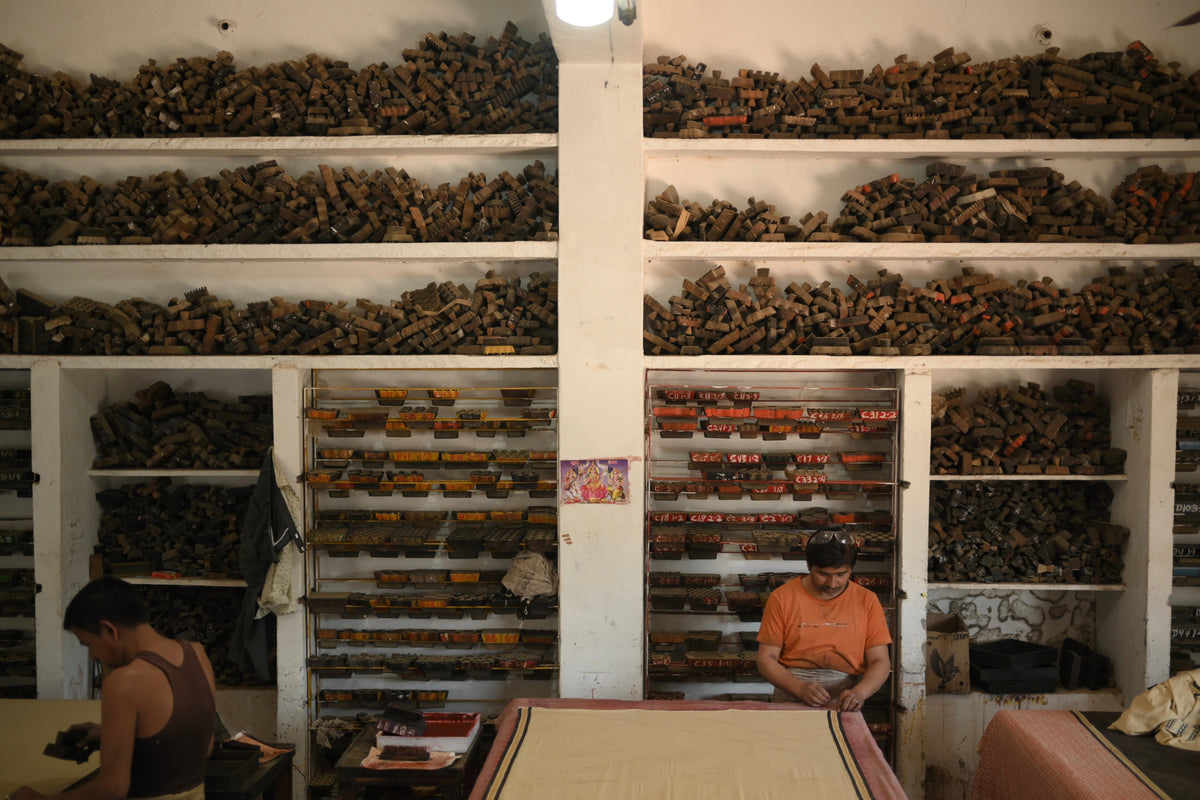
Traditional printing blocks are commonly made from seasoned hardwoods such as sheesham. Depending on the design, different blocks may be required for the outline, the background and finer details. These are often described as rekh, gadh and datta blocks. A single finished motif may therefore require several separate impressions, each carefully aligned by the printer. The vocabulary of Bagru printing includes floral and botanical forms such as gainda, gulab, kamal, badaam and bel, alongside small repeating butis, larger butas, jaalis and geometric arrangements. What is remarkable is the diversity that can be achieved within this established vocabulary. A change in scale, spacing, border placement or colour can give a familiar motif an entirely different character. These are not necessarily designs that need to be reinvented to remain relevant. Their strength lies in the refinement they have acquired through repeated use and adaptation over generations.
For Parvai, this is a particularly important consideration.
We are constantly surrounded by new designs, seasonal palettes and demands for visual novelty. Yet, within the older archives of Bagru, there exists an extraordinary wealth of prints that deserve to be studied, understood and returned to use. Our interest is not in taking a traditional motif and changing it beyond recognition to satisfy contemporary fashion. It is in understanding the original proportions, the relationship between motifs, the rhythm of a repeat and the colour arrangements that gave these designs their identity.
We believe there is enormous creative value in studying the language of a craft before attempting to modify it.
Printing by hand: skill in repetition
After the fabric has been prepared and the blocks selected, the printing begins.
Lengths of cloth are spread over padded tables, and the printer works with wooden blocks dipped into prepared printing mixtures. Each impression is placed by hand, with the next impression aligned against the previous one. This process requires more than steady hands. It calls for an understanding of the design’s repeat, the amount of colour carried by the block, the pressure necessary for a clear impression and the ability to maintain consistency over several metres of fabric. A sari measuring five and a half metres can require hundreds of individual impressions. More elaborate designs demand repeated printing with different blocks, sometimes separated by drying or dyeing stages. Minor variations in impression, alignment and colour are part of the character of hand printing. They are evidence of the process, although good craftsmanship still demands accuracy, discipline and technical control.
Traditional Bagru also encompasses different methods of printing. In direct printing, colour-producing substances or mordants are applied through blocks. In dabu printing, a resist paste containing clay and other ingredients is printed onto selected areas of the fabric. The resist protects these areas during subsequent dyeing, and when it is removed, the reserved pattern emerges. Some textiles may require several stages of resist printing, dyeing, washing and drying before the design is complete. The result is a printed surface built gradually, through a sequence of carefully coordinated processes rather than a single application of colour.
The people behind the printed cloth
The history of Bagru is often told through its printers, and understandably so. The Chhipa community has been central to the town’s textile identity.
However, the production of a traditional printed textile extends well beyond the person holding the wooden block. There are the block makers who carve and maintain the printing tools; the people who prepare the cloth; those who mix and manage dye solutions; the specialists who carry out washing and scouring; printers who understand the sequence of multiple blocks; dyers who develop and deepen colours; and the workers responsible for rinsing, drying and finishing the cloth.
Some families and workshops undertake several of these operations themselves, while others depend upon specialised workers and neighbouring enterprises.
The washer’s knowledge is just as consequential as the printer’s precision. A fabric that has been inadequately prepared may not receive colour evenly. Insufficient rinsing can affect the final appearance. Mishandling during drying or finishing can compromise work already completed.
Similarly, the dyer must understand not only how to produce a colour but how to reproduce it across lengths of fabric while working with materials that may vary naturally.
A skilled block maker must maintain the clarity of a pattern that may be printed thousands of times.
These contributions are not always visible in the finished sari, and they do not always receive equal recognition. At Parvai, we see craft as the work of a community rather than the achievement of a single individual. If one part of this network weakens, the larger tradition is affected. The disappearance of a block maker, a washer familiar with older treatments or a dyer knowledgeable in traditional recipes can represent a loss of specialised knowledge that is difficult to recover.
This is why our engagement with Bagru extends beyond the finished product. We are interested in the people and relationships that make its production possible.
The Derawala family and the importance of inherited archives
Our work in Bagru has brought us into association with the Derawala family, whose printing practice is supported by a remarkable inheritance of traditional patterns, printing blocks and knowledge accumulated across generations. Within their archives are hundreds of designs that reflect the long and varied history of the region’s printed textiles. These include patterns that have remained part of the family’s working vocabulary, alongside older compositions and colour combinations that offer a valuable understanding of how Bagru’s visual language has evolved.

For us, these archives are not merely a source of design references.
They represent the accumulated labour of generations of printers, block makers and dyers. Every surviving block carries decisions made by craftspeople who understood the relationship between design and technique. Every established colour recipe reflects the experience of those who worked with natural materials long before standardised industrial colour systems became widely available. Equally significant are the people who continue to work with the family, including artisans whose familiarity with particular processes has developed over many years.
This continuity matters to us.
An archive becomes especially valuable when the knowledge required to interpret and use it remains alive. A wooden block preserved on a shelf tells part of a story. The printer who knows how to align it, the dyer who understands the colour it was intended to carry and the washer who knows how to treat the finished fabric complete that story.
Our collaboration with the Derawala family gives us an opportunity to engage with this living knowledge and to bring older print traditions into the everyday wardrobes of our patrons.
Parvai’s constant pursuit of the traditional
At Parvai, our work has always involved looking closely at the foundations of textile practice.
Whether we are working with handloom weavers or block printers, we find ourselves returning to similar questions. What was the original method? Why was a particular material chosen? What were the established design proportions? Which colours belonged to a particular tradition? Who possesses the knowledge to reproduce it today?
And perhaps most importantly, can we continue to produce these textiles in ways that respect the people and systems from which they emerged? This approach is not always the quickest or most commercially convenient.

There are circumstances in which a design can be screen printed far more easily than it can be reproduced through traditional wooden blocks. A chemical colour may offer greater predictability than a natural dye recipe. An entirely new digital design may appear more marketable than a historical motif. We recognise the place of these methods in contemporary textile production. Screen printing and other industrial processes serve legitimate purposes and make printed textiles widely accessible. But they are not substitutes for preserving the knowledge of hand block printing.
Our interest in Bagru lies precisely in the practices that cannot be fully understood by studying the finished pattern alone. We want to explore older combinations of motifs, understand how their repeats were constructed, continue using traditional blocks wherever feasible and work with families who retain knowledge of natural dyeing and printing. We are particularly interested in retaining the identity of the original design language rather than reducing Bagru to a broadly recognisable ethnic aesthetic.
A traditional print does not need to be made more elaborate to become valuable. Sometimes its character lies in a modest floral repeat, a narrow border, an unusual relationship between two colours or the restraint with which the pattern occupies the cloth.
These are qualities that we are continually learning to recognise and appreciate.
Our pursuit is not an attempt to freeze Bagru in the past. It is an effort to ensure that its inherited knowledge remains part of contemporary production, where it can continue to be practised, questioned, improved and passed forward.
Bringing Bagru into the everyday wardrobe
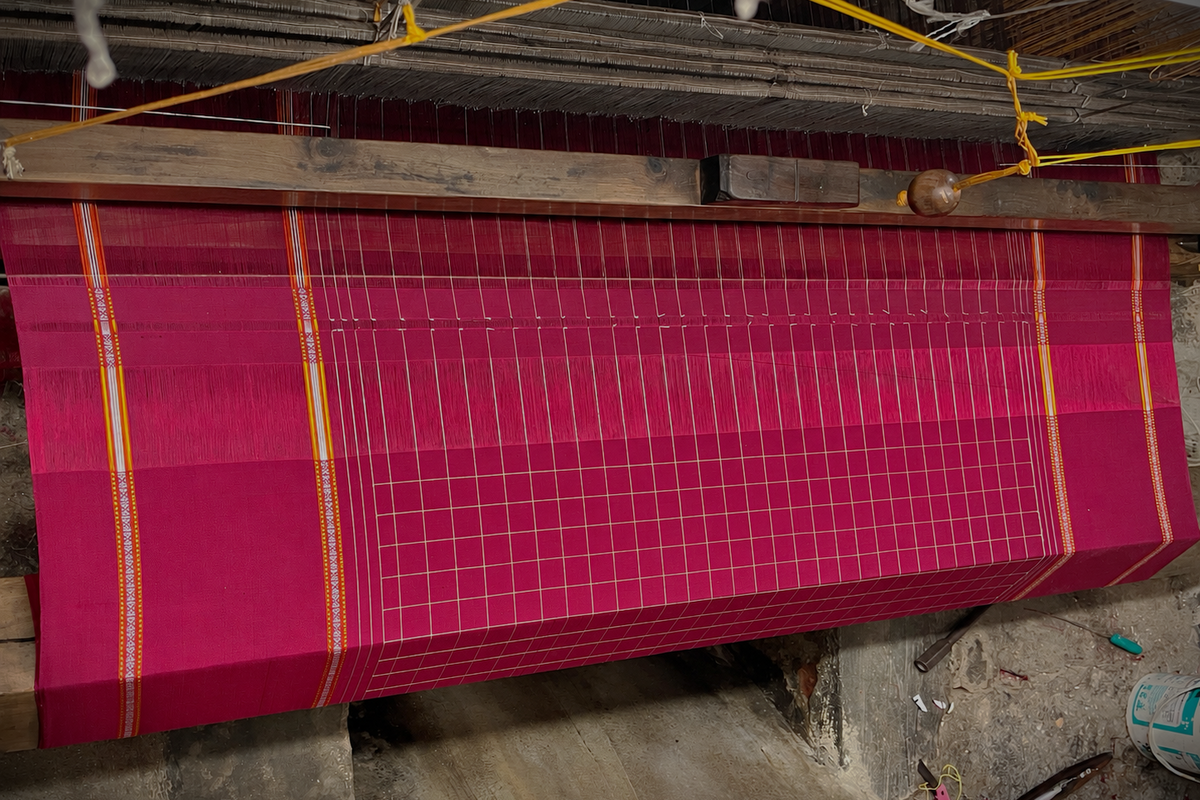
Our latest collection of silk-cotton saris brings together two distinct areas of textile production. The base fabric is woven in Coimbatore, Tamil Nadu, and subsequently travels to Bagru, where it is printed using traditional wooden blocks and natural dye processes through our collaboration with the Derawala family. The decision to use silk-cotton is deliberate. We wanted a textile that would be comfortable, manageable and versatile enough to be worn frequently, without the stiffness or weight that can make certain occasion-oriented saris less practical for everyday use. The fabric offers a gentle drape, a pleasing balance between softness and structure and a subtle surface character that works particularly well with Bagru’s restrained colour palettes and traditional repeating motifs. Each sari measures approximately 5.5 metres, with an additional 0.8-metre blouse extension, and weighs around 420grams.
 They are saris intended to be worn to work, while travelling, to informal gatherings, or simply as part of one’s regular wardrobe. Their appeal is not dependent on elaborate styling or the occasion for which they are chosen. We are particularly fond of how these older prints lend personality to otherwise understated textiles. The colours are often earthy and composed, the motifs familiar without being ordinary, and the overall impression one of quiet confidence. The intention has not been to produce a contemporary reinterpretation of Bagru.
We wanted the prints themselves to remain central, allowing their inherited character and established design proportions to speak through a fabric suited to present-day use.
Traditional craft deserves an everyday place
One of the concerns we return to frequently at Parvai is the tendency to place traditional craft within an excessively romantic framework.
Handmade textiles are often presented as rare treasures, extraordinary objects or possessions to be acquired only on special occasions. While some forms of textile production are undeniably complex and labour-intensive, we believe this framing can sometimes distance crafts from the everyday lives in which they originally belonged. Many of India’s enduring textile traditions were developed to serve ordinary human needs. They were made to be worn, washed, repaired, reused and enjoyed. Their visual languages became sophisticated because generations of people worked with them continuously, developing practical solutions alongside aesthetic preferences.
Bagru’s history is closely connected with this relationship between utility and beauty. Its printed textiles were not always conceived as luxury objects. They belonged to local wardrobes and households, fulfilling practical and cultural functions. We find great value in returning to that understanding. By producing well-made, naturally dyed, traditionally printed saris on comfortable fabrics, we hope to make this extraordinary knowledge part of the everyday experience of wearing clothes. The objective is not to make craft appear exclusive. It is to make good craft accessible, useful and relevant, while recognising the labour and expertise that go into its production.
Preserving a craft means sustaining its work
There is an important distinction between appreciating a traditional design and supporting the systems through which it is produced.
A historical pattern can be photographed, digitally copied and reproduced almost indefinitely. But the survival of the original craft depends upon whether skilled block makers continue carving, whether traditional printers have work, whether dyers continue using and teaching their recipes, and whether the many supporting occupations remain economically viable. The movement towards faster and more standardised textile production has changed the circumstances in which craft communities operate. Access to water, the cost of materials, the availability of skilled workers, production timelines and changing market expectations all influence what remains practical for workshops to produce.
We believe these realities deserve as much attention as the beauty of the finished textile. At Parvai, our contribution is necessarily modest. We do not claim to preserve an entire tradition or sustain a craft town through the production of a small collection of saris. What we can do is choose how we engage with the people who make our textiles. We can seek out knowledgeable practitioners, commission work that makes use of inherited skills, invest time in understanding processes, respect realistic production requirements and give traditional designs a meaningful place within our collections. We can also communicate more accurately about what goes into making these textiles, so that patrons understand the difference between a printed design and the craft tradition responsible for it.
This is an ongoing process of learning for us, not a claim of having mastered or completed that understanding.
The future of Bagru lies in its continuity
Bagru’s remarkable legacy survives because generations of craftspeople have continued to practise and adapt their skills.
Its significance lies as much in the working knowledge of its people as in the textiles they produce. The hand-carved blocks, the prepared dye solutions, the long printing tables, the cloth laid out to dry, the repeated washing and the careful alignment of motifs are all parts of a larger system that has developed through centuries of practice. We believe this system deserves to remain active. Not simply because traditional printing creates beautiful textiles, but because it sustains a form of knowledge that cannot be separated from the people who carry it. For Parvai, every engagement with Bagru is another opportunity to learn from that inheritance, to return to its archives, to understand its materials and to find meaningful ways of continuing its work. Our pursuit is not of novelty for its own sake. It is of continuity, skill, good design and honest production. And perhaps the most meaningful expression of that pursuit is a beautifully made sari that becomes part of someone’s regular life.
A sari that is worn often, cared for, appreciated and eventually remembered not because it was an extraordinary possession, but because it was an exceptionally good piece of cloth. That, to us, is one of the most meaningful ways a textile tradition continues.
Parvai | Made with people, for people.

Written by Effie Thomas