Article: BEE & BLOOM | BY PARVAI
BEE & BLOOM | BY PARVAI
An Exploration of Ecological Consciousness, Indian Cotton, Traditional Craftsmanship and the Interdependence of Life
Bee & Bloom is Parvai’s continuing collection of handcrafted cotton shirts and dresses, inspired by the extraordinary relationship between bees and the natural world. Developed through traditional Indian textile practices and the skills of generational artisan communities, the collection reflects our belief that clothing can carry meaning beyond its immediate purpose, connecting the everyday act of dressing with a deeper awareness of the environment, the people who make our garments and the natural systems that sustain human existence.
The Beginning: Clothing as an Expression of Environmental Consciousness
The relationship between human civilisation and the natural environment is one of profound and enduring interdependence. The resources that support our existence, the agricultural systems that provide our food, and the ecological processes that regulate the natural world are sustained through complex relationships between living organisms and their environments. Yet, despite our complete reliance upon these systems, contemporary lifestyles often create a considerable distance between human activity and the natural processes that make it possible. Many of the relationships essential to life remain largely invisible within the routines of everyday existence, becoming apparent only when their disruption begins to affect the world around us.
At Parvai, our work has always been shaped by an appreciation for the relationships between people, materials, traditions and the environments in which they exist. Our engagement with Indian craftsmanship has taught us that making is never an isolated activity. Every textile carries within it a network of knowledge, resources, labour and cultural histories, beginning with the cultivation of raw materials and continuing through the many processes required to transform them into something useful and beautiful. This understanding has gradually encouraged us to consider how the clothing we create might also communicate ideas that extend beyond craftsmanship itself.
Bee & Bloom emerged from this reflection and from our particular concern for the natural world, especially the ecological importance of bees. We wanted to develop a collection that would gently remind us of the extraordinary systems sustaining human existence and of our responsibility to preserve the environments upon which we depend. Rather than approaching environmental awareness as a separate campaign or temporary initiative, we sought to integrate this message into the clothing itself, allowing it to become part of an individual’s everyday experience.
The collection was conceived around an uncomplicated but meaningful idea: that the things we choose to wear can carry reminders of what we consider important. A shirt worn to work, a dress selected for an ordinary afternoon or a garment that becomes part of a familiar wardrobe can communicate a personal philosophy without requiring an explicit declaration. Through colour, print, fabric and a small hand-embroidered bee, we wanted to create clothing that invites reflection upon the relationship between human life and the natural environment.
Bee & Bloom therefore represents more than a design exploration. It is a continuing expression of Parvai’s commitment to traditional craftsmanship, the dignity of artisan livelihoods and a thoughtful approach to the materials and processes involved in clothing production. The collection brings together environmental awareness and cultural continuity, recognising that both the natural world and traditional knowledge systems require sustained attention if they are to remain meaningful for future generations.
The Bee: Understanding Its Importance Within the Natural World
Bees occupy an extraordinarily important position within terrestrial ecosystems, particularly through their role in the pollination of flowering plants. Pollination is the process through which pollen is transferred between the reproductive structures of flowers, enabling fertilisation and, in many species, the subsequent development of seeds and fruits. Although this process can occur through wind, water and other mechanisms, a considerable proportion of flowering plants depend upon animals to facilitate pollen transfer, with bees representing one of the most significant groups of pollinators. The relationship between bees and flowering plants is an example of ecological interdependence developed over millions of years of evolution. Flowers provide resources such as nectar and pollen, while bees, during their search for these resources, contribute to the reproductive processes of many plant species. This interaction supports the regeneration of vegetation, the maintenance of plant diversity and the functioning of habitats upon which numerous other organisms depend. Its importance extends far beyond the individual flower or insect, influencing the composition and resilience of entire ecological communities. The contribution of pollinators to agriculture is equally significant. Many crops grown for human consumption benefit from animal pollination, including several fruits, vegetables, nuts and seeds that form important components of human diets. The Food and Agriculture Organization has highlighted that approximately three-quarters of the world’s food crop types depend, at least partly, upon pollinators. This does not mean that the same proportion of total food production would disappear in their absence, but it illustrates the breadth of the relationship between pollination and agricultural diversity. Beyond their contribution to food systems, bees support the reproduction of wild flowering plants that provide shelter and nourishment for other insects, birds and animals. Their ecological significance is therefore connected to the broader stability of natural habitats. Changes affecting pollinator populations can influence plant reproduction and, over time, alter relationships within the wider ecosystem.
Despite their importance, many bee species face increasing environmental pressures. Habitat destruction and fragmentation reduce access to suitable nesting areas and flowering resources, while agricultural intensification, certain pesticide exposures, pollution, disease and climate change can affect their survival and reproductive success. The severity and nature of these pressures vary between species and geographical regions, making bee conservation a complex subject that requires careful ecological understanding and locally appropriate responses. It is precisely this complexity that makes the bee such a meaningful symbol for Bee & Bloom. Its relatively small presence conceals an ecological contribution that extends across landscapes, agricultural systems and natural habitats. The bee reminds us that the importance of a living organism cannot be judged by its physical size or immediate visibility, and that the stability of the natural world frequently depends upon relationships we seldom recognise.
Through this collection, we hope to encourage a greater appreciation of bees and, more broadly, of the countless forms of life that contribute to the wellbeing of our planet. We regard environmental awareness not as an isolated concern, but as an essential part of understanding the conditions that make human existence possible.
The Language of Colour: Yellow, Purple and the Relationship Between Bees and Flowers
The visual identity of Bee & Bloom developed from our observations of the natural relationship between bees and flowering plants. Rather than drawing inspiration from seasonal fashion forecasts, we looked towards the colours associated with flowering landscapes and the visual environments through which pollinators move. Yellow and purple emerged as the primary colours of the collection, offering a distinctive palette that could be interpreted through traditional textile techniques while remaining suitable for contemporary everyday clothing.
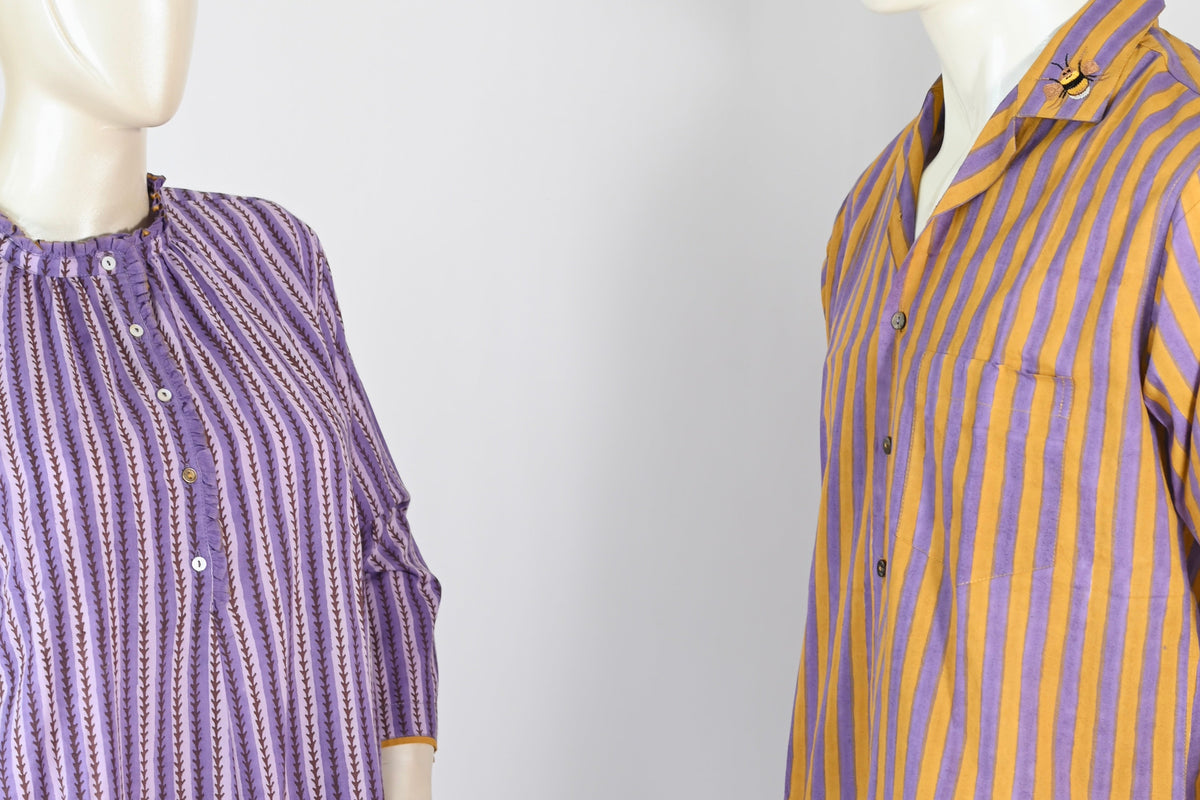
The relationship between floral colour and pollination is particularly interesting because the visual perception of bees differs considerably from that of humans. Bees possess colour receptors sensitive to ultraviolet, blue and green wavelengths, enabling them to distinguish visual information that is not always apparent to human observers. Many flowering plants display contrasting patterns, including ultraviolet markings, that can assist pollinators in locating floral resources. Yellow and violet flowers, which are visually striking to us, also provide a compelling reference for the diversity of floral signals within pollinator environments, although bees do not perceive these colours in precisely the same manner as humans. Our interpretation of this relationship is aesthetic and symbolic rather than a scientific reproduction of bee vision. We wanted to translate the visual character of flowering landscapes into textiles that felt expressive, familiar and timeless, allowing natural inspiration to inform the design without overwhelming its practical purpose. The palette developed for Bee & Bloom moves through varied shades of yellow and purple, including golden yellow, mustard, soft lavender, lilac, violet and deeper purple tones. Each shade has been carefully considered in relation to the others, creating combinations that explore warmth, contrast, softness and depth. Some garments feature more pronounced contrasts between yellow and purple, while others employ quieter tonal arrangements that lend themselves to understated everyday dressing.
Stripes form a prominent element of the collection’s design vocabulary. Their simple geometric structure allows colour to become the principal means of expression, while the repetition of printed lines introduces rhythm and continuity across the cloth. The proportions, spacing and colour relationships within these stripes have been developed to create a recognisable identity that can continue across different garments and future additions to the collection. The familiarity of stripes also contributes to the versatility of Bee & Bloom. Rather than creating highly decorative garments intended primarily for occasional use, we wanted the textiles to retain a visual clarity that would remain relevant across seasons and changing wardrobes. Their distinctive colour combinations provide character, while their fundamental design remains grounded in an enduring textile language. As Bee & Bloom continues, new interpretations of the palette may emerge through different fabrics, prints and garment silhouettes. Nevertheless, the relationship between yellow, purple and the hand-embroidered bee will remain central to the collection, establishing a consistent visual identity that connects each garment to its original environmental inspiration.
The Fabric: Indian Cotton, Material Character and Everyday Comfort
The selection of fabric was an essential part of developing Bee & Bloom, particularly because the collection was conceived as clothing intended for frequent, everyday use. From the outset, we wanted to work with natural cotton, a fibre whose history is deeply connected to India’s agricultural, commercial and textile traditions. Cotton offers a familiar combination of comfort, breathability and versatility, while its ability to accommodate different yarn counts, weave structures and surface finishes makes it particularly suitable for the variety of garments and traditional printing techniques explored within the collection.
India’s relationship with cotton extends across several millennia, encompassing cultivation, spinning, weaving, dyeing, printing and garment construction. Different regions have developed specialised knowledge relating to the preparation and transformation of cotton, creating a remarkable diversity of textiles with distinct weights, textures, appearances and functional characteristics. This history is especially meaningful to Parvai because it illustrates how a seemingly ordinary natural fibre can become the foundation for highly sophisticated traditions of material craftsmanship.
For Bee & Bloom, we selected three cotton fabric types that offer different expressions of the same natural material: 40s cotton sourced from Andhra Pradesh, and 60s cotton and cotton poplin sourced from textile mills in Coimbatore, Tamil Nadu. These fabrics were chosen to provide variations in texture, fineness, structure and drape, allowing us to develop garments that remain consistent in their design philosophy while offering individual differences in their material character.
The 40s cotton sourced from Andhra Pradesh provides a comparatively substantial textile character, lending itself to garments where a certain degree of body and structure is desirable. The fabric’s natural surface texture complements traditional hand block printing, allowing printed designs to retain a tactile quality that reflects the character of the underlying cloth. Its balance of structure and comfort makes it particularly suitable for relaxed shirts designed to maintain their intended shape without feeling overly formal or restrictive. The 60s cotton sourced from Coimbatore introduces a finer yarn into the collection. Within the English cotton count system, a higher number indicates a finer yarn, although the eventual weight and softness of the finished fabric also depend upon its weave construction, yarn density and finishing processes. The use of finer cotton allows us to explore fabrics with a more refined handle and potentially softer drape, making them particularly appropriate for garments where lightness and freedom of movement are important considerations. Cotton poplin, also sourced from Coimbatore’s textile mills, introduces another dimension to the collection through its closely woven plain-weave structure and relatively smooth surface. Poplin is valued for its ability to combine a neat, crisp appearance with the familiar comfort of cotton, making it particularly suitable for carefully constructed shirts and dresses. Its comparatively even surface provides an appropriate foundation for clearly defined printed patterns, while its structure supports the accurate construction of collars, plackets, pockets and other tailoring details.The decision to work with more than one cotton construction reflects our understanding that fabric selection must respond to the intended garment rather than simply fulfil an aesthetic preference. Yarn fineness, weave density, surface texture, weight and the behaviour of cloth during cutting and stitching all influence the final result. The relationship between textile and garment construction is especially important when working with traditional tailoring techniques, where the quality of the finished piece depends upon the maker’s understanding of how different materials behave.
The fabrics also respond differently during printing. Variations in their surface characteristics, absorbency and construction can influence the definition and appearance of printed colour, contributing to subtle distinctions between garments even when they share a common design language. These characteristics are considered during the development of the collection so that the chosen print, fabric and silhouette complement one another. Our sourcing from Andhra Pradesh and Coimbatore also reflects the broader network of expertise within India’s cotton textile industry. Behind the finished fabric lies a succession of processes involving cotton cultivation, fibre preparation, spinning, weaving and finishing. The garments created for Bee & Bloom therefore carry the contributions of individuals involved long before the fabric reaches the printing table or tailoring workshop. The use of cotton is consistent with our preference for materials that are comfortable and practical for regular wear, but we also recognise that natural fibres are not automatically without environmental impact. Cotton cultivation and processing involve water, energy and agricultural resources, and the environmental characteristics of a finished textile depend upon the methods employed throughout its production. Our decision to work with natural cotton is therefore one aspect of a wider effort to make considered choices about materials, production quantities, printing practices and garment longevity.
Ultimately, the different cotton fabrics within Bee & Bloom allow us to explore how material character contributes to the experience of wearing clothing. Whether through the more pronounced texture of 40s cotton, the finer qualities of 60s cotton or the crisp surface of cotton poplin, each fabric provides a distinct foundation for the collection’s prints and tailoring. Together, they reflect our belief that thoughtfully designed everyday clothing begins with an informed appreciation of the textile itself.
Traditional Hand Block Printing: The Continuity of an Inherited Craft
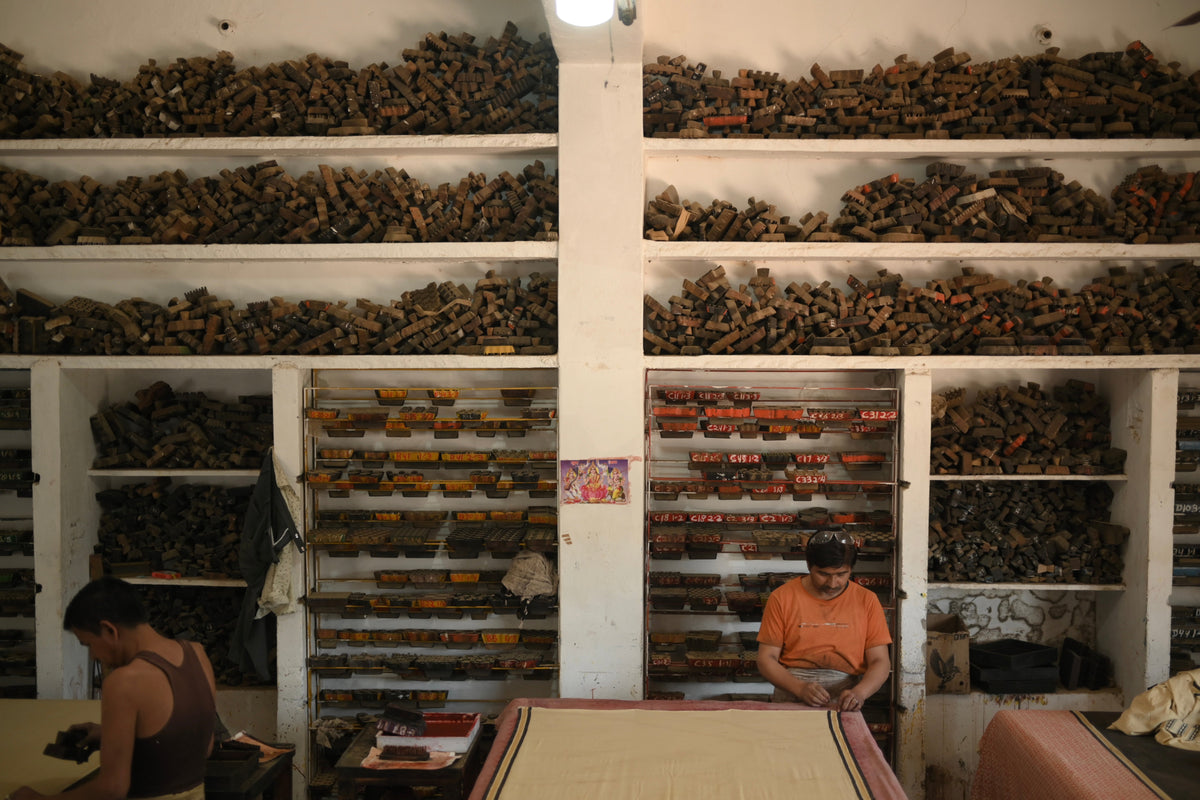
Hand block printing is among the most recognisable traditions of Indian textile decoration, representing an intricate combination of design knowledge, manual precision and regional craft expertise. Across India, printing communities have developed distinctive approaches to the preparation of fabrics, carving of wooden blocks, application of colour and repetition of patterns. These practices have evolved through exchanges between regions, communities and commercial networks, while retaining the central importance of skilled human involvement. The production of a hand block printed textile begins with the interpretation of a design into a form suitable for repeated impressions. Skilled block makers translate drawings into carved wooden surfaces, considering the proportions, spacing and structural relationships required for successful printing. The quality of the carving determines not only the clarity of the printed impression but also the way a pattern repeats across the cloth. Once prepared, the blocks become instruments through which the printer translates the design onto fabric. Each impression requires careful positioning, control over the printing medium and an understanding of the relationship between pressure, fabric surface and colour application. Maintaining continuity across a length of cloth demands considerable experience, particularly when several blocks or colours are involved. The physical repetition inherent in hand block printing should not be mistaken for a purely mechanical activity. Every impression involves the judgement of the artisan, who must respond to the condition of the fabric and the behaviour of the printing materials. The subtle variations that emerge through this process reveal its human character, distinguishing hand-printed textiles from the uniformity achievable through fully automated systems.
For Bee & Bloom, traditional hand block printing provides both the aesthetic language and an important cultural foundation for the collection. The designs are carefully selected and developed, with particular attention to the arrangement of stripes, the relationship between colours and the way patterns interact with the different cotton fabrics. The collection also draws upon the wider knowledge of traditional Indian printing techniques, including resist-printing traditions such as Dabu where applicable to the specific fabric. Dabu employs a resist paste, traditionally based on mud and other ingredients, to protect selected areas of cloth during dyeing. This is distinct from direct hand block printing, in which colour is applied to the fabric using carved blocks. Recognising these differences is important because each technique represents a particular body of specialised knowledge. We regard the small variations inherent in handcrafted printing as part of the individuality of the textile. Differences in impression, colour density or alignment, within acceptable standards of workmanship, reveal the physical process through which the fabric has been produced. They remind us that the finished textile is the result of numerous decisions and repeated acts of skilled manual work. The preservation of block printing is also inseparable from the continuity of the artisan communities who practise it. Craft knowledge is often transmitted through observation, apprenticeship and participation in family workshops, with expertise developing gradually over years of practice. Maintaining demand for these textiles creates opportunities for this knowledge to remain active within contemporary production.
By making traditional hand block printing a continuing part of Bee & Bloom, we hope to contribute to a commercial environment in which these skills are valued not simply for their historical significance but for their relevance to clothing made and worn today.
Responsible Printing, Resource Management and Thoughtful Production
The environmental inspiration behind Bee & Bloom required us to consider the methods through which the fabrics are produced and printed. Textile manufacturing, regardless of whether it is undertaken through traditional or industrial techniques, involves the use of natural resources and the generation of waste. A responsible approach to making clothing must therefore examine the relationship between materials, production processes, resource consumption and the management of residual substances.
Hand printing offers a distinctive craft process, but its environmental impact depends upon the specific practices employed by the production unit. Water consumption, the preparation and application of printing materials, washing processes and the treatment or disposal of wastewater are among the considerations that influence the environmental performance of textile printing. For Bee & Bloom, we work with specialist printing units that incorporate resource-conscious practices into their production methods. These include systems for recycling, efforts to reduce unnecessary material wastage and careful management of production residues. The artisans and units involved also contribute to the wider supply networks of recognised textile brands that place importance on responsible printing and manufacturing practices. Our preference is to collaborate with workshops that combine the continuity of traditional craft knowledge with an understanding of contemporary environmental responsibilities. We believe that the preservation of historic techniques and the improvement of production practices should be approached as complementary objectives rather than competing priorities.
The scale of our production is equally important. Bee & Bloom is manufactured in deliberately small batches, allowing us to plan garment quantities in relation to demand and avoid the unnecessary accumulation of unsold stock. Smaller production runs also create opportunities for closer attention to fabric utilisation, print quality, construction and finishing. We recognise that small-batch production does not, by itself, establish that a garment has a lower environmental footprint. Its value lies in the possibility of more considered planning, greater production oversight and a closer relationship between the people who commission, make and eventually wear the garments.
For Parvai, responsible production is not a fixed designation but a continuing process of learning, evaluation and improvement. It requires attention to the resources consumed, the systems used to manage waste, the conditions under which artisans work and the useful life of the final product. Through Bee & Bloom, we aim to remain attentive to these interconnected responsibilities as the collection develops.
The Traditional Indian Darzi: Preserving the Knowledge of Individual Tailoring
Once printed, the cotton fabrics move into the hands of traditional Indian Darzi families, whose expertise transforms lengths of cloth into carefully constructed garments. The role of the Darzi is deeply embedded in the history of clothing across the Indian subcontinent, where tailoring has long been practised through small workshops, family enterprises and personal relationships between makers and wearers.
Traditional tailoring requires an understanding of proportions, fabric behaviour, construction techniques and the practical relationship between clothing and the human body. Skilled tailors acquire knowledge through years of experience, learning how different textiles respond to cutting, stitching, pressing and repeated wear. This expertise extends beyond the ability to reproduce a pattern, encompassing the judgement necessary to ensure that a garment maintains its intended form while remaining comfortable and functional. Historically, many tailoring traditions were sustained within families, with skills passed between generations through observation and participation in daily workshop activities. Such forms of knowledge transmission remain important because they preserve practical expertise that is not always fully captured in formal technical instructions. The expansion of industrial garment manufacturing has profoundly altered the organisation of clothing production. Standardised processes and large-scale assembly systems have made garments widely accessible, but they have also changed the economic environment in which independent tailoring workshops operate.
At Parvai, we believe there remains considerable value in preserving the attentiveness and workmanship associated with traditional Darzi tailoring. Bee & Bloom garments are individually cut, stitched and finished by skilled artisans working through small, home-based workshops rather than large-scale garment factories. The shirts have been designed with a contemporary straight fit, providing ease through the body while retaining a clean and balanced silhouette. The Cuban collar introduces an open, relaxed neckline, particularly appropriate for informal dressing and warm climates, while the half sleeves and waist-length construction support comfortable movement throughout the day. A single front patch pocket adds a familiar functional detail without distracting from the printed fabric.
The choice of these elements reflects our intention to create clothing that can be worn across a wide range of ordinary settings. Rather than designing garments whose relevance depends upon a particular occasion, we have concentrated on proportions and construction that complement the natural character of cotton and the practicality of everyday dressing. Particular care is given to garment finishing. French seams are used to enclose raw fabric edges, producing a neat interior and reducing exposed edges along the seams where this construction is applied. Collars, plackets, hems and pockets are constructed with attention to proportion and workmanship, reflecting the traditional tailoring principle that the quality of a garment should be evident in both its visible appearance and its internal details. Natural buttons and carefully considered finishing elements further support the understated character of the shirts. These choices are intended to complement the cloth rather than compete with its printed design.
Although the garments are produced in standard sizes, their construction draws upon the values associated with individual tailoring: patience, precision, attention to materials and pride in the finished piece. The result is contemporary everyday clothing that retains a meaningful connection to the knowledge and practices of traditional Indian Darzi communities.
The Hand-Embroidered Bee: A Signature of Awareness and Craftsmanship
The defining element of every Bee & Bloom garment is a small, hand-embroidered bee. Conceived as a permanent signature of the collection, this detail carries its central environmental message while introducing another form of traditional craftsmanship into the making process. We deliberately chose to express the bee through embroidery rather than through a large graphic or printed slogan. Our intention was to create a symbol that would remain understated and personal, allowing the garment to be appreciated for its fabric, colour and construction while carrying a deeper meaning for those who recognise it. Hand embroidery requires control over thread, stitch placement, proportion and texture. Even a relatively small motif involves careful manual work, and slight differences in the execution of each bee are a natural expression of the process. The embroidered detail adds another human contribution to a garment already shaped by the knowledge of printers and tailors.
The motif represents the importance of bees within the natural world, but it also offers an opportunity to reflect upon the wider idea of interdependence. The ecological contribution of pollinators demonstrates how relationships between organisms sustain larger systems, while the creation of a handcrafted garment similarly depends upon the contributions of several individuals performing specialised tasks. The block maker, printer, tailor and embroiderer each bring distinct knowledge to the process. Their combined work creates the finished garment, even though the contribution of each artisan may not be immediately apparent to the person wearing it. The embroidered bee therefore connects two ideas that are central to Parvai’s philosophy: the importance of recognising the often-overlooked relationships sustaining the natural environment, and the importance of valuing the skilled individuals whose work makes traditional craftsmanship possible. We hope that this small symbol will remain a familiar reminder of the collection’s purpose, encouraging awareness without requiring the garment to become an overt statement. Its meaning lies partly in its simplicity and in the possibility that an ordinary detail can invite reflection upon something much greater.
Small-Batch Production and the Continuity of Artisan Livelihoods
One of the most important decisions behind Bee & Bloom was to establish it as a continuing collection rather than a seasonal range that would be introduced, sold and eventually discontinued. This approach reflects our belief that meaningful support for traditional craft communities requires consistency of engagement and a willingness to develop relationships beyond individual production orders.
Artisan livelihoods are frequently influenced by variations in demand, changing market preferences and irregular production cycles. For small workshops and family-based enterprises, the availability of recurring work can be important to maintaining equipment, purchasing materials, supporting household incomes and encouraging younger generations to continue practising inherited skills. The preservation of traditional craftsmanship therefore requires an economic foundation that allows artisans to continue using their knowledge within contemporary markets. Celebrating a craft’s history is valuable, but its long-term continuity also depends upon whether skilled practitioners can earn livelihoods through the work they perform.
Through Bee & Bloom, Parvai intends to sustain an ongoing relationship with a focused network of block makers, printers, embroiderers and traditional Darzi families. By establishing a recognisable collection that can be replenished through carefully planned production runs, we hope to create recurring opportunities for these artisans while maintaining the personal character of the making process.
Our approach is deliberately small in scale. The collection will be produced in limited batches, allowing designs and quantities to be reviewed in relation to actual demand. This helps us maintain closer oversight of production and ensures that the development of the collection remains connected to the capacity and circumstances of the artisans involved. The intention is not to pursue volume for its own sake, but to build a body of work that can continue over time while preserving the quality, individuality and cultural knowledge associated with traditional production. Bee & Bloom will therefore remain open to gradual development. New designs, colour combinations and garment forms may be introduced, but the central relationship between environmental awareness, natural cotton, handcrafted printing and traditional tailoring will remain consistent.
For us, the continuity of the collection is as important as the garments themselves, because it allows the work to become part of a sustained relationship between Parvai, its artisans and the people who choose to support it.
Everyday Clothing and the Relationship Between Objects and Values
Clothing occupies a distinctive place within material culture because of its intimate and repeated relationship with the human body. Unlike objects encountered only occasionally, garments accompany people through their daily routines, becoming part of how they experience comfort, identity, movement and social interaction. The significance of clothing is therefore not limited to its visual appearance or commercial value. Garments can carry memories, express personal preferences, reflect cultural histories and communicate the values of the individuals who choose to wear them. Within contemporary fashion, environmental messages are frequently communicated through visible slogans, promotional campaigns or collections associated with particular events. Although these approaches can attract attention, we wanted Bee & Bloom to explore a quieter and more enduring relationship between clothing and awareness.
Our intention was to create garments that would be worn frequently and comfortably, allowing their meaning to emerge through familiarity rather than spectacle. The use of breathable cotton, practical silhouettes and carefully developed prints supports this everyday purpose, while the embroidered bee offers a subtle reminder of the ecological ideas behind the collection. We believe that the longevity of a garment is influenced not only by its physical durability but also by the relationship the wearer develops with it. Clothing that remains comfortable, useful and personally meaningful is more likely to retain a place within an individual’s wardrobe.
This understanding has informed our approach to Bee & Bloom. Rather than developing garments that depend upon short-lived novelty, we have sought a balance between distinctive design and lasting practicality. The familiar structure of a striped cotton shirt or an easy everyday dress provides a foundation through which the environmental message can remain relevant beyond a particular season. The collection is intended to participate naturally in everyday life, carrying its ideas through repeated use and personal association. We hope that the garments will be appreciated not only for the way they look and feel, but also for the craftsmanship and environmental awareness they represent.
Patronage, Craft Communities and the Value of Human Work
The creation of a Bee & Bloom garment involves a network of skilled individuals whose contributions extend across different stages of textile and clothing production. Cotton is transformed into fabric through established processes of spinning and weaving. Designs are translated into printing blocks and transferred onto cloth through the work of experienced artisans. The printed fabric is then cut and constructed by traditional Darzi families, before being completed with its hand-embroidered bee. Each stage contributes a distinct form of knowledge, and the quality of the finished garment depends upon the relationship between them. At Parvai, we have always regarded this network of craftsmanship as fundamental to the value of what we create. The finished product is important, but so too are the people, processes and inherited skills through which it comes into existence. Our work is therefore guided by a belief in patronage that recognises artisans as essential participants in production rather than anonymous contributors to an industrial process.
When someone purchases a Bee & Bloom garment, their patronage supports the continuation of this network of traditional textile and tailoring practices. It contributes to demand for handcrafted production and helps us maintain recurring relationships with the artisans involved.
We consider this particularly meaningful at a time when many traditional occupations face pressure from changing economic circumstances and industrial production methods. Sustaining craftsmanship requires an active relationship between makers and markets, allowing inherited knowledge to remain relevant through contemporary design and use. The value of Bee & Bloom consequently extends beyond the garment’s immediate function. It includes the time, attention, practical intelligence and cultural experience embodied within every stage of its making.
Environmental Awareness as a Continuing Responsibility
The environmental issues that inspired Bee & Bloom cannot be addressed through individual clothing choices alone. Protecting pollinators and sustaining healthy ecosystems requires scientific research, habitat conservation, responsible agricultural practices, informed public policy and collective action at multiple levels of society. We recognise that a garment bearing an embroidered bee does not directly conserve pollinator populations, nor does the use of traditional production methods automatically remove the environmental consequences associated with textile manufacturing.
The purpose of Bee & Bloom is therefore not to make such claims, but to encourage awareness and to bring environmental questions into an ordinary part of daily life. We believe that public understanding of ecological issues develops through education, observation and continued engagement. A garment can contribute modestly to this process by carrying a symbol that encourages curiosity and discussion, particularly when it is supported by a considered explanation of the ideas behind it.
For Parvai, this educational dimension is inseparable from our commitment to responsible making. We want the collection to encourage appreciation of bees and biodiversity while remaining attentive to the materials, resources and human labour involved in its production. The connection between these commitments is rooted in a shared understanding that the systems supporting our lives deserve recognition and care. Whether considering the ecological relationships that sustain flowering plants or the craft communities that preserve traditional textile knowledge, we are reminded that continuity depends upon the wellbeing of the individuals and environments involved.
Bee & Bloom is our small contribution to keeping these questions present within the everyday experience of clothing.
An Enduring Collection by Parvai
Bee & Bloom represents a continuing journey rather than a completed statement. Its development will remain guided by our appreciation of the natural world, our engagement with Indian cotton and traditional textile techniques, and our commitment to sustaining relationships with the artisans who bring the collection to life. The colours, prints and garments may evolve as we explore new interpretations of the original concept, but the principles behind the collection will remain unchanged. We will continue to approach production in limited batches, work with traditional craft communities and develop clothing that combines comfort, thoughtful design and careful construction. We also hope that the collection will encourage a broader understanding of the relationship between the things we make and the world in which we live. The cotton used in our garments connects us to agricultural and textile-producing regions. The prints connect us to generations of artisans who have refined their skills through practice. The tailoring connects us to family-based traditions of clothing construction, while the embroidered bee reminds us of the ecological relationships upon which life depends.
Taken together, these elements express a philosophy that has become increasingly important to Parvai: that meaningful design begins with an awareness of connection.The natural world is sustained through relationships between organisms, habitats and environmental processes. Traditional craftsmanship is sustained through relationships between knowledge, communities, livelihoods and those who value their work. Clothing, when approached thoughtfully, can become a means of recognising both. Through Bee & Bloom, we wanted to create garments that remain useful and beautiful while carrying a reminder of these wider responsibilities. We wanted the collection to support the hands that make it, acknowledge the natural systems that inspire it and encourage those who wear it to remain conscious of the world beyond themselves.
The little embroidered bee is our expression of this belief. Its presence is deliberately small, yet the idea it represents is immense: that life is sustained through relationships, and that the things we may consider insignificant are often essential to the wellbeing of the whole.
Bee & Bloom is our continuing tribute to these connections, expressed through the language we know best: natural textiles, traditional craftsmanship and clothing made with care. For the hands that create, the bees that sustain, and the earth that nurtures us all.
Explore Bee & Bloom | The Collection of Handcrafted Shirts & Dresses
Discover nature-inspired cotton clothing, thoughtfully handcrafted by India's traditional artisans.

Written by Effie Thomas