Sidra: Our starlit sky
A Parvai Perspective
Chanderi occupies a distinctive position within the textile history of the Indian subcontinent. Celebrated for the remarkable lightness, translucency and luminosity of its cloth, its weaving traditions developed over centuries through relationships between skilled artisan communities, regional courts, mercantile networks and changing systems of patronage. Fine cottons, silk-cotton textiles, zari ornamentation and delicately articulated woven motifs became part of the vocabulary for which Chanderi came to be recognised. Today, however, Chanderi must be understood not merely as a historic textile centre but as a substantial contemporary production ecosystem. Its looms operate within the realities of price, livelihood, demand and competition; successful designs are necessarily repeated, production is frequently organised around efficiency, and assisted technologies enable simpler saris to be woven considerably faster than more labour-intensive handloom constructions. This commercial vitality is important. A craft cannot remain alive through historical significance alone; it must participate successfully in the economy of its own time.
It was precisely this abundance that led Parvai to approach Chanderi with a degree of hesitation. In a cluster already producing a very large number of saris, we had little interest in contributing another textile simply for the sake of expanding a collection. The question that concerned us was whether there remained a meaningful space within this highly productive environment for work that deliberately prioritised time, technical engagement and the fuller capabilities of the artisan. Commercial production is not the opposite of craftsmanship, nor do we consider slower production inherently superior. The concern is subtler. When the economic structure surrounding a craft consistently rewards speed, repeatability and price, highly skilled artisans may find themselves practising only a portion of what they know. A loom may remain active while certain sophisticated abilities associated with that loom gradually cease to be commissioned. For us, therefore, the continuity of a craft cannot be measured solely by the number of operational looms or the quantity of textiles produced. It must also be considered in relation to whether the deeper knowledge contained within the community continues to find opportunities for expression.
Sidra emerged from this enquiry. Rather than asking how many saris could be produced from a design, we began by asking what might become possible if a loom were given more time and an artisan were asked to exercise greater precision. The intention was not complexity for its own sake, nor was it to manufacture exclusivity through an artificially difficult process. We wanted the additional labour to have a discernible purpose: to create work sufficiently demanding to engage highly skilled weavers, to develop a textile whose distinction arose from the quality of its making, and to offer our patrons something that could not easily become another extensively replicated Chanderi. In this sense, the project represented a deliberate shift in emphasis, from asking the loom to produce more to asking what more the loom and the people working upon it might be capable of producing.
A Young Weaver and the Question of Continuity
The most important outcome of this project, however, has not been the textile itself. It has been our relationship with Shadman Ansari, a twenty-two-year-old from a hereditary Chanderi weaving family, understood within his family to represent approximately the seventh generation connected with the craft. Shadman grew up in a household where weaving knowledge was deeply embedded. His ageing parents belong to an older generation of highly skilled Chanderi weavers capable of undertaking fine and demanding work. Yet, like many younger people born into hereditary craft communities, Shadman had chosen a different economic path. Rather than becoming directly involved in weaving, he was earning his livelihood through a small shop, reselling commercially produced saris.
We consider his decision important precisely because it should not be romanticised. No young person has an obligation to continue a hereditary profession simply because generations before them did so. Cultural inheritance cannot, by itself, provide a sustainable livelihood. If weaving is to remain meaningful to a younger generation, it must offer economic possibility, professional dignity, intellectual engagement and some prospect of growth. Within a commercial environment where a sari can be sourced and resold relatively quickly, while a technically demanding handwoven textile may occupy a loom and skilled artisans for several weeks, the economic calculation facing a twenty-two-year-old is understandable. The important question is therefore not why young people move away from the loom, but whether the conditions surrounding the loom can be made sufficiently meaningful for them to choose to return to it.
Our association with Shadman has developed over more than a year and has involved substantially more than the placement of production orders. There have been discussions about yarn, loom preparation, weave structures, design interpretation, motif density, costing, finishing and timelines, as well as the inevitable corrections and negotiations involved in producing something outside routine commercial practice. Initially, Shadman approached this work with a mixture of enthusiasm, anxiety and anticipation. Our requirements were exacting, the production slower, and the relationship between material quality, artisan remuneration and the final price required careful negotiation. Gradually, however, uncertainty has given way to confidence. Today, Shadman has established five looms under his own leadership, coordinating work with experienced artisans and learning to manage increasingly complex production.
For Parvai, this development represents the most meaningful measure of the project. A young man who had primarily participated in Chanderi through the resale of commercially produced saris is now establishing and managing looms of his own. More importantly, he is increasingly dependent upon the technical knowledge of the generation before him. One of his observations during our work together has remained particularly significant to us: older weavers enjoy being given fine and unusual work. The remark reveals an aspect of craft sustainability that is often overlooked. Experienced artisans may possess sophisticated skills accumulated over decades, yet commercial production does not necessarily require those abilities to be exercised regularly. When commissions become predominantly standardised, an artisan may continue weaving while the more complex dimensions of their knowledge gradually fall out of use.
This is why we have come to believe that preserving a craft must also mean preserving opportunities for skill. Techniques survive not simply because someone remembers them, but because there remains a reason to practise them. Much of a master weaver’s knowledge is tacit and embodied: an understanding of tension, yarn behaviour, proportion, rhythm, loom preparation and the innumerable adjustments made while a textile is being formed. Such knowledge cannot be preserved adequately through documentation alone. It is transmitted most effectively through practice and proximity, when generations continue to work beside one another. Shadman’s five looms therefore represent something more significant than additional production capacity. They potentially become spaces through which older knowledge can acquire contemporary economic purpose and through which a younger generation can encounter that knowledge as a viable foundation for the future.
The Ansari Weaving Continuum
Shadman’s family belongs within the wider history of Ansari weaving communities across the Indian subcontinent. Ansari weavers have long been associated with textile-producing regions across North and Central India, including Chanderi, Banaras and Kota, alongside other centres in Rajasthan. Their histories form part of a broader and complex movement of Muslim weaving communities, skills and patronage networks across the subcontinent. Rather than attempting to reduce this history to a single linear genealogy, what is particularly relevant to Sidra is the intergenerational character of the knowledge itself. Textile expertise has historically moved through families and communities, adapting to different patrons, materials, technologies and markets while retaining a highly developed understanding of the loom.
This distinction is important when we describe Shadman as belonging to approximately the seventh generation of a weaving family. The significance does not lie simply in the number seven. Heritage becomes meaningful only when accumulated knowledge remains capable of transmission. The more important question is whether the skills held by his parents and by the older weavers around him can become sufficiently relevant to his own working life that he chooses to learn from them, commission them and eventually carry some part of that knowledge forward. Living heritage is not the preservation of the past unchanged; it is the ability of knowledge inherited from the past to remain useful and valued in the present.
The Design Concept: From a Starlit Field to a Garden
The visual conception of Sidra began with an image that is deeply personal to the way we see the textile at Parvai: a starlit sky. The rich purple body was conceived as a nocturnal field, while the minute diamond buttas were imagined as points of light dispersed across its surface. The first Sidra contains 1,024 individually woven buttas; the second develops the same idea considerably further, with 2,050 buttas distributed across the body. The intention was not to achieve richness through the scale of the motif but through repetition. From a distance, the sari remains composed and relatively restrained; only on closer observation does the density of its woven surface become fully apparent. In this sense, the experience resembles looking into a night sky: what initially appears as darkness gradually reveals an extraordinary accumulation of points of light.
Although this interpretation of the body as a field of stars is our own, the underlying compositional language has important precedents within historic textiles of the Indian subcontinent. Courtly textiles associated with Mughal and later regional traditions frequently employed small repeated floral or geometric motifs distributed across expansive grounds, juxtaposing these ordered fields with more elaborate borders, flowering vines, trellises and terminal compositions. Surviving examples in museum collections demonstrate the sophisticated use of repeated naturalistic flowers, metal-wrapped threads and organised vegetal patterns within seventeenth- and eighteenth-century Indian textiles. The Metropolitan Museum of Art, for example, preserves Mughal-period textiles in which formally arranged poppies, roses and lilies are repeated across shimmering grounds, while the Victoria and Albert Museum has documented the close relationship between floral decoration in Mughal textiles, architecture and the highly cultivated garden culture of the period.
What interests us is not the reproduction of any particular historical textile. Sidra is not intended as a reconstruction of a Mughal fabric or an antique Chanderi. Rather, we are interested in the design intelligence visible across these older traditions: the discipline of repetition, the relationship between geometric order and vegetal abundance, the use of metallic thread to manipulate light, and the progression from relatively restrained fields towards more elaborate borders and terminal compositions. These principles formed an important conceptual background against which Sidra developed.
The pallu becomes the most dramatic expression of this relationship. After the disciplined repetition of the body, the composition opens into a spectacular arrangement of diagonally moving leaves, creepers and trellis-like forms. The diagonal orientation is essential. It prevents the pallu from becoming a static ornamental panel and instead creates a pronounced visual movement across the cloth. When the sari is draped, this movement becomes even more apparent. The ordered stillness of the body gives way to botanical rhythm, and what began conceptually as a night sky appears to resolve into a garden.
The trellis and flowering vine have particularly deep associations within the visual culture of North India. Under Mughal patronage, botanical imagery developed into an extraordinarily sophisticated decorative vocabulary that travelled between architecture, textiles, carpets, garments, furnishings and objects. Gardens were not merely ornamental spaces but carried complex associations with order, abundance and paradise, while flowers and vines were repeatedly organised within architectural and geometric frameworks. The relationship between geometry and vegetation consequently became one of the enduring characteristics of courtly design. Sidra’s pallu does not copy this historical vocabulary literally, but its combination of structured diagonal movement and organic creepers consciously resonates with that larger aesthetic inheritance.
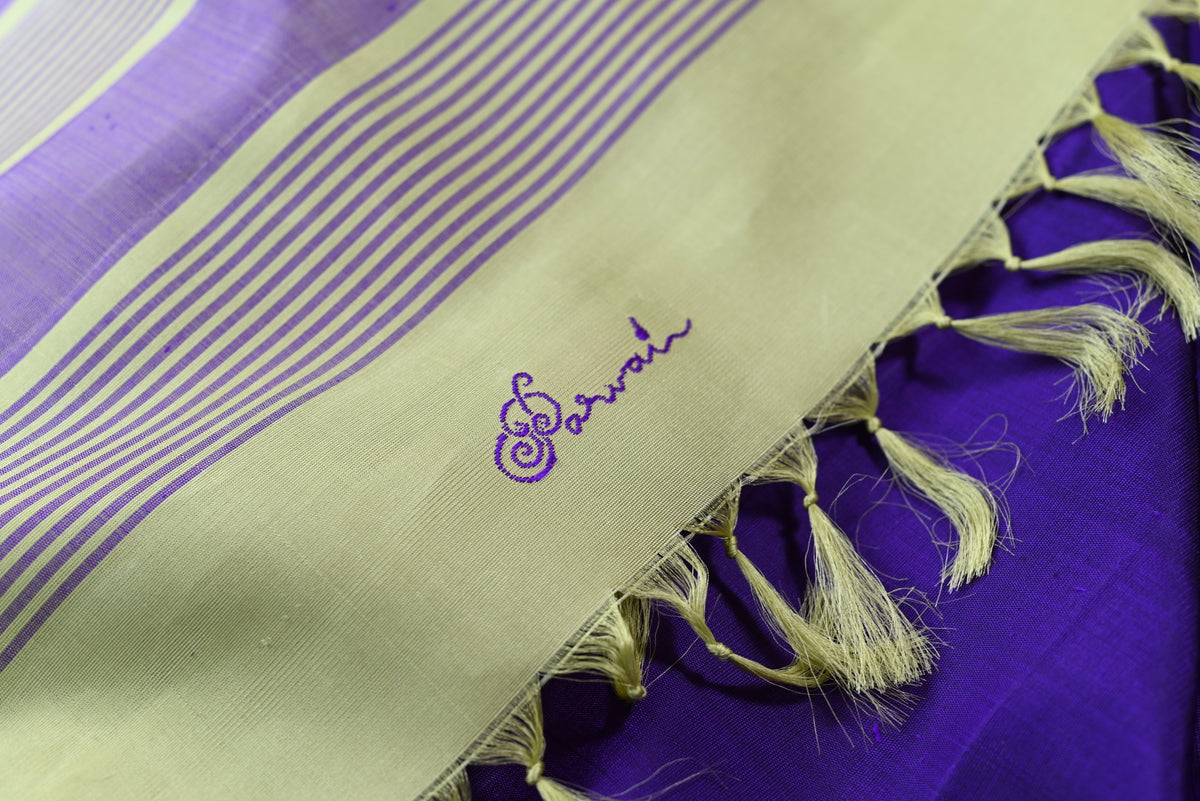
The gold zari twill band, delicately accented with green, acts as an important transition within this composition. The twill provides structural definition around the purple field, while gold introduces luminosity and green anticipates the botanical vocabulary that becomes fully articulated at the pallu. The sari consequently develops through a deliberate visual progression: the eye begins with individual points of light, moves across an expansive constellation of buttas, encounters the architectural discipline of the border and finally arrives at the animated vegetal movement of the pallu. The design is therefore intended to unfold rather than reveal itself all at once.
Material Integrity and the Chanderi Ground
The design rests upon a carefully considered material structure. Sidra is woven with pure two-ply silk resham in the warp and fine pure 100s-count cotton in the weft, creating the lightness, translucency and gentle structure characteristic of fine silk-cotton Chanderi. The combination is particularly important because the sari carries substantial ornamentation. Our intention was never to allow intricacy to become physical weight. However demanding a textile may be technically, it must ultimately remain pleasurable to wear.
For Parvai, this is a fundamental measure of quality. Craftsmanship cannot be assessed exclusively through the number of motifs, the complexity of a technique or the amount of time required for production. Material quality, comfort, drape and longevity are equally important. Sidra therefore attempts to hold two apparently opposing qualities together: a considerable density of woven work within an exceptionally light textile.
1,024 Buttas: Twelve Days at the Loom
The first Sidra carries 1,024 individually woven diamond buttas. The figure is meaningful not as a claim of numerical superiority, but because it begins to reveal the relationship between design and labour. Each butta represents an intervention within the weaving process, and collectively those interventions determine the amount of time and concentration required to complete the cloth.
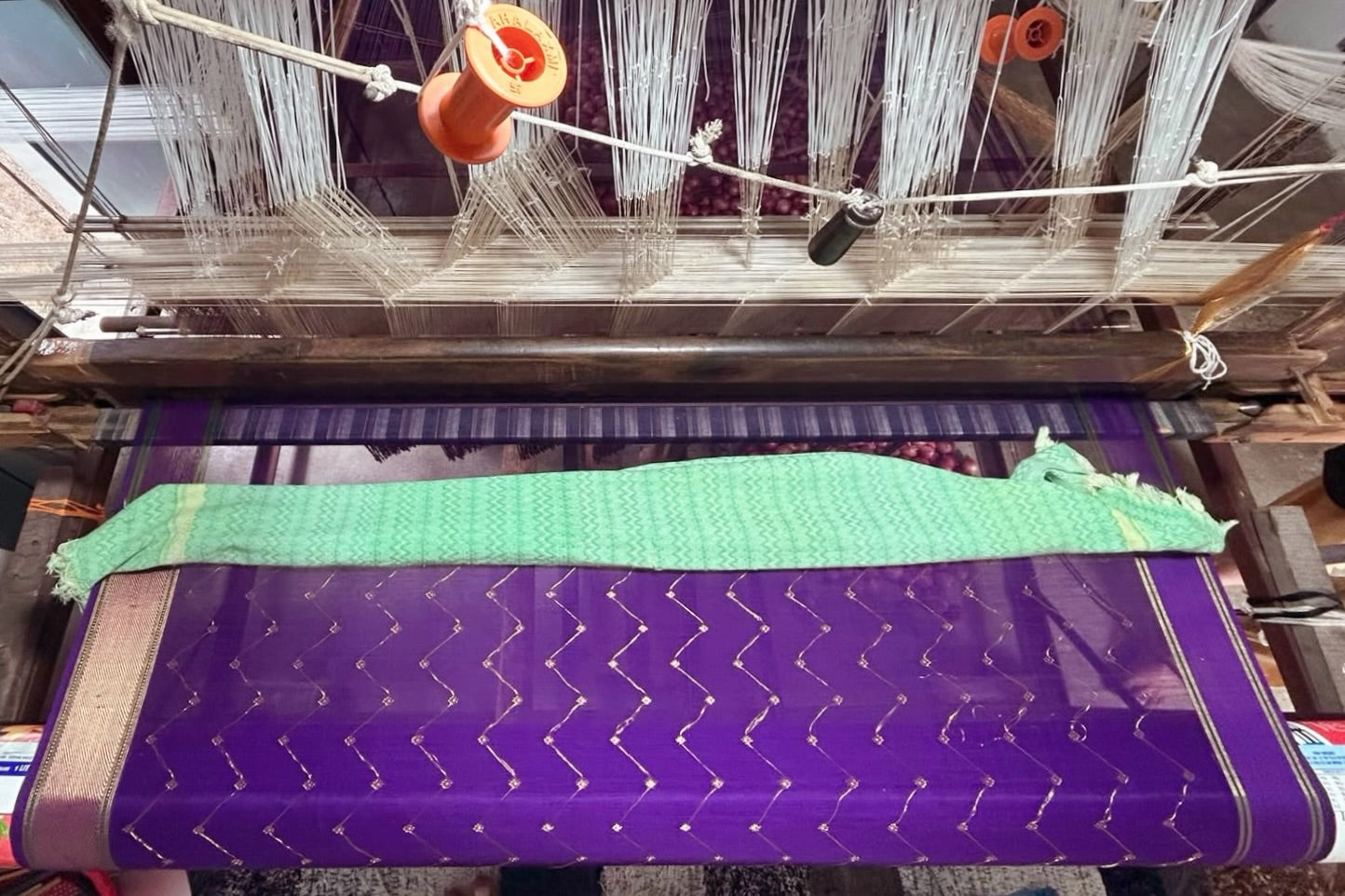
The sari is woven by Baseema Ansari and his wife, Saahistha Ansari, working together on a single loom for approximately twelve hours each day. Even the first Sidra requires approximately twelve days of weaving to complete. Once finished, however, the labour becomes almost invisible. The thousands of movements required to construct the surface disappear into a textile that appears remarkably effortless. This is one of the paradoxes of accomplished craftsmanship: mastery frequently conceals the difficulty of making.
For this reason, we consider the identities of the weavers and the time spent at the loom to be intrinsic to the description of the textile rather than supplementary narrative. The twelve days are part of Sidra just as surely as the silk, cotton and zari are. The finished cloth is not merely composed of material; it is composed of material transformed through human time.
2,050 Buttas: Twenty Days at the Loom
The second Sidra takes the same visual language into a substantially more demanding territory. The number of diamond buttas increases from 1,024 to 2,050, producing a much denser constellation across the purple body while preserving the delicacy of the individual motif. Visually, the alteration appears subtle because the fundamental vocabulary remains unchanged. At the loom, however, the difference is profound.
Baseema and Saahistha again work together for approximately twelve hours each day, yet a single 2,050-butta Sidra requires around twenty days to complete. A design instruction that can be expressed on paper in a few words—an increase in the density of the motifs—becomes approximately eight additional days of skilled human labour.
The 2,050 buttas therefore become something more than ornament. They are a record of concentration and repetition, a means through which time becomes materially embedded in the textile. The apparent weightlessness of the finished Chanderi stands in striking contrast to the substantial human effort necessary to create it.
The Economics of Choosing the Difficult Route
Within a commercially productive weaving cluster, occupying a loom with a single sari for approximately twenty days is an economically consequential choice. During the same period, simpler textiles may be produced far more quickly. It would therefore be insufficient for Parvai simply to ask artisans to work more slowly in the name of craft. Time must have economic value if slow and skilled work is to remain viable.
This has been one of the most challenging aspects of our relationship with Shadman and the artisans. Parvai maintains certain non-negotiable requirements for projects of this nature: non-assisted handlooms, carefully selected high-quality raw materials, rigorous workmanship, comfort and wearability, transparency of process and appropriate remuneration for the people undertaking the work. Maintaining these standards while remaining within a realistic commercial budget is considerably more difficult than stating them.
There are numerous points at which production can be made cheaper. Yarn can be substituted, processes simplified, mechanical assistance introduced, motif density reduced, finishing compromised or labour negotiated downwards. Our approach has instead been to establish a different understanding with Shadman: we are prepared to recognise the value of exceptional work when the work itself genuinely demonstrates that value. This creates reciprocal responsibility. Fair remuneration cannot be separated from excellence, just as excellence cannot reasonably be demanded without fair remuneration. If we ask an artisan to spend twenty days producing one sari, we must acknowledge the economic implications of that decision; equally, if we ask a patron to support a higher value, we must be able to demonstrate why the textile warrants it.
Why Small Batches Matter
For the same reason, Sidra is produced in deliberately limited quantities. Small-batch production is sometimes understood primarily as a strategy of exclusivity; for Parvai, its more important function is to protect the conditions under which exceptional work can occur. Working in smaller quantities allows one sari to inform the next, gives artisans time to make adjustments, permits greater attention to raw materials and finishing, and leaves room for dialogue between designer, coordinator and weaver. It also prevents a successful experiment from immediately being converted into hundreds of identical pieces simply because the market might absorb them.
If a sari requires twelve days, we allow it twelve days. If another requires twenty, we allow twenty. The rarity of the resulting textile is therefore a consequence of the integrity of its production rather than its principal selling proposition.
The Patron and the Continuity of Skill
The final participant in this ecosystem is the patron. At Parvai, we increasingly understand patronage not simply as consumption but as participation. When someone chooses a Sidra, their decision reaches backwards through the entire chain of production. Patronage makes twelve or twenty days at the loom economically meaningful; it creates a reason for Shadman to maintain and develop looms capable of undertaking fine work; and it provides older artisans with commissions that ask them to exercise sophisticated skills rather than merely reproduce familiar forms.
In return, the patron deserves more than a claim of rarity. They deserve distinction with reason: a difference that can be understood through material, felt through comfort, seen through workmanship and traced to identifiable people and processes. Sidra should not possess value simply because relatively few examples exist. It should remain limited because producing it properly requires circumstances that do not lend themselves naturally to mass repetition.
This circular relationship between artisan, younger producer and patron is perhaps the most important lesson the project has given us. An older generation possesses knowledge. A younger generation must find a reason to value and organise that knowledge. Thoughtful design can create opportunities for the knowledge to be exercised. Appropriate remuneration gives the work economic meaning. Patronage completes the relationship by providing a contemporary destination for the resulting textile. Each participant depends, in some measure, upon the others.
What Sidra Ultimately Represents
Sidra can, of course, be described simply as a fine silk-cotton Chanderi: pure two-ply silk resham in the warp, fine pure 100s-count cotton in the weft, a deep purple field illuminated by 1,024 or 2,050 diamond buttas, a traditional twill-woven zari band with restrained green accents, and a dramatic pallu of diagonally moving creepers and trellis-like forms. Yet to describe Sidra only through these technical and visual features would be to account for the object while overlooking the larger significance of the project.
For Parvai, Sidra represents an attempt to examine how value may be reconstructed around skilled handloom practice within a highly commercial contemporary weaving environment. It asks whether older artisans can continue to receive work that requires the depth of knowledge they have accumulated over decades; whether a young person such as Shadman can find economic and creative possibility in producing fine textiles rather than participating only in their resale; whether slower work can remain viable without becoming detached from commercial reality; and whether patrons can be encouraged to recognise that time, judgement, skill and material integrity are as fundamental to a textile as its colour and pattern.
The project also challenges a common understanding of craft preservation. Preservation is often discussed in relation to techniques, motifs, looms and archival knowledge, all of which are important. But a living craft depends equally on whether there continue to be commissions that demand skill, markets that recognise quality, and younger generations who can see a viable future in the knowledge available to them. In this sense, the five looms established under Shadman’s leadership are significant not because they represent scale, but because they create working spaces in which intergenerational knowledge may continue to circulate.
This is perhaps the most meaningful outcome of Sidra for us. A twenty-two-year-old who had largely chosen a commercial route through sari resale is now coordinating five looms and engaging directly with older-generation weavers. Those artisans, in turn, are being asked to undertake the fine and unusual work they themselves value. What began with uncertainty and anxiety has gradually developed into confidence, not only in the making of Sidra but in the possibility of taking on more technically demanding work.
For Parvai, this is where the real continuity of craft lies. Not in preserving the past unchanged, but in creating conditions in which inherited knowledge remains useful, economically meaningful and intellectually alive. The older generation must have reason to practise what it knows; the younger generation must have reason to learn from it; and patrons must be willing to support the conditions under which such work can continue.
Sidra therefore exists at the intersection of several forms of value: material value, represented by fine silk, cotton and zari; technical value, represented by the precision of the weave; temporal value, represented by twelve or twenty days at the loom; cultural value, represented by inherited knowledge; and social value, represented by the relationship between older artisans, a younger organiser and the patrons who make the work viable.
The 1,024-butta Sidra and the 2,050-butta Sidra embody these values differently, but both make the same proposition. A textile need not be important because it is produced in large numbers, nor valuable simply because it is rare. Its significance can arise from the quality of its materials, the integrity of its process, the difficulty of its execution, the knowledge of the people who make it and the purpose that the work creates within the larger craft ecosystem.
In that sense, Sidra is not merely a sari. It is a study in what becomes possible when a loom is given time, when skilled hands are given work worthy of their ability, and when a younger generation is given reason to see inherited knowledge not as a burden of the past, but as a possibility for the future.

Written by Effie Thomas