Shubhangini
Parvai's Promise
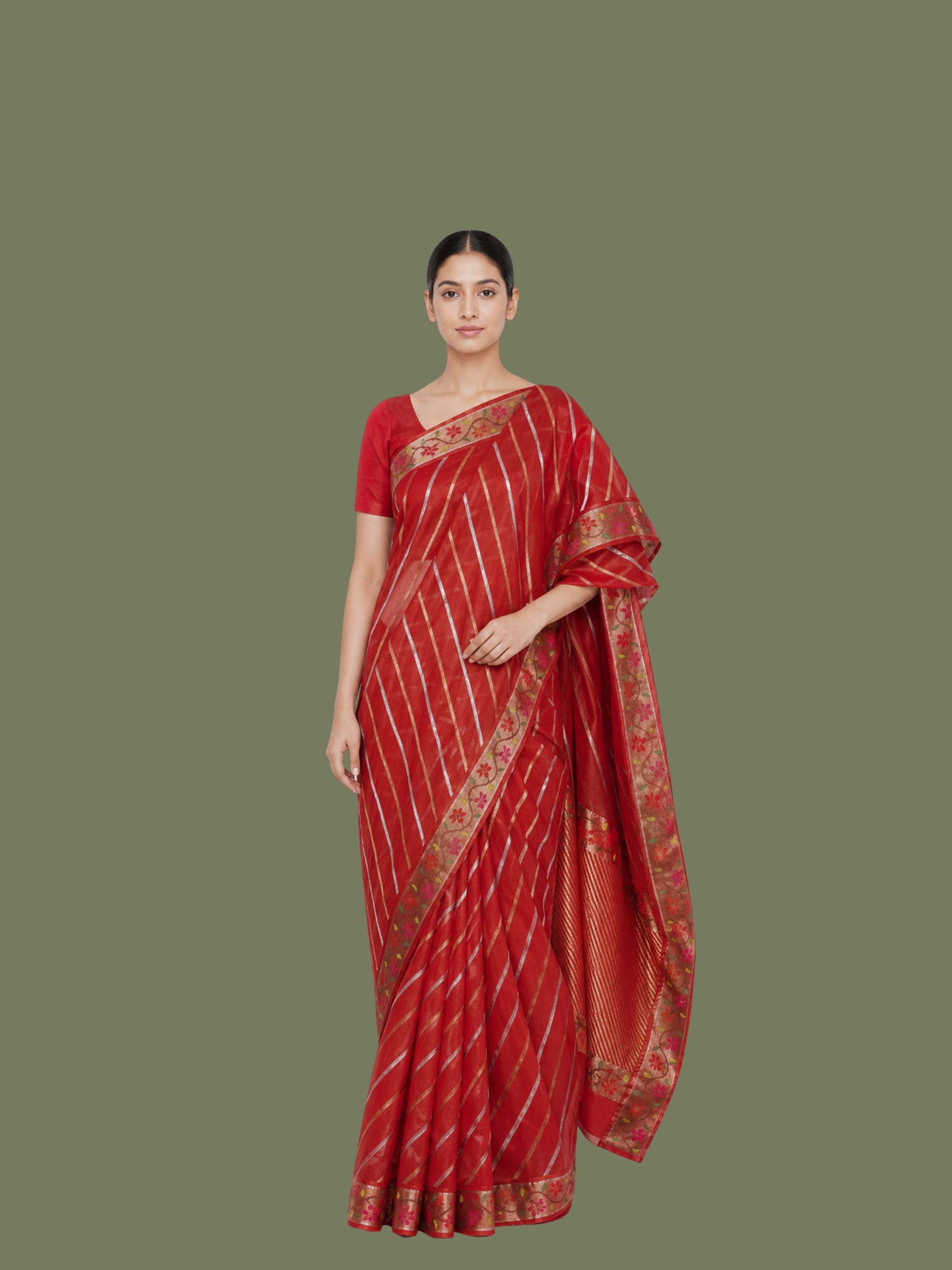
This exquisite Kota Doriya sari draws inspiration from Jaipur’s iconic leheriya pattern, blending tradition with refined craftsmanship.
A remarkable highlight of this piece is the generous use of real gold and silver zari, which constitutes nearly 70% of the sari’s weight. Two distinct tones of zari have been intricately woven together, creating a beautiful sense of depth and layered elegance.
The vibrant red body is adorned with diagonal zari lines that emulate the fluidity of leheriya waves. Complementing this is an ornate zari border, featuring delicate multicolour floral vines set against a rich golden base—adding a touch of grandeur and timeless charm to the sari.
What you should know about this saree:
- Inspired by the exotic and vibrant gates of Rajasthan.
- Allday everyday sari/Occasionwear
- Unique rich pallu
- Astonishing texture and fall
- Luxurious comfort
- Soft and airy
- Easy to drape
- Moisture absorbent
- Low maintenance
- Labor Intensive craftwork requiring over 180 person-hours
- Crafts deeply rooted in history.
- Artisans fully paid dignified wages.
- Printed in an eco-friendly dyeing unit
- Available as a single piece only
- Environmental friendly process and product
- Durable, Sustainable, Biodegradable
Product
Parvai sarees are wide & we cut no corners to craft our products. Each saree is accompanied by a 1-meter blouse that can be made into a blouse or jacket of your choice.
Dimensions:
- Length - 5.5 meters with
- Width - 46 inches,
- Weight - 427grams
- Blouse - 1meter blouse fabric.
- Woven with:
- Warp: Pure cotton 132SS & 20/22 denier China silk.
- Weft Cotton: Pure cotton100S & 20/22 denier China silk
- Zari is made from metals, including 6% genuine gold 60-62 % silver on a red silk thread.
- Technique: Traditional Fly Shuttle Jaala loom
- Pre-loom preparation time: 18 days
- Weaving process: 17 days
- Garment care: Dry Clean only.
Garment care: Take care of your garment, for these are heirloom pieces that can be passed across generations. We recommend gently hand-washing these sarees in cool water with mild detergent. Shade dry these sarees & avoid drying under direct sunlight.
Process
Each Parvai saree is a labour of love. We consciously choose eco-friendly processes where ever possible. We work with artisans & weavers to understand and appreciate the ancient crafts. Our wish is for every saree to pave the way for better understanding & appreciation for handmade products. Read about the process that went into creating this Parvai Original.
The weaving of Kota Doria is a household activity in Kaithoon, Rajasthan. At least one pit loom for weaving can be found in almost every house in Kaithoon. Though all family members participate in the process, it is mainly handled by the women of the house.
Listed below are the steps involved in the making of Kota Doria –
- Winding: Winding is the process of transferring yarn from these hanks onto bobbin for warp and on pirn for weft.
- Warping: Warping is the process of obtaining a predetermined length of warp having the desired number of threads that shall be needed for the complete width of the fabric
- Dyeing: The yarns are dyed (or coloured) manually by dipping them in utensils filled with heated water and pre-dissolved dyes.
- Sizing: Sizing is done to impart strength to the yarn and is mainly cotton. A thin rice paste (mandi) and locally available wild onion juice are used for this purpose.
- Drafting-Denting-Piecing: All individual cotton and silk threads are drafted through double clasped country cotton heald ('Ranch') and dented through dents of bamboo/ steel reed ('Fani') in a particular pattern to produce the checks or 'khat' along with the weft. Since drafting and denting individual threads is time-consuming, an alternative method called piecing is used. The individual new threads of the warp are tied to the corresponding threads of the previous leftover warp.
- Weaving: Weaving is done on the pit looms by the throw shuttle technique. It is done so skillfully that an almost uniform size of the 'khat' or the check pattern is produced.
People
Do you ever wonder who made your clothes? If you don't do it yet, it is about time you did. Often, handmade products are made at the cost of slave labour and inhuman working conditions. At Parvai, we ensure our process do not directly or indirectly support such practices, pay artisans their due & take pride in ensuring the saree we don do not come at the cost of someone else's misery. Each saree is hence truly a labour of love.
- Designed by: Ane Thomas
- Master Weaver: Mr Sharif Ansari
- Woven by: Mrs Mobina Bano & Ms Misbah
- There are almost 18 to 20 other people who have contributed to the making of the sari. this includes the raw material suppliers, dyers, sixers, warpers and helpers.
Perspective
What makes the Kota Doriya so unique?...Ever wondered?
The fabric weaving is done in a square-check pattern by a combination of thick and thin yarns of cotton and silk. Such varying fibre and its thickness composition are called Khat and such weave imparts its characteristic lightweight open structure and
transparent appearance. Each Khat has 14 threads composed of 8 cotton and 6 silk yarns. The conventional fabric is made by 300 to 350 Khata cross the width of the fabric and the number of ends and picks per inch results in 2400 cotton and 1800 silk yarns.
Other questions
Note: This product is handwoven due to which there might be slight irregularities. Imperfections and variations in the product cannot be termed as defects, as these are intrinsic to the handmade process. The actual product colours may vary due to the light sources or your monitor setting.
Do you want to know more? We are available at +917358550888 (WhatsApp) & happy to speak to you about our creations.
Choose options
Care & Product Notes
A few things we would like you to know
Care
Air your Parvai sari after wear and store it in a clean cotton or muslin cover, away from direct sunlight, moisture and plastic. Refold it from time to time so that the same creases do not remain under stress, especially along zari-rich borders and pallus. Heavier saris are best stored folded or gently rolled rather than hung for long periods. Clean only when necessary, preferably through a trusted specialist familiar with fine silk and handwoven textiles.
Handwoven Character
Every Parvai textile is handmade and may carry slight variations in weave, texture, colour, motif placement, finish or dimensions. These are natural to the making process and are part of the textile’s character, not defects. Measurements and weights are approximate.
Colour
Colours may appear differently across devices due to variations in screen brightness, resolution, colour settings and lighting. If you would like a closer colour reference or any clarification before purchase, please contact us.
Questions
We are always happy to speak about the textiles we make. WhatsApp us at +91 73585 50888.